Being the Best at Beginning

The other day I was listening to an excellent episode of The Art of Network Engineering talking about technical marketing engineers (TME). The discussion was excellent and there was one line from Pete Lumbis in the episode that stuck with me. He said that one of the things that makes you good as a TME is being an “expert beginner”. That phrase resonates at lot with me.

Fresh Eyes on the Problem

I talked a bit about this last year when I talked about being a beginner and how exciting that it was to start over with something. As I compared that post to the AONE episode I realized that what Pete was talking about was a shift in mindset that gives you the energy and focus to pick things up quickly.

You may have heard the phrase “familiarity breeds contempt”. It’s a common phrase used to describe how we feel less impressed with things the more we learn about then. Our brains are wired to enjoy new things. We love new experiences, going to new places, or even meeting new people. The excitement and rush that we get from something unfamiliar causes our brain to devour things. It’s only once we become familiar with them that we feel the contempt set in.

It’s not always possible to avoid the contempt part of things. Think about something as dreary as your morning commute to work, whether it’s walking down the stairs or driving to the office. I used to joke that my car was practically on auto-pilot most mornings because I knew every bump in the road and every turn by heart. When I would go somewhere new I would have to focus more on road signs or directions.

Back to Basics

The beginner aspect of things is easier to deal with. That’s because we can trick ourselves into seeing something with fresh eyes. On a number of occasions I’ve mentioned my friend and mentor John Pross and his assertion that every upgrade or deployment that happened was like the first time doing it. He never took anything for granted. He always took things step-by-step. While this had the affect of him making sure everything was followed to the letter it also gave him the beginner aspect of looking for ways to improve or discovering new solutions to problems along the way.

Once the contempt or apathy sets in you’re going to get very good at just clicking through the steps to get to the end as fast as possible. If you don’t believe me think about how many times you’ve given directions that involve something like “Just click Next, Next, Next, Next and then you’re done”. Trust me, it sounds funnier when you say it out loud. But it speaks to the fact that we know the dialog boxes so well that we know they aren’t important. But what if they are?

If you want to understand what it feels like to be a beginner again and you’re having a hard time getting yourself in that mindset you should find a beginner and coach them through a task like a setup. Don’t just tell them what to do. Let them figure it out. Answer questions as they come up. Make them explain why they’re doing something. I bet you’ll learn a lot more as you have to help them understand why that configuration line is in there or why you always choose twice the amount of RAM in an instance. Once you see the process through the eyes of a beginner you have to learn it more completely in order to help them understand it.

In some roles, like a TME or a VAR engineer, the ability to be an expert beginner is critical to your job. You have to see a technology for the first time and pick up the basics quickly. I used to tell people that the excitement of being an engineer at a VAR was the variety of problems I’d be called on to solve. One day might be wireless clients. The next could be iSCSI storage arrays. Whatever the case may be I could count on finding myself in a new situation pretty regularly. It kept things exciting and made me realize I had to stay on my toes.

For those that work as product managers or on more specialized teams you need to make sure you’re taking time to approach things as a beginner. The “same old, same old” may not actually be the same any more. That kind of contempt and familiarity leads to the phrase “the way we’ve always done it” and doesn’t force you to challenge the process to understand how to improve it. Sometimes you need to step back and remember that you have to see everything for the first time.


Tom’s Take

Beginners shouldn’t feel like they’re a nuisance. In fact they should be celebrated for the energy and focus they bring to a task or project. For roles like a TME it’s important to bring the same kind of energy to new things. You can learn a lot when you allow your brain to soak up knowledge like a fresh sponge. More importantly, the ability to be a beginner helps you refine your knowledge base more and will ensure that you can explain a concept or process to someone with absolute certainty.

Friday Networking Field Day Thoughts

I’m wrapping up Networking Field Day 30 this week and as is always the case there was a lot of great discussion from both the presenters and the delegates outside of the presentations. It’s one of the reasons why I love doing this job even after almost ten years. I get to meet fun people and have an impact on so many things in the tech industry.

  • Network-as-a-Service is coming. We recorded a roundtable discussion about it and I think the impact that it’s going to have on mid-sized businesses is massive. It’s going to be like cloud. Not just in operational capability. It’s also going to be a huge driver for what you can do with your network in support of applications. The snowflakes may melt under the weight of the cookies we make from the cookie cutter deployments.
  • It feels like a lot of companies are trying to find what’s next. Part of that is coming from the ways that organizations are changing their outlook for what an office should be after the pandemic shutdowns. But still others are realizing they can’t use the same revenue stream for the next five years and hope to survive. This isn’t simply a game of trying to find an adjacent market to move into to drive growth to keep shareholders and investors happy. This is more about finding something that needs to be done because the alternative is no longer having a company.
  • Sadly, it looks as though third party Twitter clients are gone for good. This is beyond irritating to me because of the way that I choose to consume Twitter. I’ve seen a lot of chatter in various comment threads about third parties making money from the good graces of Twitter but the fact is that those programs drive a LOT of the way that power users interact with the system. If the exodus wasn’t already accelerating I would imagine you’re going to see a lot more coming very, very soon.

Tom’s Take

Stay tuned for all the great info from Networking Field Day on the Tech Field Day YouTube channel and don’t forget to thank your networking team today. You may not need to call them today to tell them something is down but trust me they will appreciate you calling just to say you appreciate them.

Controlling Your View of the World

Straw Bales on Hill Landscape, Tuscany, Italy

As I’m writing this it looks like Twitter has made some changes to the way that third-party clients interact with service. My favorite client, Tweetbot, is locked out right now. The situation is still developing but it’s not looking pretty for anyone using anything other than the web interface. While I will definitely miss the way I use Tweetbot I think it’s the kick I needed to move away from Twitter more than before.

A Window on the World

The apps that we use to consume and create content are the way that we view things. Maybe you prefer a webpage over an app or the way that one client displays things over another but your entire view is based on those preferences. If the way you consume your media changes your outlook on it changes too.

I didn’t always use Tweetbot to view Twitter. I tried using the standard app for a long time. It wasn’t until the infamous “Dickbar” incident back in 2011 that I broke away for something that wasn’t so slavishly dependent on ads. The trending topic bar might not have been specifically for ads at the time but the writing on the wall was there. The way I chose to view my content wasn’t compatible with the way that the service wanted to monetize it.

Fast forward to today. Instagram doesn’t show you time sequence posts. Neither does Facebook. Twitter now defaults to an algorithmic timeline. Apps like TikTok are built on their algorithms. It’s all a way to show you things the system thinks you want to see with a sprinkling of ads mixed in whenever they want to show them to you. Could you imagine a TV channel where the ads were just thrown in to the show whenever they wanted you to see one as opposed to more of a standard time? You probably can imagine because that’s what it feels like to watch platforms like Youtube.

Platforms cost money to operate. That fact isn’t lost on me. What is annoying is that trying to change the way I access the platform in order to serve more ads is going to cause more damage in the long run. Given the choice between using the web version of Twitter and just not using it I’m more inclined to the latter. I want a timeline that shows me tweets in chronological order without the need to change to that format every time I open the page. I want to see what I want to see without being forced to view things that don’t interest me. Forcing me to use the web app to see ads is almost as bad as forcing me to follow people that you think are interesting that I have no desire to interact with.

The Only Winning Move

I’m more than a passive participant in services like Twitter. I create content and use them to share it. I participate actively. And I don’t like the way I’m being forced to play.

I started a Mastodon account many years ago the last time Twitter looked like it was making changes. In the past few months I’ve migrated it to a new profile. The Mastodon interface has robust apps and a great way to interact with people. It may not have the numbers that Twitter does right now but it won’t take long for a lot of the best creators to go there instead.

More importantly, choosing an open platform over a monetized nightmare gives me hope that the real value of what we do on the Internet isn’t selling ads. It’s creating valuable things that people enjoy and sharing them with a receptive audience. That may not be the millions of people on Twitter right this minute but those millions of people are about to find out what it feels like when the best reasons to be on a platform are gone.


Tom’s Take

I want to choose how I see the world, not how someone wants me to see it. I want to decide how I share what I’ve made with people and when they see it, not have it placed behind other things a software function decides are more likely to be clicked. If the future of social media is endless ads and trickery designed to make me spend more time fighting through the timeline instead of consuming it then I guess my view of the world is outdated and needs to change. But it will change on my terms.

Problem Replication or Why Do We Need to Break It Again?

There was a tweet the other day that posited that we don’t “need” to replicate problems to solve them. Ultimately the reason for the tweet was that a helpdesk refused to troubleshoot the problem until they could replicate the issue and the tweeter thought that wasn’t right. It made me start thinking about why troubleshooters are so bent on trying to make something happen again before we actually start trying to fix an issue.

The Definition of Insanity

Everyone by now has heard that the definition of insanity is doing the same thing over and over again and expecting a different result. While funny and a bit oversimplified the reality of troubleshooting is that you are trying to make it do something different with the same inputs. Because if you can make it do the same thing over and over again you’re closer to the root cause of the issue.

Root cause is the key to problem solving. If you don’t fix what’s actually wrong you are only dealing with symptoms and not issues. However, you can’t know what’s actually wrong until you can make it happen more than once. That’s because you have to narrow the actual issue down from all of the symptoms. If you do something and get the same output every time then you’re on the right track. However, if you change the inputs and get the same output you haven’t isolated the issue yet. It’s far too common in troubleshooting to change a bunch of things all at once and not realize what actually fixed the problem.

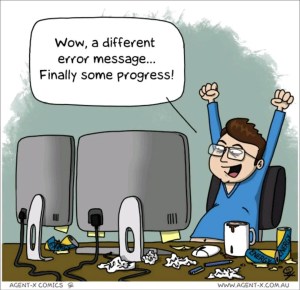
Without proper isolation you’re just throwing darts. As the above comic illustrates sometimes the victory is causing a different error message. That means you’re manipulating the right variables or inputs. It also means you know what knobs need to be turned in order to get closer to the root cause and the solution. So repeatability in this case is key because it means you’re not trying to fix things that aren’t really broken. You’re also narrowing the scope of the fixes by eliminating things that don’t need to be monitored.

Resource Utilization

How long does it take to write code? A couple of hours? A day? Does it take longer if you’re trying to do tests and make sure your changes don’t break anything else? What about shipping that code as part of the DevOps workflow? Or an out-of-band patch? Do you need to wait until the next maintenance window to implement the changes? These are all extremely valuable questions to ask to figure out the impact of changes on your environment.

Now multiply all of those factors by the number of things you tried that didn’t work. The number of times you thought you had the issue solved only to get the same error output. You can see how wasting hours of a programming team working on things can add up to the company’s bottom line quickly. Nothing is truly free or a sunk cost. You’re still paying people to work on something, whether it’s fixing buggy code or writing a new feature for your application. If they’re spending more of their time tracking down bugs that happen infrequently with no clear root cause are they being used to their highest potential?

What happens when that team can’t fix the issue because it’s too hard to cause it again? Do they bring in another team? Pay for support calls? Do you throw up your hands and just live with it? I’ve been involved in all of these situations in the past. I’ve tried to replicate issues to no avail only to be told that they’ll just live with the bug because they can’t afford to have me work on it any longer. I’ve also spent hours trying to replicate issues only to find out later that the message has only ever appeared once and no one knows what was going on when it happened. I might have been working for a VAR at the time but my time was something the company tracked closely. Knowing up front the issue had only ever happened once might have changed the way I worked on the issue.

I can totally understand why people would be upset that a help desk closed a ticket because they couldn’t replicate an issue. However, I also think that prudence should be involved in any structured troubleshooting practice. Having been on the other side of the Severity One all-hands-on-deck emergencies only to find a simple issue or a non-repeatable problem in the past I can say that having that many resources committed to a non-issue is also maddening as a tech and a manager of technical people.


Tom’s Take

Do you need to replicate a problem to troubleshoot it? No. But you also don’t need to follow a recipe to bake a cake. However, it does help immensely if you do because you’re going to get a consistent output that helps you figure out issues if they arise. The purpose of replicating issues when troubleshooting isn’t nefarious or an attempt to close tickets faster. Instead it’s designed to help speed problem isolation and ensure that resources are tasked with the right fixes to the issues instead of just spraying things and hoping one of them gets the thing taken care of.

Making It Work in 2023

We’re back to the first of the year once again. January 1, 2023 is a Sunday which feels somewhat subdued. That stands in contrast to the rest of the year that felt like a rollercoaster always one heartbeat away from careening out of control. As is the tradition, I’ll look at the things I wanted to spend more time working on in 2022:

  • More Analytical Content: I have to honestly give myself a no on this one, at least from a technical perspective. I did spend some time making analytical content for my Tomversations series. However, the real difference in analytical content came from my posts about leadership and more “soft skill” focused ideas. I’ve gotten more comments about those posts than anything in 2022 and I couldn’t be more proud.
  • Saying No to More Things: This is the part where I would insert an animated GIF of someone laughing manically. While I did make strides in telling people that I have way too much going on to take care of one extra thing the reality is that I took on more things that I probably should have. That’s something that I definitely do need to change but the real hard part isn’t saying No. It’s making it stick.
  • Getting In Front of Things: This one actually was one that I had the hardest time with. I was able to work on some of this in my Tech Field Day job but it was my blog that suffered the most. I wanted to start spending more time thinking about post topics earlier in the week so I wasn’t always posting on Fridays. The irony is that toward the end of the year I did manage to get some posts out on other days. I just did it because I was having severe writer’s block and I was late on several posts. In fact, I technically missed a post in 2022 for the first time in twelve years. I think it’s more a reflection on how important it is to keep your eye on the prize as you create content. I don’t have metrics like those on YouTube channels driving me to put out 2-3 videos a week. Instead I really have to make sure I’m aware of what needs to happen to keep the content coming out.

2022 was a year of getting things back to a version of normal but it also was a year of me trying to implement things that didn’t go the way I wanted. That seems to be the challenge for all good intentions. So let’s look at what I want to do in 2023 to keep myself from struggling the way that I did before.

  • Keeping Track of Things: I knew I was in for trouble when I stopped writing things down two weeks into the year. My plans for bullet journaling seemed to evaporate because I tried to make changes that didn’t stick. So I’m resetting it back to Square Zero. I’m writing everything down somewhere and I’m not going to forget it this time. I know where my notes are and I know what I need to do to keep myself on track. The difference between writing it down when I do it and just trying to remember to do it is very, very stark. So rather than thinking I have a good memory and forgetting that I don’t I’m not leaving anything up to chance.
  • Creating Evergreen Content: During my workouts this year I’ve spent more time listening to podcasts like Hidden Brain and Huberman Lab which focus on behavior and the brain. Why? Because I’m fascinated to learn why we think and do the things we do. When you couple that with my outside work in the Wood Badge leadership program I think I’m starting to see the value of creating content more around skills and leadership instead of just talking about the next iteration of wireless or SD-WAN. That doesn’t mean my technical writing is going to go away. It does mean that I’m going to try to sprinkle in more posts about mentoring, leadership, and creating a culture that will help you pay dividends unlike ATM, HD-DVD, and several other forgotten technologies.
  • Ensuring Intentionality: This one feels a bit nebulous but that’s because it’s hard to pin down what being intentional really means to everyone. I’ve used the world a bit more in the latter half of 2022 when discussing certain aspects of my job and it seems to have stuck with others. Intentionality to me means making sure that I’m focused on ensuring outcomes happen. A lack of intentionality is like gathering the ingredients for a cake, assembling them on a table, and then hoping that a cake somehow magically appears. You have to combine the ingredients in the proper amounts and make things happen to create a cake. Even with all the right conditions you still need to do the work to make things happen. And if you think that’s an easy thing to do take a look around in your office and tell me just how many people that you work with that aren’t intentional in what they do.

Tom’s Take

One of the things that I can look back on over the past few years is that my first of the year posts have reflected the challenges that I’ve faced. The shifting landscape of content has forced me to look at what I create. The challenges of a world that went into hibernation for a while have changed the way I look at how I get my work done. Even the growth that I’ve experienced over the years has shifted my thinking. I won’t be the next big YouTube star. My gift is in writing. And focusing on that as my starting point for the year to come is going to help me make things work.