
My Belated Review of Cisco Live 2023

It’s been a couple of weeks since Cisco Live US 2023 and I’m just now getting around to writing about it. I was thrilled to attend my 18th Cisco Live and it was just the thing I needed to reconnect with the community. The landscape of Cisco Live looks a little different than it has in years past. There are some challenges that are rising that need to be studied and understood before they become bigger than the event itself.

Showstopping Reveals? Or Consistent Improvement?

What was the big announcement from Cisco this year? What was the thing that was said on stage that stopped the presses and got people chattering? Was it a switch? A firewall? Was it a revolutionary new AI platform? Or a stable IP connection to Mars? Do you even know? Or was it more of a discussion of general topics with some technologies brought up alongside them?

In the last few years you may have noticed that the number of huge big announcements coinciding with the big yearly conferences has come down a bit. Rather than having some big news drop the morning of the keynote the big reveals are being given their own time to shine instead. Rather than piling up tons of news of acquisitions or new product releases and watching them all get lost in the shuffle of fanfare they’re now being spaced out or bunched up at the end of quarters instead.

The big keynotes are instead being used to push initiatives. Rather than talking products the companies are talking strategies. Things like sustainability and outreach replace speeds and feeds. The goal isn’t to show off something shiny but instead to show off what the goal is to utilize the new products. Those kinds of announcements tend to play better with the press and analysts as well as the investors.

Does that mean that we’re never going to see another big announcement during an event keynote? No. What it does mean is that you shouldn’t expect to see groundbreaking shifts happening during those discussions. Steady and predictable is what the investors like. And during those keynotes that’s what you’re going to see for the most part.

Community Marches On

Social media sure has been fun for the past few months wouldn’t you say? The decline of Twitter, the rise of Mastodon and BlueSky, and even more craziness all over the place. Proof? Check out my badge from Cisco Live this year:
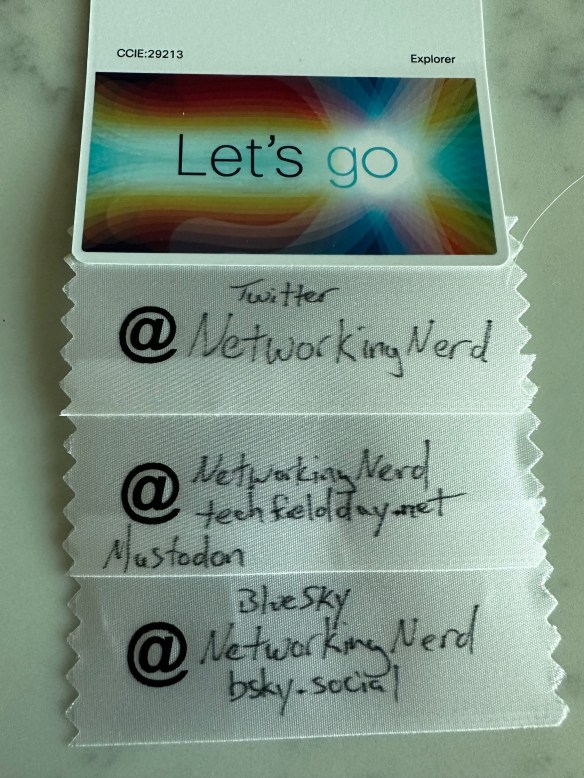
Yes, I needed all of those flags to show people where I was posting things to social media. And keeping track of all of the communities can be tiring. Some people still use Twitter because it’s there. Some people have embraced the Fediverse and deleted Twitter altogether. Others are trying out BlueSky and finding their groove again. And that doesn’t even discuss the number of people that are embracing video platforms or other means of posting. It is a certainty that the former king of the hill is rolling down very quickly in the face of so many other options.

One thing that I loved is that the community around Cisco Live has endured through so much upheaval. As soon as we arrived on site it was just like old times. People coordinated hangouts and invited friends all over. Parties were held. Introductions were made. And people caught up as if they hadn’t seen each other in forever. It made me happy to see that the impending collapse of a social platform didn’t affect the people that used it to build a great group.

Another thing that I realized when I got to the event was that this was the tenth anniversary of the Cisco Live Social Media Hub. I can still vividly remember when I walked into the convention center in Orlando in 2013 to find this brand new area dedicated for us to hang out and enjoy a little spotlight. Over the years the hub has grown from just a few tables and some laptops to an entire control center that serves as a central meeting location for folks as well as a set for some creative content to be made. I remember on more than one occasion seeing folks running around staging shots for a TikTok video and seeing lots of extra content being posted from everywhere. It’s good when you don’t have to make your own little space.


Tom’s Take

What does the future of Cisco Live look like? Is it going to continue to be a huge draw for people to come and enjoy the community? Is Cisco going to keep releasing new products and making this a destination for networking professionals? Given the number of attendees increased again this year I’d say that there is definitely a desire for people to attend conferences in person again. Given that the community has continued to persevere through all manner of challenges I’d say they’re also here to stay as well. All in all, I’m glad to see Cisco Live has continued to see success. As long as we temper our expectations for what the conference will be in the future and continue to keep the community alive then I don’t see any challenges that can’t be overcome.


Using AI for Attack Attribution

While I was hanging out at Cisco Live last week, I had a fun conversation with someone about the use of AI in security. We’ve seen a lot of companies jump in to add AI-enabled services to their platforms and offerings. I’m not going to spend time debating the merits of it or trying to argue for AI versus machine learning (ML). What I do want to talk about is something that I feel might be a little overlooked when it comes to using AI in security research.

Whodunnit?

After a big breach notification or a report that something has been exposed there are two separate races that start. The most visible is the one to patch the exploit and contain the damage. Figure out what’s broken and fix it so there’s no more threat of attack. The other race involves figuring out who is responsible for causing the issue.

Attribution is something that security researchers value highly in the post-mortem of an attack. If the attack is the first of its kind the researchers want to know who caused it. They want to see if the attackers are someone new on the scene that have developed new tools and skills or if it is an existing person or group that has expanded their target list or repertoire. If you think of a more traditional definition of crime from legal dramas and police procedurals you are wondering if this is a one-off crime or if this is a group expanding their reach.

Attribution requires analysis. You need to look for the digital fingerprints of a group in the attack patterns. Did they favor a particular entry point? Are they looking for the same kinds of accounts to do privilege escalation? Did they deface the web servers with the same digital graffiti? For attackers looking to make a name for themselves, attribution is pretty easy to figure out. They want to make a splash. However, for state-sponsored crews or organizations looking to keep a low profile it is much more likely they’re going to obfuscate their methods to avoid detection as long as possible. They might even throw out a few red herrings to make people attribute the attack to a different group.

Picking Out Patterns

If the methodology of doing attribution requires pattern matching and research, why not use AI to assist? We already use AI and ML to help us detect the breaches. Why not apply it to figuring out who is doing the breaching? We already know that AI can help us identify people based on a variety of characteristics. Just look up any kind of market research done by advertising agencies and you can see how scary they can predict buyer behavior based on all kinds of pattern recognition.

Let’s apply that same methodology to attack attribution. AI and ML are great at not only sifting through the noise when it comes to pattern recognition but they can also build a profile of the patterns to confirm those suspicions. Imagine profiling an attacker by seeing that they use one or two methods for gaining entry, such as spearphishing, to gain access to start privilege escalation. They always go after the same service accounts and move laterally to the same servers after gaining it. This is all great information for predicting attacks and stopping them. But it’s super valuable for tracking down who is doing it.

Assuming that crews bring new attackers on board frequently to keep their crime pipeline full you can also see how much of the attack profile is innate talent versus training. One could assume that these organizations aren’t terribly different from your average IT shop when it comes to training. It’s just the result of that training that differs. If you start seeing a large influx of attacks that use repetition of similar techniques from different locations it could be assumed that there is some kind of training going on somewhere in the loop.

The other thing that provides value is determining when someone is trying to masquerade as a different group using techniques to obfuscate or misattribute breaches. Building a profile of an attacker means you know how long it takes them to move to new targets or how likely they are to take certain actions within a specific window. If you work out the details of an attack you can see quickly if someone is following a script or if they’re doing something in a specific way to make it look like someone else is trying to get in. This especially applies at the level of nation-state sponsored groups, since creating doubt in the attribution can prevent your detection or even cause diplomatic sanctions against the wrong country.

Of course, the real challenges is that AI and ML aren’t foolproof. They aren’t the ultimate arbiter of attack recognition and attribution. Instead, they are tools that should be introduced into the kit to help speed identification and provide assurances that you’ve got the right group before you publicize what you’ve found.


Tom’s Take

There’s a good chance that some security companies out there are already looking at or using AI to do attribution. I think it’s important to broaden our toolkits and use of models in all areas of cybersecurity. It also provides a baseline for creating normalized investigation. There have been too many cases where a researcher has rushed to pin attribution on a given group only to find out it wasn’t them at all. Using tools to confirm your suspicions not only reduces the likelihood you will name the wrong attacker but it also reduces the need to publicize quickly to claim credit for the identification. This should be about protection, no publicity.

Time Is Not On Your Side

It’s been almost five years since I wrote about the challenges of project management and timing your work as an engineer. While most of that information is still very true even today I’ve recently had my own challenges with my son’s Eagle Scout project. He is of a mind that you can throw together a plan and just do a whole week of work in just a couple of days. I, having worked in the IT industry for years, have assured him that it absolutely doesn’t work like that. Why is there a disconnect between us? And how does that disconnect look to the rest of the world?

Time Taking You

The first problem that I often see when working with people that aren’t familiar with projects is that they vastly underestimate the amount of time it takes to get something done. You may recall from my last post that my project managers at my old VAR job had built in something they called Tom Time to every quote. That provided a way for my estimate to reflect reality once I arrived on site and found the things didn’t go according to plan.

Part of the reason why my estimates didn’t reflect reality was because there are a lot of things that go into a project that can’t quite be explained or calculated into the final estimate. For example, how long does it take for a switch to reboot? Some of them can be ready to pass traffic in a couple of minutes. Larger devices that need to test modules may take up to ten minutes to be ready to go. If you have to reboot that switch multiple times during your project how do you account for that time? Is there a line item for a hour’s worth of switch reboots? What about the project closeout meetings a paperwork? How do you build that into a project timeline?

People that underestimate the timeline of a project are almost always only focused on the work. They see that it should take them about five minutes to copy the config the switch and ten minutes to put it in the rack. Did they think about the time to unbox it? Cable it? Do a final test to ensure all configuration is correct and saved to the startup config? Each of these things sound trivial but they add time. Maybe you don’t do the final config test and hope for the best. But you can’t shave time on unboxing unless you have someone helping you do that. Which, of course, just adds time to the project in a different way.

The Price of Time

Does this mean that you just need to increase the amount of time that you put on a project? No, it doesn’t. One of the connectivity providers I worked with in the past had what they called a “foolproof method” of getting the right time estimate for a circuit. They doubled the number and increased to the next time unit. So two hours became four days. Three days became six weeks. And I became infuriated when I realized how much time something like this would take.

Part of the reasoning behind that thinking was that the project management overhead always took longer than expected. But the other thinking was that quoting much longer timelines gave them more room to cram in too much work for a single team. They could juggle deployments because they had enough hours in the quote that they could be more interrupt driven. Work on something until someone complains then move to that project and work on it until the complaining stops. You can see why providers like that quickly get a reputation for padding their projects.

Time costs money. Either someone is paying you to do the job or you’re paying for that resource to be unavailable for doing the job. You have to learn how to allocate your resources effectively. If you need to help your teams or your contractors understand the additional time that it takes to do a project you need to either package that time as a line item or educate them about what additional tasks you see. Accounting for that extra time is a better way to show value than just adding lots of extra wiggle room to a project so you don’t go over budget. The education aspect is especially important for talent that isn’t familiar with things from the outset. Teaching them how to look for those time sinks and making sure they’re tracked means their estimates will be much more accurate in the future.


Tom’s Take

My son is going to complete his project but he’s going to learn a lot about the way the world works in the process. Paint doesn’t dry overnight. It takes time to load and unload lumber. People need more than 24 hours notice to show up to work on something. These are all lessons I’ve learned over the years that I’m happy to teach. Time is important to us all because we don’t get any more of it. Every minute that goes by is a minute we can’t get back. Make the most of your time by tracking it appropriately and building those hidden things into your project estimates. That’s how you get time to be on your side for once.