CCIE Loses Its Voice

ccievThe world we live in is constantly adapting and changing to new communications methods.  I can still remember having a party line telephone when I was a kid.  I’ve graduated to using landlines, cellular phones, email, instant messaging, text messaging, and even the occasional video call.  There are more methods to contact people than I can count on both hands.  This change is also being reflected in the workforce as well.  People who just a few years ago felt comfortable having a desk phone and simple voice mail are now embracing instant messaging with presence integration and unified voice mail as well as single number reach to their mobile devices.  It’s a brave new world that a voice engineer is going to need to understand in depth.

To that end, Cisco has decided to retire the CCIE Voice in favor of an updated track that will be christened the CCIE Collaboration.  Note that they aren’t merely changing the blueprint like they have in the past with the CCIE SP or the CCIE R&S.  This is like the CCIE Storage being moved aside for the CCIE Data Center.  The radical shift in content of the exam should be a tip-off to the candidates that this isn’t going to be the same old voice stuff with a few new bells and whistles.

Name That Tune

The lab equipment and software list (CCO account required) includes a bump to CUCM 9.1 for the call processor, as well as various 9.x versions of Unity Connection, Presence, and CUCME.  There’s also a UCS C460, which isn’t too surprising with CUCM being a virtualized product now.  The hardware is rounded out with 2921 and 3925 routers as well as a 3750-X switch.  The most curious inclusion is the Cisco Jabber Video for Telepresence.  That right there is the key to the whole “collaboration” focus on this exam.  There is a 9971 phone listed as an item.  I can almost guarantee you’re going to have to make a video call from the 9971 to the video soft client in Cisco Jabber.  That’s all made possible thanks to Cisco’s integration of video in CUCM in 9.1.  This has been their strategy all along.

The CCIE Voice is considered one of the hardest certifications to get, even among the CCIE family.  It’s not that there is any one specific task to configure that just wrecks candidates.  The real issue is the amount of tasks that must be configured.  Especially when you consider that a simple 3-point task to get the remote site dial plan up and running could take a couple of hours of configuration.  Add in the integrated troubleshooting section that requires you to find a problem after you’ve already configured it incorrectly and you can see why this monster is such a hard test.  One has to wonder what adding video and other advanced topics like presence integration into the lab is going to do to the amount of time the candidate has to configure things.  It was already hard to get done in 8 hours.  I’m going to guess it’s downright impossible to do it in the CCIE Collaboration.  My best guess is that you are going to see versions of the test that are video-centric as well as ones that are voice-centric.  There’s going to be a lot of overlap between the two, but you can’t go into the lab thinking you’re guaranteed to get a video lab.

Hitting the Wrong Notes

There also seems to have been a lot of discussion about the retirement of the CCIE Voice track as opposed to creating a CCIE Voice version 4 track with added video.  In fact, there are some documents out there related to the CCIE Collaboration that reference a CCIE Voice v4.  The majority of discussion seems to be around the CCIE Voice folks getting “grandfathered” into a CCIE Collaboration title.  While I realize that the change in the name was mostly driven about the marketing of the greater collaboration story, I still don’t think that there should be any automatic granting of the Collaboration title.

The CCIE Collaboration is a different test.  While the blueprint may be 75% the same, there’s still the added video component to take into account (as well as cluster configuration for multiple CUCM servers).  People want an upgrade test to let the CCIE Voice become a CCIE Collaboration.  They have one already: the CCIE Collaboration lab exam.  If the title is that important, you should take that lab exam and pass it to earn your new credential.  The fact that there is precedent for this with the migration of the Storage track to Data Center shows that Cisco wants to keep the certifications current and fresh.  While Routing & Switching and Security see content refreshes, they are still largely the same at the core.  I would argue that the CCIE Collaboration will be a different exam in feel, even if not in blueprint or technology.  The focus on IM, presence and video means that there’s going to be an entirely different tone.  Cisco wants to be sure that the folks displaying the credential are really certified to work on it according to the test objectives.  I can tell you that there was serious consideration around allowing Storage candidates to take some sort of upgrade exam to get to the CCIE Data Center, but it looks like that was ultimately dropped in favor of making everyone go through the curriculum.  The retirement of the CCIE Voice doesn’t make you any less of a CCIE.  Like it or not, it looks like the only way to earn the CCIE Collaboration is going to be in the trenches.

It Ain’t Over Until…

The sunsetting officially starts on November 20th, 2013.  That’s the last day to take the CCIE Voice written.  Starting the next day (the 21st) you can only take the Collaboration written exam.  Thankfully, you can use either the Voice written or the Collaboration written exam to qualify for either lab.  That’s good until February 13, 2014.  That’s the last day to take the CCIE Voice lab.  Starting the next day (Valentine’s Day 2014), you will only be able to take the Collaboration lab exam.  If you want to get an idea of what is going to be tested on the lab exam, check out the document on the Cisco Learning Network (CCO account required).

If you’d like to read more about the changes from professional CCIE trainers, check out Vik  Malhi (@vikmalhi) on IPExpert’s blog.  You can also read Mark Snow’s (@highspeedsnow) take on things at INE’s blog.


Tom’s Take

Nothing lasts forever, especially in the technology world.  New gadgets and methods come out all the time to supplant the old guard.  In the world of communications and collaboration, Cisco is trying to blaze a trail towards business video as well as showing the industry that collaboration is more than just a desk phone and a voice mailbox.  That vision has seen some bumps along the way but Cisco seems to have finally decided on a course.  That means that the CCIE Voice has reached the apex of potential.  It is high time for something new and different to come along and push the collaboration agenda to the logical end.  Cisco has already created a new CCIE to support their data center ambitions.  I’m surprised it took them this long to bring business video and non-voice communications to the forefront.  While I am sad to see the CCIE Voice fade away, I’m sure the CCIE Collaboration is going to be a whole new barrel of fun.

Change The CCIE Portal Login!

It’s been said that achieving the CCIE is one of the more painful processes in networking and certification.  There’s a lot of time and effort that must be expended to obtain those singular digits that identify you as an internetworking expert in the eyes of Cisco.  However, the pain doesn’t always end after you get your CCIE.

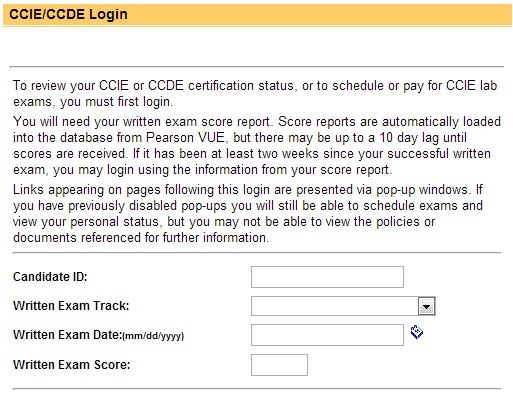
All the information accrued by a CCIE candidate lives in a database somewhere at Cisco.  The access method for this database is somewhat archaic.  When you attempt to access any information from the http://www.cisco.com/go/ccie landing page, you must first log in using your Cisco Connection Online (CCO) login.  This is a pretty standard login for anything on the Cisco website, from software downloads to partner page access.  Once you input the information to log into your CCO account, you aren’t automatically granted access to the CCIE portal.  Instead, you are redirected to https://tools.cisco.com/CCIE/Schedule_Lab/CCIEOnline/jsp/UpdateProfile_Form.jsp.  For those that might not otherwise be familiar with this page, here’s what it looks like:

CCIE Login Page - Thanks to @MrTugs

CCIE Login Page – Thanks to @MrTugs

Anyone that has taken the CCIE written, tried to schedule the CCIE lab, or has passed the lab knows the pain of this page.  In order to access your score report or CCIE logos or even schedule a lab exam, you must first provide the laundry list of random information.  The candidate ID is easy enough to find since it’s the CSCO number that tracks you through the Cisco certification program.  The rest of the info is the pain point.

Why is it that almost twenty years after the inception of the program that I still need to provide my written score report information?  I could understand providing all this information the first time I log into the system.  PearsonVUE and Prometric require similar information from your first testing score report in order to tie your database record to a test and begin to track you in their system.  If I had to provide the score report for the first time to tie the CCIE written exam to my CSCO number, I would totally understand.  However, I need to provide my written score EVERY. TIME. I. LOG. IN.  Even after I pass the CCIE lab, I still need to remember that score to access my certification record.  If you’re someone that has taken several recertification exams it can be painful.  If you’re been a CCIE as long as Terry Slattery, it’s downright excruciating.  If you’re considering a multiple CCIE, the process is even worse.  You have to log into the system with your specific track score report in order to schedule a lab.  Don’t have your CCIE Voice score report handy?  Better not log in with your CCIE R&S information.  You won’t have access to schedule the lab for Voice.  It’s almost like the CCIE database is a series of separate databases running on someone’s desktop in RTP.

EDIT: Marko Milivojevic (@icemarkom) pointed out to me that the database is consistent if you are a multiple CCIE holder.  Using any one of your written exams allows you to log in and see all of your records.  You still need to use a track-specific written test to schedule the associated lab exam, however.

Cisco has a certification tracking database located at http://www.cisco.com/go/certifications/login.  It holds all the information related to non-CCIE certifications.  It also happens to be integrated with the CCO login completely.  I used to have to login to the Cisco Cert Tracker with my CSCO ID, but now I just have to login with my regular CCO login and I’m passed right on through to the pertinent information.  There’s even a field in the Cert Tracker for my CCIE number.  However, there is no information to be found related to the CCIE itself.  I’m pretty sure this has a lot to do with the historical separation between the CCIE team and the rest of the certification organization.  The CCIE was always held apart from everything else, both due to its grandfatherly status in the certification industry and the lack of any prerequisites to take the written exam.  It has only been recently that the CCIE team has been folded into the greater Cisco Certifications team.  If they truly are a part of the greater whole, it’s high time to start bring the CCIE portal over to the Cert Tracker.

I can’t see any reason to continue to require CCIEs in good standing to remember a decade-old score report in order to access a logo or look up a lab exam date.  I can see logging in with the score report information the first time to tie everything together to a candidate record.  But after that, you should only need to login with your CCO login or your CSCO number.  That information should be a unique enough value to guarantee non-overlapping logins.  You already require the CCIE candidate to have a valid CSCO number in order to take the written at a PearsonVUE testing center.  Why not use it as the sole login credential?


Tom’s Take

I’ve known too many CCIE candidates that have frantically tried to recall their written test information when the dreaded lab score report email comes.  I had my info saved in Chrome so it would auto-fill when I got to that page.  It worked until I changed laptops and didn’t import my Chrome info.   I had to dig through a filing cabinet to track down the information I needed to login.  Think about the CCIEs that have been certified for more than a decade.  Why should they be forced to produce information that has been lost to time?  My written score has been displaced by RSTP timers and EIGRP admin distance numbers.  Sure, I could keep that info somewhere safe (like a 1Password entry), but I think the better fix would be to bring the CCIE database into the 21st century and integrate it with all the other tools that Cisco provides.  You can stage the migration over the course of a few months.  Even just allowing your CCO login to access the CCIE portal would be a huge step forward.  I know this is a delicate process that has been going on for many years.  But the process is broken and silly and it’s time that someone fixed it.


Opengear – A Box Full Of Awesome

Presenter number two at Network Field Day 4 was Opengear.  This was a company that I hadn’t heard much about.  A cursory glance at their website reveals that they make console servers among other interesting management devices.  Further searching turned up a post by Jeremy Stretch over at Packetlife about using one of the devices as the core of his free community lab.  If it’s good enough for Stretch, it’s good enough to pique my interest.

As you can see from the short opening, Opengear is dedicated to making network infrastructure management equipment like console servers as well as PDU management and environmental sensors.  Most interesting to me was the ACM5004-G unit the delegates received, which is a 4-port model with a 3G radio uplink.  They also make much more dense devices like the one in Stretch’s lab for those that are wanting something with a few more ports.  Most of the people I know that are looking at something like this for the CCIE lab use an old 2511 router with octal cables.  Those are fairly cheap on eBay but you are taking a risk with the hardware finally wearing out and being out of warranty.  As well, there are a ton of features that you can configure in the Opengear software (we’ll get to that in a minute.

Up next…is a caution for Opengear and other would-be Tech Field Day presenters.  Yes, I understand you are proud of your customer base and want to tell the world about all the cool people that use your product.  That being said, a single slide crammed full of logos, which I affectionately call “The NASCAR Slide” may be a better idea that slide after slide of each company broken down by industry vertical.  You have to think to yourself that filling 8-10 slides of your deck with other people’s logos is not only wasting time and space, but not doing a very good job of telling us what your product does.  All of the companies on that list probably use toilet paper as well, but we don’t see that on your slides.  Better to focus on your product.

Okay, now for awesome time.  Opengear’s management software has a bunch of bells and whistles to suit your fancy.  You can configure all manner things like multiple authentication methods for your users to prevent them from accessing consoles they aren’t supposed to see.  As the underpinnings of the whole Opengear system run on Linux, it’s no surprise that their monitoring software is built on top of Nagios.  This allows you to use their VCMS product to manage multiple disparate units.  Think about that.  You’re using the Opengear boxes to manage your equipment.  Now you can use their software to manage your Opengear boxes.  Those units can also be configured to “call home” over secured VPNs to ensure that your traffic isn’t flying across the Internet unencrypted.  VCMS can also use vendor-neutral commands to manage connected UPSes.  I can’t tell you the number of times having a device that could power cycle a UPS or PDU would have saved my bacon or prevented a trip across the state.  The VCMS can even script responses to events, such as triggering a power cycle if the system is hung or stops responding.

Next up is a demo of the software.  Worth a look if your interested in the gory details of the interface:

We finished off the day with a talk about some of the new and interesting things that Opengear is doing with their devices.  I think the story about configuring them to use a webcam to take pictures of people opening roadside boxes then upload the pictures to an FTP server running on the Opengear box that then sends the picture over 3G back to central location was the most interesting.  Of course, everyone immediately seized on the salmon farm as the strangest use case.  It’s clear that Opengear has a great solution that is only really limited by your imagination.

If you’d like to learn more about Opengear and their variety of products, you can check out their website at http://opengear.com.  You can also follow them on Twitter as @Opengear.


Tom’s Take

I can’t count the number of times that I’ve needed a console server.  Just that functionality alone would save me a lot of pain in some remote deployments I’ve had.  Opengear seems to have taken this idea and ran with it by adding on some great additional functionality, whether it be cellular uplinks or software controls for all manner of third party UPSes.  I think the fact that you can do so much with their boxes with a little imagination and some elbow grease means that we’re going to be hearing stories like the fish farm for a while to come.

Tech Field Day Disclaimer

Opengear was a sponsor of Network Field Day 4.  As such, they were responsible for covering a portion of my travel and lodging expenses while attending Network Field Day 4.  In addition, Opengear provided me with an ACM5004-G console server and a polo shirt. They did not ask for, nor where they promised any kind of consideration in the writing of this review.  The opinions and analysis provided within are my own and any errors or omissions are mine and mine alone.

Do They Give Out Numbers For The CCIE Written?

I’ve seen a bit of lively discussion recently about a topic that has vexed many an engineer for years.  It revolves around a select few that put “CCIE Written” as their title on their resume or their LinkedIn account.  While they have gone to great lengths to study and take the 100-question multiple choice written qualification exam for the CCIE lab, there is some notion that this test in and of itself grants a title of some sort.  While I have yet to interview someone that has this title, others that I talk to said they have.  I have been in a situation where some of my co-workers wanted to use that particular designation for me during the period of time when I passed the written but hadn’t yet made it through the lab.  I flat out told them “no.”

I understand the the CCIE is a huge undertaking.  Even the written qualification exam is a huge commitment of time and energy.  The test exists because the CCIE has no formal prerequisite.  Back before the CCNA or the CCNP, anyone could go out and attempt the CCIE.  However, since lab spots are a finite resource, some method of pre qualification had to be in place to ensure that people wouldn’t just book spot after spot in the hope of passing the lab.  The written serves as a barrier to entry that prevents just anyone from grabbing the nearest credit card and booking a lab slot they may have no hope of passing.  The written exam is just that, though – a qualification exam.  It doesn’t confer a number or a title of any kind.  It’s not the end of the journey.  It’s the beginning.  I think the rise of the number of people trying to use the CCIE written as a certification level comes from the fact that the exam can now be used to recertify any of a number of lower level certifications, including CCxA, CCxP, and almost all the Cisco Qualified Specialist designations.  That’s the reason I passed my first CCIE written.  At first, I had no real desire to try and get my brains hammered in by the infamous lab.  I merely wanted to keep my professional level certifications and my specialist tags without needing to go out and take all those exams over again.  However, once I passed the written and saw that I indeed knew more about routing and switching than I anticipated, I started analyzing the possibility of passing the lab.  I passed the written twice more before I got my number, both to keep my eligibility for the lab and to keep my other certifications from expiring.  Yet, every time someone asked me what my new title was after passing that test I reminded them that it meant nothing more beyond giving me the chance at a lab date.

I’m not mad at people that put “CCIE Written” as their title on a resume.  It’s not anger that makes me question their decision.  It’s disappointment.  I almost feel sorry that people see this as just another milestone that should provide some reward.  The reward of the CCIE Written is proving you know enough to go to San Jose or Brussels and not get your teeth kicked in.  It doesn’t confer a number or a title or anything other than a date taken and a score that you’ll need to log into the CCIE site every time you want to access your data (yes, even after you pass you still need it).  Rather than resting your laurels after you get through it, look at it as a license to accelerate your studies.  When someone asks you what your new title is, tell them your lab date.  It shows commitment and foresight.  Simply telling someone that you’re a CCIE written is most likely going to draw a stare of disdain followed by a very pointed discussion about the difference between a multiple choice exam and a practical lab.  Worst case scenario?  The person interviewing you has a CCIE and just dismisses you on the spot.  Don’t take that chance.  The only time the letters “CCIE” should be on your resume is if they are followed by a number.

Mental Case – In a Flash(card)

You’ve probably noticed that I spend a lot of my time studying for things.  Seems like I’ve always been reading things or memorizing arcane formulae for one reason or another.  In the past, I have relied upon a large number of methods for this purpose.  However, I keep coming back to the tried-and-true flash card.  To me, it’s the most basic form of learning.  A question on the front and an answer on the back is all you need to drill a fact into your head.  As I started studying for my CCIE lab exam, this was the route that I chose to go down when I wanted to learn some of the more difficult features, like BGP supress maps or NTP peer configurations.  It was a pain to hand write all that info out on my cards.  Sometimes it didn’t all fit.  Other times, I couldn’t read my own writing.  I wondered if there was a better solution.

Cue my friend Greg Ferro and his post about a program called Mental Case.  Mental Case, from Mental Faculty, is a program designed to let you create your own flashcards.  The main program runs on a Mac computer and allows you to create libraries of flash cards.  There are a lot of good example sets when you first launch the app for things like languages.  But, as you go through some of the other examples, you can see the power that Mental Case can give you above and beyond a simple 3″x5″ flash card.  For one thing, you can use pictures in your flash cards.  This is handy if you are trying to learn about art or landmarks, for instance.  You could also use it as a quick quiz about Cisco Visio shapes or wireless antenna types.  This is a great way to study things more advanced than just simple text.

Once you dig into Mental Case, though, you can see some of the things that separate it from traditional pen-and-paper.  While it might be handy to have a few flash cards in your pocket to take out and study when you’re in line at the DMV, more often than not you tend to forget about them.  Mental Case can setup a schedule for you to study.  It will pop up and tell you that it’s time to do some work.  That’s great as a constant reminder of what you need to learn.  Another nice feature is the learning feature.  If you have ever used flash cards, you probably know that after a while, you tend to know about 80% of them cold with little effort.  However, there are about 20% that kind of float in the middle of the pack and just get skipped past without much reinforcement.  They kind of get lost in the shuffle, so to speak.  With Mental Case, those questions which you get wrong more often get shuffled to the front, where your attention span is more focused.  Mental Case learns the best ways to make you learn best.  You can also set Mental Case to shuffle or even reverse the card deck to keep you on your toes.

When you couple all of these features with the fact that there is a Mental Case IOS client as well as a desktop version, your study efficiency goes through the roof.  Now, rather than only being able to study your flash cards when you are at your desk, you can take them with you everywhere.  When you consider that most people today spend an awful lot of time staring at their iPhones and iPads, it’s nice to know that you can pull up a set of flash cards from your mobile device and go to town at a moment’s notice, like in the line at the DMV.  In fact, that’s how I got started with Mental Case.  I downloaded the IOS app and started firing out the flash cards for things like changing RIP timers and configuring SSM.  However, the main Mental Case app only runs on Mac.  At the time, I didn’t have a Mac?  How did I do it?  Well, Mental Case seems to have thought of everything.  While the IOS app works best in concert with the Mac app, you can also create flash cards on other sites, like FlashcardExchange and Quizzlet.  You can create decks and make them publicly available for everyone, or just share them among your friends.  You do have to make the deck public long enough to download to Mental Case IOS, but it can be protected again afterwards if you are studying information that shouldn’t be shared with the rest of the world.  Note, though, that the IOS version of the software is a little more basic than the one on the Mac.  It doesn’t support wacky text formatting or the ability to do multiple choice quizzes.  Also, cards that are created with more than two “sides” (Mental Case calls them facets) will only display properly in slideshow mode.  But, if you think of the IOS client as a replacement for the stack of 10,000 flash cards you might already be carrying in your backpack or pocket the limitations aren’t that severe after all.

The latest version of Mental Case now has the option to share content between Macs via iCloud.  This will allow you to keep your deck synced between your different computers.  You still have to sync the cards between your Mac and your IOS device via Wi-Fi.  You can share at shorter ranges over Bluetooth.  You can also create collection of cards known as a Study Archive and place them in a central location, like Dropbox for instance. This wasn’t a feature when I was using Mental Case full time, but I like the idea of being able to keep my cards in one place all the time.

Mental Case is running a special on their software for the next few days.  Normally, the Mac version costs $29.99.  That’s worth every penny if you spend time studying.  However, for the next few days, it’s only $9.99.  This is a steal for such a powerful study program.  The IOS app is also on sale.  Normally $4.99, it’s just $2.99.  Alone the IOS app is a great resource.  Paired with its bigger brother, this is a no-brainer.  Run out and grab these two programs and spend more time studying your facts and figures efficiently and less time creating them.  If you’d like to learn more about Mental Case from Mental Faculty, you can check out their webiste at http://www.mentalcaseapp.com.

Disclaimer

I am a Mental Case IOS user.  I have used the demo version of the Mental Case Mac app.  Mental Case has not contacted me about this review, and no promotional consideration was given.  I’m just a really big fan of the app and wanted to tell people about it.

Study Advice – Listen To That Little Voice

During Show 109 of the Packet Pushers podcast, I had the unique honor to be involved in an episode that included the uber geek Scott Morris, distinguished Cisco Press author Wendell Odom, and the very first CCDE, Russ White.  Along with Natalie Timms, the CCIE Security program manager and Amy Arnold, we discussed a lot of various topics around the subject of certification.  One of the topics that came up about 37 minutes in was about being persistent in your studies.  Amy brought up a good point that you need to find a study habit that works for you.  I followed up with a comment that I still have a voice in the back of my head that tells me I need to study.  I promised a blog post about that, so here it is only a month late.

I took three years to get my CCIE.  Only the last year really involved intense study on a regular basis.  The previous 24 months, I spent a great deal of time and effort with my regular job.  I picked up a book from time to time and refresh my memory, but I wasn’t doing the kind of heavy duty labbing necessary to hone my CCIE skills.  After I had some conversations with my mentors about what the CCIE really meant to me, I jumped in and started doing as much studying as I could every night.  Almost all of my study time came after my kids went to bed.  Basically, from 8 p.m. until about 1 a.m. I fired up my GNS3 lab and tested various scenarios and brain teasers.  I took me a bit of time before I really settled into a routine, though.  There were lots of things that kept tugging at my attention.  The devilsh Internet, the seductive allure of my television, and the siren call of video games all competed to see which one could lure me away from the warm glow of my console screen.  I had to spend a great deal of time focusing on making a conscious decision to drop what I was doing and start working on my lab.  It’s a lot like running, in a way.  Most runners will tell you that if you can get outside and start running, the rest is easy.  It’s overcoming all the obstacles in your way that are trying to keep you from running.  You have to push past the distractions and keep moving no matter what.  Don’t let an email or a text message keep you from starting R1.  Don’t let a late-night snack run distract you from loading a troubleshooting configuration.  The real key is to get started.  Crack open those lab manuals and fire up your routers, whether they be real or virtual.  After that, the rest just falls into place.

There is a downside to all that training, though.  It’s now been 13 months since I passed my CCIE lab.  To this day, I stil have a little voice in the back of my head telling me that I need to be studying.  Every time I flip on the TV or sit down on the couch, I feel like I should have a book in my lap or have a lab diagram staring me in the face.  I’ve taken some certification tests since the lab, but I haven’t really taken a great deal of time to study something that isn’t familiar to me.  I talked about what I wanted to do at the beginning of the year, and I firmly believe now that I’m halfway through that I’ve missed some opportunities to get back on the horse, as it were.  I know that the only way to satisfy that voice that keeps telling me that I should be doing something is to feed it with chapters of study guides and time in front of the lab console again.  I don’t think it will take the same kind of time investment that the CCIE did, but who knows what it might build into in the end?  I certainly never thought I’d be taking the granddaddy of all certification tests when I first started learning about networking all those many years ago.

For those out there just starting to study for your certifications, I would echo Ethan’s advice during the podcast.  You need to make a habit out of studying.  Many people that I talk to want to study for tests, but they want to do it on someone else’s time.  They want their employer to mark off time for study or provide resources for learning.  While I’m all for this kind of idea and would love to see more employers doing things like this, there is a limit that you will eventually reach.  Your employer expects you to spend your time providing a service for them.  If you truly want to have as much study time as you want, you will have to do it outside working hours.  Your boss doesn’t care what you do from 5 p.m. on.  In the case of the CCIE, it was a whole lot easier for me to try and do mock labs on Saturday than it was to try and do them on Tuesday.  The work week doesn’t afford many uninterrupted opportunities for study.  Nights and weekends do.

Make sure you take your study habits as seriously as you do your job.  It might be easy to kid yourself into thinking that you can just pick up the book for five minutes before the next TV show comes one, but we both know that won’t work.  Unless you immerse yourself in studying, all that knowledge that you gained in those scant minutes of furious reading will evaporate when the theme song to that hit sitcom starts.  You don’t have to have total silence, though.  I find that I do some of my best studying when I have some noise in the background that forces me to pay attention to what I’m doing.  However, if you don’t apply some serious consideration to your studies, you’ll probably end up much like I did in the first couple of years of my studies – adrift and listless.  If you can knuckle down and treat it just like you would a troubleshooting task or an installation project, then you’ll do just fine.

CCDE and CCAr – Why All The Hate?

Cisco Live 2012 gave me an opportunity to sit in a session dedicated to the newer Cisco expert certfications.  BRKCRT-8862 is for CCIEs that are looking at moving to the Cisco Certified Design Expert (CCDE) and maybe even the Cisco Certified Architect (CCAr).  The CCDE is a pretty well known certification at this point.  Developed in large part by Russ White, the CCDE tests a candidate on their knowledge of taking a set of requirements and producing a valid design for a given scenario.  Originally envisioned as a board certification exam not unlike the VMware Certified Design Expert (VCDX), the CCDE is instead an 8-hour exam with some multiple choice and some fill-in-the-blank type questions.  The CCDE is a prerequisite for the CCAr, which is the culmination of something Cisco is trying to do with focusing on solutions.  The CCAr tends to focus more on the Planning and Preparation areas of the PPDIOO model.  Cisco tends to see them as “big picture” solutions engineers that focus on more conceptual ideas that revolve around things like business contraints and specific use cases.  From what Cisco was describing, it appears that the role of the CCAr is to gather information about the customer desires that will then be given to the CCDEs to generate a design.  The CCAr is a 5-month long board exam that is graded by three judges (mostly existing CCArs) that are with you during the entire process, from the initial submission of your application up until the final board review.  Note that not all those that apply to the program will be selected for review.

The BRKCRT session highlighted a lot of hesitation in the CCIE ranks where the CCAr is concerned.  Cisco has spent a lot of time over the last three years attempting to have the CCDE reach parity with the CCIE in terms of importance.  Had they simply called it the CCIE: Design it would likely have been much more accepted in the community.  However, there is a legacy of the original failed CCIE: Design track from a decade ago, so I’m sure that Cisco wanted to avoid carrying the negativity forward.  Instead, they’ve had to fight the reputation that the exam has gotten for being too focused on very specific technologies or being a bad representation of what a design test should be.  Much of this criticism focuses on the major test developer, Russ White.  When I first heard of the exam going live, many people said it was easy so long as you asked yourself “What Would Russ White Do?”  With the new version of the exam being recently released, as well as Cisco offering the exam at new locations, the CCDE may very well be on the road to gaining a little more respect.

The CCAr, on the other hand, is a pretty big target.  CCIEs are upset that the CCDE is the only prerequisite for the exam.  After almost twenty years of being told that the CCIE is the most important certification inside of Cisco, if not the world, now we’re told that the CCIE isn’t even good enough for us to get our foot in the door of the Architect board.  I think some of this comes from the reality that many CCIEs are called upon to do designs in their every day work.  Often, after a CCIE goes through all the training necessary to pass the lab exam, they have a very good idea of the capabilities of the product set within their particular track.  Therefore, many companies call on them to produce designs, as they are usually the best suited to make the decision between using a particular model of switch or router or firewall.  However, not all CCIEs are good at design.  Many of them have a “bottom up” view of things that tends to lead them down the path of point solutions without regard for higher-level thinking.  Call it a “forest for the trees” type of mentality.  They get so bogged down on the decisions between what line cards to use or why they’d rather use a 4500 in place of a 6500 that they lose sight of the bigger goals.  There’s also no guarantee that a CCIE will be able to produce a valid design from a pile of non-technical interviews and business requirements instead of data sheets and performance specs.  The CCDE teaches engineers how to keep a bigger view of things in mind when planning a design.

The problem, however, is that both the CCDE and CCIE are still focused on providing their respective documents, whether they be for design or implementation.  Someone still has to lay the groundwork for the project and figure out how to focus the task of the designers.  Without an even bigger picture, design is just throwing things at the wall until something sticks.  Some designers understand that and ask specific questions before diving into their work.  These are the folks that are the target of the CCAr program.  Cisco doesn’t just want a bill of materials or a pretty Visio document handed to the customer.  They want a cohesive plan and design delivered to sell a vision, whether it be an architecture like a connected sports stadium or a connected energy grid.  Architects take into account more than just technology.  They are constantly thinking about esoteric things like regulatory laws and other logistic restraints.  These are the kinds of things that CCIEs and CCDEs either shy away from or would rather not think about.

Look at it like this:  The CCAr is like the CEO of the team.  They have the vision and the desire to go out and kickstart things by looking at the big picture.  They have to play the role of project manager and pre-sales at the same time.  They keep a handle on the non-technical aspects of the project.  Once they’ve determined the direction, the send in the CCDEs.  These guys take all the documentation the CCAr has generated and meld it with the best practices needed to create a valid, working design.  Once the CCDEs have everything in order, it’s up to the CCIEs to go out and make it all work.  They are the technical piece that gets the hard work accomplished.  The CCAr may not be typing commands in on the CLI, but they are the ones running interference from the other side by keeping customers appraised and kicking over rocks to find things the designers need to know.

If you’d like to read a few more takes on the CCDE, check out Russ White’s Why CCDE? post at the Packet Pushers site.  Also, read about the journey to CCDE success from CCDE 2012::1, Ronnie Angello (@rangello)

Tom’s Take

I’ll be shocked if there are ever more than a hundred Cisco Certified Architects.  The level of thinking required for this exam isn’t something that can be taught.  You are either born to be a technical architect or you aren’t.  With that being said, I think that the skills that are crucial to having a well rounded view of architecture are best served by requiring both the CCIE and CCDE as a prerequisite for the CCAr.  Design without technical know-how is a dicey proposition at best, but trying to attain and architecture role without knowing how to design is equally capable of colossal folly.  Just like any recipe, you need a good mix of both to make the final product come out right.

The CCIE Spelling Bee

I’ve seen a lot of discussion recently about the CCIE with regards to how “hard” the test really is.  There is no denying that the exam is of a very high difficulty level.  The discussion revolves around application.  It has been said that one of the reasons the CCIE lab exam is so difficult is because it doesn’t test the candidate on “real world” network designs.  According to these folks, the CCIE lab tests you on things that you would never see yourself doing in reality outside a lab environment solely for the purpose of seeing how well you can follow directions.  There is some merit to this, as the overview for the CCIE clearly states that this is not a “best practices” examination of networking theory.  It’s a practical implementation test with a given set of parameters and instructions.  There was also a story told in one of my bootcamps with Narbik Kocharians about a student taking a mock lab that took two hours to finish the first section because he spent all his time doing it the “right” way and ensuring there couldn’t be any possible problems down the road.  He thought like an engineer working on a production network instead of a CCIE candidate.  Those clues tend to lend credence to the idea that the CCIE is hard because you are doing things you might not do otherwise.

The more I thought about this, the more I realized the CCIE lab exam is a lot like another type of test that almost every one of us has taken at some point in our lives – a spelling bee.  The time honored tradition of rounding up a group of students and giving them strange words out of the dictionary to see how well they can disassemble them and regurgitate them back in serialized order.  When you think about it, there’s a lot in common with the granddaddy of networking exams.  Both are practical, in that multiple choice isn’t allowed (curiously, the first round of the Scripps National Spelling Bee uses a multiple choice format sometimes, similar to the CCIE written qualification exam).  Both exams don’t give any points for partial credit.  Transposing two letters of a word gets you the same number of points as forgetting to enable mls qos on a switch in the lab (zero).  Both exams give you all the answers up front.  For the CCIE, it’s all there in the documentation. In the spelling bee, you usually get a word list of some kind, either the Spell It! book or Webster’s Third International Dictionary.  In both cases, the amount of documentation that must be sorted through is rather large.  Both tests tend to introduce a large amount of performance anxiety.  And finally, both tests tend to focus on things you wouldn’t normally see for the sake of testing the candidate’s abilities.

Think about this for a moment.  The winning words for the last three National Spelling Bee winners were (in order) cymotrichous, Stromuhr, and Laodicean.  I can’t even pronounce those words, let alone use them in general conversation.  There are even differences in the vocabulary I use in my blog posts versus the words I use in conversation.  Does it make the above words any less valid if the only appear in a dictionary?  No, it doesn’t.  Yes, many of the constructs in the CCIE lab are presented in such a way as to test the candidate’s grasp on applying concepts.  Yes, the lab is crafted in such a way as to eliminate several obvious choices that make life easier.  Just like a spelling bee doesn’t give you access to the dictionary.  Yes, there is a time crunch in the lab.  Just like a spelling bee doesn’t give you three hours to think about how to spell the word.  You only have 2.5 minutes to spell the word from the time it’s first pronounced.  Overall, both the spelling bee and the CCIE lab exam take specific examples that demonstrate advanced concepts and give the test takers a short amount of time to produce results.  It shouldn’t matter that I may never configure multi-router redistribution or RIP neighbor relationships across RSPAN VLANs.  The point is that these examples are designed to test my knowledge of a subject, just like cymotrichous is designed to test my spelling ability a lot better than dog or cat.

Tom’s Take

There’s no denying the CCIE is a hard exam.  The question of real word application versus crafted lab scenarios is a semantic one at best.  While many feel that making the exam reflect scenarios that you might encounter in your job every day would be more appropriate, I feel that having it test a broad subject matter with intricate questions is a better application.  I’d much rather be looking at a problem and think to myself, “Hey! I’ve seen this in the lab before!”  That way, I feel more comfortable having seen it work in a controlled environment before.  At the end of the day, making the CCIE lab a “real world” test is as bad an idea as making the National Spelling Bee only test over words used in everyday conversation.  The test would soon become a very rigid and insular example of the mythical “real world” that would either need to be updated every six months to stay current or it wouldn’t be updated frequently enough and eventually become what people are accusing it of today, namely being a “bad” example of the real world.  I think it’s better to stretch our horizons and spend a little time thinking outside the box for solutions that may not apply in every day life but force us to think about our methods and processes.  Whether that involves routing protocol configuration or challenging the “I before E except after C” rule, the end result is the same.  People question more and dig deeper rather than just accepting someone’s idea of what reality looks like.  And, after all, we know that in our world, I and E really come after two Cs.

CCIE Data Center – The Waiting Is The Hardest Part

By now, you’ve probably read the posts from Jeff Fry and Tony Bourke letting the cat out of the CCIE bag for the oft-rumored CCIE Data Center (DC) certification.  As was the case last year, a PDF posted to the Cisco Live Virtual website spoiled all the speculation.  Contained within the slide deck for BRKCRT-1612 Evolution of Data Centre Certification and Training is a wealth of confirmation starting around slide 18.  It spells out in bold letters the CCIE DC 1.0 program.  It seems to be focused around three major technology pillars: Unified Computing, Unified Fabric, and Unified Network Services.  As people who have read my blog since last year have probably surmised, this wasn’t really a surprise to me after Cisco Live 2011.

As I surmised eight months ago, it encompasses the Nexus product line top to bottom, with the 7009, 5548, 2232, and 1000v switches all being represented.  Also included just for you storage folks is a 9222i MDS SAN switch.  There’s even a Catalyst 3750 thrown in for good measure.  Maybe they’re using it to fill an air gap in the rack or something.  From the UCS server side of the house, you’ll likely get to see a UCS 6248 fabric interconnect and a 5148 blade chassis.  And because no CCIE lab would exist without a head scratcher on the blueprint there is also an ACE 4710 module.  I’m sure that this has to do with the requirement that almost every data center needs some kind of load balancer or application delivery controller.  As I mentioned before and Tony mentioned in his blog post, don’t be surprised to see an ACE GSS module in there as well.  Might be worth a two point question.

Is the CCIE SAN Dead?

If you’re currently studying for your SAN CCIE, don’t give up just yet.  While there hasn’t been any official announcement just yet, that also doesn’t mean the SAN program is being retired any time soon.  There will be more than enough time for you SAN jockeys to finish up this CCIE just in time to start studying for a new one.  If you figure that the announcement will be made by Cisco Live Melbourne near the end of March, it will likely be three months for the written beta.  That puts the wide release of the written exam at Cisco Live San Diego in June.  The lab will be in beta from that point forward, so it will be the tail end of the year before the first non-guinea pigs are sitting the CCIE DC lab.  Since you SAN folks are buried in your own track right now, keep heading down that path.  I’m sure that all the SAN-OS configs and FCoE experience will serve you well on the new exam, as UCS relies heavily on storage networking.  In fact, I wouldn’t be surprised to see some sort of bridge program run concurrently with the CCIE SAN / CCIE DC candidates for the first 6-8 months where SAN CCIEs can sit the DC lab as an opportunity and incentive to upgrade.  After all, the first DC CCIEs are likely to be SAN folks anyway.  Why not try to certify all you can?

Expect the formal announcement of the program to happen sometime between March 6th and March 20th.  It will likely come with a few new additions to the UCS line and be promoted as a way to prove to the world that Cisco is very serious about servers now.  Shortly after that, expect an announcement for signups for the beta written exam.  I’d bank on 150-200 questions of all kinds, from FCoE to UCS Manager.  It’ll take some time to get all those graded, so while you’re waiting to see if you’ve hit the cut score, head over to the Data Center Supplemental Learning page and start refreshing things.  Maybe you’ll have a chance to head to San Jose and sit in my favorite building on Tasman Drive to try and break a brand new lab.  Then, you’ll just be waiting for your score report.  That’s the hardest part.

CCIE Numbers Skyrocket – Red Alert?

Congratulations to Chris Martin, CCIE# 34310, according to IPExpert’s Successful Candidates page.  Thanks to Windows Calculator and my non-binary math skills, that means we’ve had 5,000 new numbers since my pass back in June.  That’s not counting the repeat passes that keep the same number.  The new numbers have been skyrocketing in the last 3 months, shooting up over 2,000 since Blake Krone passed his lab at the end of October.

I’ve heard a lot of interesting theories in the past couple of weeks about why the numbers are shooting up so quickly.  Some attribute it to the official Cisco 360 training program churning out candidates left and right.  There are also those that believe there is something hinkey is going on with the numbering scheme.  Is Cisco pre-allocating numbers to each lab seat every day and then discarding them if the lab isn’t passed?  Are they counting by even numbers now?  Is the numbering now logarithmic?  Add in the recent troubles that Marc La Porte has had with Cisco and his unofficial CCIE Hall of Fame Webpage and the conspiracy theories started spreading like wildfire.  Why is Cisco trying to take down the page?  Are they trying to hide something?

After listening to all the theories and rumors and some of the more outlandish theories that I didn’t even bother to put down, I keep thinking back to a conversation that I had with Terry Slattery back at Cisco Live 2011.  Being the fanboy that I am, I had a chance to ask Terry what he thought about the CCIE numbers climbing ever so higher.  Some of the thoughts he shared with me were rather intriguing and got me to thinking about things in a light that I hadn’t really considered before.  With the acceleration of the new numbers being spit out, I think now more than ever that Terry might have been on to something.

Let’s say for the sake of argument that there isn’t anything funny going on with the numbers.  Let’s also assume that there isn’t rampant cheating going on, as some have suggested to me.  That means that we have a large number of people taking and passing the lab.  But we aren’t hearing about them.  They don’t have blogs or spend time on Groupstudy or post success stories on LinkedIn.  There isn’t any information about them out there.  Almost as if they didn’t really have a big presence on the Internet.  As if they weren’t really looking to market their skills to others and instead were either already at jobs that required the CCIE or had one lined up and ready to go.  Where would such a thing be possible?

China.

Stop and think about it for a minute.  According to Cisco, China is seeing explosive growth in networking, everything ranging from power systems to survellience.  They’re ramping up and infrastructure that’s going to need to support over a billion people all looking to get connected somehow.  China is leading the way in deploying IPv6 internally as a way to alleviate the exhaustion of IPv4 addresses.  Ask yourself then: Where are they getting all these engineers?  How many of your friends and colleagues are flying to China to work on these massive projects?  I’m guessing hardly any.  Why’s that?  Where is the supply coming from to meet this massive demand?

I believe that there are sponsored learning facilities inside China that are essentially functioning like advanced technology vocational technology centers in an effort to train a workforce to go out and assume the roles needed to build and maintain advanced networking and computing infrastructures.  That way, they don’t need to sort out all the details of arranging for a large number of visas to allow foreign engineers to come and work for months at a time.  They also don’t have to worry about bad press from said foreign engineers coming back home and discussing things like the Internet filtering policies.  Instead, they can focus on creating a highly-skilled group of workers to go out and tackle these huge projects.  Because these facilities are likely sponsored or run by the government, profit is of less concern than results.  And if you have a populace that is willing to clamor toward a job that doesn’t involve manual labor or other undesirable work, you would have a motivated pool of talent to pick from.  Taking into account the mind-bending numbers of people available for these jobs, passing even 1,000 extra CCIEs into the global pool is a blip on the radar for China.

One other thing that I’ve mentioned before lends credence to the Chinese CCIE theory in my mind.  Remember those dastardly Open Ended Questions that I hated so much?  Guess which testing facility instituted the in-person interview process that led to the OEQs before the new troubleshooting section?  That’s right, Beijing.  I’m not accusing anyone of wrongdoing.  But the fact that the OEQ program originated there means they must have had a very high pass rate they were suspect of in the first place.  What if the pass rate is still legitimately high even with the new safeguards against impropriety?  Since Cisco doesn’t release numbers on pass rate per lab, I guess we’ll never know.

Tom’s Take

At this rate, we’re looking at seeing CCIE 40,000 before the end of the year.  That’s really going to hit home for people if it took almost 3 years to go from 20,000 to 30,000 and then only takes a year to climb up to 40,000.  I don’t like to think about the idea that lab cheating is so rampant that Cisco has given up trying to protect the value of the CCIE.  Quite the contrary, I’ve heard rumors that the difficulty of the lab is as strong as ever and people are working as hard as they can to get their digits.  To me, that says there is a large contingent of people passing the lab and not talking about it, either by their own choice or the choice of someone above them.  And since we in the U.S. aren’t seeing the workforce flooded with new CCIEs daily, that must mean those passing are someone other than the U.S. (or Europe).  Add in the fact that there aren’t many network rock stars studying Mandarin or watching Ni How Kai-Lan and I am guessing that means that many of our new unknown CCIE brethren are from the Orient.  No crazy conspiracies or funny math.  Just a group of dedicated people doing their best to make it in the world.