
Production Reductions

You’ve probably noticed that I haven’t been writing quite as much this year as I have in years past. I finally hit the wall that comes for all content creators. A combination of my job and the state of the industry meant that I found myself slipping off my self-appointed weekly posting schedule more and more often in 2023. In fact, there were several times I skipped a whole week to get put something out every other week, especially in the latter half of the year.

I’ve always wanted to keep the content level high around here and give my audience things to think about. As the year wore on I found myself running out of those ideas as portions of the industry slowed down. If other people aren’t getting excited about tech why should I? Sure, I could probably write about Wi-Fi 7 or SD-WAN or any number of topics over and over again but it’s harder to repeat yourself for an audience that takes a more critical eye to your writing than it is for someone that just wants to churn out material.

My Bruce Wayne job kept me busy this year. I’m proud of all the content that we created through Tech Field Day and Gestalt IT, especially things like the weekly Rundown show. Writing a post every week is hard. Writing a snarky news show script is just as taxing. If I can find a way to do that I can find a way to write, right?

Moving Targets

Alas, in order to have a plan for content creation you have to make a plan and then stick to it. I did that last year with my Tomversations pieces and it succeeded. This year? I managed to make one. Granted, it was a good one but it was still only one. Is it because I didn’t plan ahead far enough? Or because I didn’t feel like I had much to say?

Part of the secret behind writing is to jot down your ideas right away , no matter how small they might be. You can develop an idea that has merit. You can’t develop a lack of an idea. I have a note where I add quotes and suggestions and random things that I overhear that give me inspiration. Sometimes those ideas pan out. Other times they don’t. I won’t know either way if I don’t write them down and do something about them. If you don’t create the ground for your ideas to flourish you’ll have nothing to reap when it’s time.

The other thing that causes falloffs in content creation is timing. I always knew that leaving my posts until Friday mornings was going to eventually bite me and this year was the year with teeth. Forcing myself to come up with something in a couple of hours time initially led to some pretty rushed ideas and that later pushed into the following Monday (or beyond). While creating a schedule for my thoughts has helped me stay consistent throughout the years the pressures on my schedule this year have meant letting some things slip when they weren’t critical. Hard to prioritize a personal post over a work video that needs to be edited or a paper that needs to be written first.

One other thing that I feel merits some mention is the idea of using tools to help the creative process. I am personally against using a GPT algorithm to write for me. It just doesn’t sound like me and I feel that having something approximating who I am doesn’t have the same feel. Likewise, one of the other things this year that I’m fighting with is word predictions in writing tools. Not as bad as full-on content creation but merely “suggestions” about what word I want to use next. I’ve disabled them for the most part because, while helpful in certain situations they annoy me more than anything when writing. Seeing a tool suggest a word for me while I’m in the flow of writing a post is like hearing a note a half step out of tune in a piece of music. It’s just jarring enough to take you out of the whole experience. Stop trying to anticipate what I’m going to say and let me say it!

Producing Ahead

Does all this mean I’m giving up on my writing? Not hardly. I still feel like writing is my best form of communication. Even a simple post about complaining about my ability to write this year is going to be wordy. I feel it’s because written words give us more opportunity to work at our own pace. When we watch videos we work at someone else’s idea of a learning pace. If you make a ten-minute video to get across a point that could have been read in three minutes you’re either doing a very good job of explaining everything or you’re padding out your work. I prefer to skim, condense, and study the parts that are important to me. I can’t really do that with a video.

I feel the written form of content is still going to be king for years to come. You can search words. You can rephrase words. You can get a sense for how dense a topic is by word count. There’s value in seeing the entire body of knowledge in front of you before you begin. Besides, the backspace key is a whole lot easier to edit than doing another take and remembering to edit out the bad one in the first place.


Tom’s Take

Writing is practically meditation for me at this point. I can find a topic I’m interested in and write. Empty my brain of thoughts and ideas and let them take shape here. AI can’t approximate that for me. Video has too many other variables to worry about. That’s why I’m a writer. I love the way the process works with just a keyboard, a couple of references, and my brain doing the heavy lifting. I’m not sure what my schedule for posting is going to look like in 2024 and beyond but trust me when I say it’s not going away any time soon.

Argument Farming

The old standard.

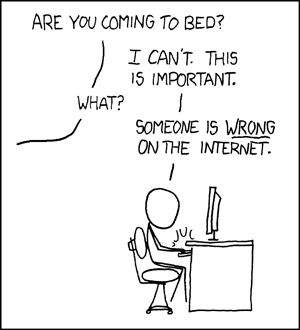
I’m no stranger to disagreement with people on the Internet. Most of my popular posts grew from my disagreement with others around things like being called an engineer, being a 10x engineer, and something about IPv6 and NAT. I’ve always tried to explain my reasoning for my positions and discuss the relevant points with people that want to have a debate. I tend to avoid commenting on people that just accuse me of being wrong and tell me I need to grow up or work in the real world.

Buying the Farm

However, I’ve noticed recently that there have been some people in the realm of social media and influencing that have taken to posting so-called hot takes on things solely for the purpose of engagement. It’s less of a discussion and more of a post that outlines all the reasons why a particular thing that people might like is wrong.

For example, it would be like me posting something about how an apple is the dumbest fruit because it’s not perfectly round or orange or how the peel is ridiculous because you can eat it. While there are some opinions and points to be made, the goal isn’t to discuss the merits of the fruit hierarchy. Instead, it’s designed to draw in people that disagree to generate comments about how apples are, in fact, good fruits and maybe if I tried one some time I would understand. In this example, I would reply to the comment with something along the lines of “thanks for your perspective” or maybe even a flippant question about why you think that way to keep the chain going.

I’ve found that this is very prevalent on platforms that reward engagement over content. Facebook and LinkedIn chiefly spring to mind. The content of the message isn’t as important as how people react to it. The reward isn’t a well-reasoned discussion. It’s people sharing your post and telling you how stupid you are for making it. Or trying to change your mind.

Except I know what I’m doing. I may not even have strongly held beliefs on my post. I may even prefer apples to oranges. The point is to get you all in an uproar and make you drive my post to the top of someone’s feed. A contrarian way to look at things for sure. But it works. Because we’ve rewarded people for making a splash instead of making a case.

Crop Rotation

In the 10x engineer post I linked above, I had no intention of it blowing up. I noticed some things that irked me about the culture we’ve created around the people that do a lot and how we worship their aura without examining the downsides. Naturally, that meant that it got picked up on Hacker News and there were a raft of comments about how I was an idiot and how I’d get fired if I worked for a “real” company because I wasn’t pulling my weight.

I was horrified, to say the least. I didn’t want that kind of engagement. I wanted a reasoned discussion. I wanted people to see my points and engage in debate. I certainly wasn’t trying to specifically craft a post with a contrarian viewpoint explicitly designed to incense the community to drive them to my page or blog. Yet that is exactly how I’m seeing some members of the wider community acting today. The clicks are more important than the words. And if you end up being proven wrong? So be it. Whoops. On to the next hot take!

I wish I had a better method for dealing with this new angle other than just ignoring it. If it’s someone with a legitimate bad viewpoint that could use some guidance or education I am happy to chip in and provide a different viewpoint. However the difference between the occasional post and constant engagement farming for arguments in the comments to drive your view counts higher is disingenuous. Disagreeing with something is one thing. Writing 400 words about how it’s the “worst mistake you can make” or “you should think about what that will mean for your career” are a bit heavy handed. And yes, I’ve seen both of those statements in recent months about something as innocuous as a training class.


Tom’s Take

Healthy disagreement and debate makes us improve. Honest mistakes happen and can be corrected. I have no issue with either of these, even if both sides will never agree. What I take issue with is people being deliberately disingenuous to manipulate algorithms or manufacture outrage for their own ends. I always come back to a simple question: Are you doing this to solve a problem? Or become popular? If the answer is the latter it might be time to put down the plow and ask yourself if the crop you’re sewing is worth it.

Perfection Paralysis

This is a sort of companion piece to my post last week because I saw a very short post here about doing less. It really hit home with me because I’m just as bad as Shawn about wanting everything to be perfect when I write it or create it.

Maximizing Mistakes

One of the things that I’ve noticed in a lot of content that I’ve been consuming recently is the inclusion of mistakes. When you’re writing you have ample access to a backspace key so typos shouldn’t exist (and autocorrect can bugger off). But in video and audio content you can often make a mistake and not even realize it. Flubbing a word or needed to do a retake for something happens quite often, even if you never see or hear them.

What has me curious and a bit interested is that more of those quick errors are making it in. These are things that could easily be fixed in post production and yet they stay. It’s almost like the creators are admitting that mistakes happen and it’s hard to read scripts perfectly every time like some kind of robot. Honest mistakes over things like pronunciation or difficult word combinations help remind us that not everything needs to be exactly perfect every time.

That’s not to say that you can get away with not doing things with the appropriate amount of practice. The difference between a simple mistake in a long passage of text and a haphazard idea just thrown out there without care is very apparent. As I tell the people that I work with for public speaking, the more something sounds off the cuff the more practice went into it to make it sound natural.

Accumulating Assets

My friend Ivan Pepelnjak reached out to me after my last post and reminded me of something he wrote a decade ago that talks about his view of the creative process. One of the big takeaways for me was the section on ideas. It’s important to realize that nothing will spring forward from your mind completely realized.

It’s a lot like baking. The ingredients are easy enough to measure. The trick is mixing them together. You have to add the right ideas in the right amounts and then let them mix together and even settle a little bit before you can make something out of them. However, you also have to be careful about how you go about doing it. Mixing merengue is a very different skill than a pound cake. Some things shouldn’t be mixed too much lest they become ruined by the extra attention. It is entirely possible to do too much to ideas without realizing it.


Tom’s Take

If you find yourself struggling with creativity or need to figure out a way to make something happen don’t be afraid to mix things up a little. Go for a walk. Play some music to force your brain into a new space. Look over your collection of half-formed ideas and see what pops up. Make something happen to change the status quo. You’d be surprised what might happen. But above all don’t get stuck on the idea that it needs to be perfect. The best ideas are very often imperfect.

Content Creation Complications

If you’ve noticed my regular blog posts have been a bit irregular as of late you’re not alone. I’m honestly working through a bit of writer’s block as of late. The irony is that I’m not running out of things to talk about. I’m actually running out of time to talk about them the way that I want.

Putting in the Work

By now you, my dear readers, know that I’m not going to put out a post of 200-300 words just to put something out during the week. I’d rather spend some time looking into a topic and creating something that informs or encourages discussion. That means having sources or doing research.

Research takes time. Ironically enough I’ve always had a much easier time writing things so long as I have the info to pull from in my head. One of the side effects of neurodivergence that I’ve learned about recently is that neurodivergent people tend to write their ‘first draft’ in their head throughout the creation process. Rather than writing and rewriting over and over again I pool all the information in my brain and work through it all to put down my final thoughts. That means what comes out is what I want to say.

However, the time it takes to make that content soup isn’t immediate. Sometimes I find myself doing a massive amount of research to learn about something that ultimately becomes two or three sentences. The rest of the information gets discarded or filed away for use later on in something that might be totally unrelated.

Lightning Bolts

Now you probably see the difficulty in the content creation process when it happens like that. When I’m motivated to write something the words are flowing as I create and edit on the fly. I have lots to say about things and I often change course in mid-stream to pivot into an entirely different idea.

However, when I’m not feeling it the content is a bit harder to create. I have starter ideas that need to germinate but just like growing a plant it takes time. Sometimes that happens when I listen to a podcast or get a spark. Other times I’m walking in circles in my backyard hoping for a bolt from the blue to hit me with inspiration. When that doesn’t happen I just find myself struggling to come up with anything that can develop into a few hundred words.

I’ve been told by many friends that this is how the creative process feels for them all the time. They have ideas but no way to gain the inspiration to write them down. I would hope that there are ways to create and inspire that kind of creative process frequently. I can honestly say that it sucks when you can’t create because the information is stuck in there and it wants to come out. I just can’t make it do the work!


Tom’s Take

The behind-the-scenes part of content creation isn’t easy. It’s also much less glamorous than you might imagine. Remember that when you wonder how you’re going to create something. Don’t worry about making it perfect but make sure to get it all down. Keep yourself to your schedules and make something happen. Otherwise you’re going to be wandering in circles until you do.

Multicasting Content in the Twilight of Social Media

During Cisco Live EMEA last week I had an interesting conversation with a few people at the show around social media and how the usage of the platforms appears to be changing thanks to decisions made by the smartest people in a given broom closet. With the acceleration of the demise of Twitter as a platform I couldn’t help but comment on the fact that social media is becoming less about conversation and more about broadcast, which seemed to catch some of the people in the conversation off guard.

Back and Forth

Ever since the beginning of my time on Twitter, I’ve seen the platform as conversational instead of content-focused. Perhaps that’s the reason why the idea of a tweet storm has irritated me so much over the past few years. Twitter is about talking to people. It’s about interacting with them and creating a conversation in the noise. Twitter allows us to connect to people and exchange ideas and viewpoints.

Contrast that with other platforms in the social media spectrum. Specifically I’m thinking of Youtube video or TikTok videos. These platforms are designed to create content and send it to a number of people to view. It’s multicasting content to viewers. You don’t interact with people on a one-on-one basis. If Twitter is about the conversation then video platforms are all about the message. Sit here, listen to what I have to say, and don’t talk back.

You may already be thinking to yourself, “But what about the comments!” And you might even be right. However, comments aren’t conversation. They’re a way to add your own viewpoint to a message that isn’t necessarily seen by someone consuming the content. Case in point? Youtube has started hiding the comments behind a widget that you need to click on. TikTok puts the comments behind a button. You can’t see them unless you go looking for them. And most of the time you don’t even want to read them anyway. I mean, Don’t Read the Comments is pretty much a meme at this point, right?

Comments aren’t conversation. Why would you think they are? Because your voice gets added to the mix? Because you get to say what you think? Is anyone even listening? How many times does a conversation or reply chain in the comments on a video involve the creator aside from answering a specific question? How often do the comments turn into a disaster area of people arguing about things not even related to the topic of the content in the first place? Comment hijacking is more common than most people realize. For some platforms it may be the only reason comments exist.

Another important point about comment sections turning into cesspools comes from the lack of interaction with the content creator. A real conversation, like one that happens in person, allows for the expression of viewpoints and discussion of ideas. You don’t have to agree but you do have to listen. And you do have to follow rules for conversation. You don’t get to walk up to someone who expresses an idea and say “You’re wrong and I’m right and here’s why” without also having to listen to the other person’s viewpoint. Well, I mean you probably could but you’ll find yourself excluded from the conversation quickly because you’re not listening. You’re just broadcasting.

Blogs as a Medium

Note that blogs and blogging fall into the same category as the videos above. I write the things I think and you read them. You can think about it or comment about what you believe. I will read it (and I do read them) but I can choose not to reply. The comment section on my NAT66 posts are still going strong something like ten years later and I haven’t left a comment on that video in forever. I’ve said what I wanted to say on the matter and that’s that.

However, blogs differ from videos in one important aspect as far as I’m concerned. The text of the blog post is searchable, as are the comments. You can look for topics or ideas much more easily in written form than you can on video. TikTok especially prefers brevity over conversation. Sure, maybe you highlight and comment and make a new video about what you read but there’s no transaction there. You could spend hours with a conversation that takes about two minutes to have in person. All this happens in a vacuum because you can’t search for the conversation. You can only watch it play out.

Yes, that’s how conversations happen in real life too. Even now I’m recalling parts of what I said to people in the conversation that I had. I’m recalling the discussion that happened and what I said. The key difference here is that I’m writing it down for others to read later and add their own viewpoints. If you choose to share this post with your audience and have your own viewpoint you’re creating conversation with others. That’s a big difference in my mind. How many times have you sent a video to someone to start a conversation? Aside from “this looks pretty cool” or “did you know about this” or “this was funny”?


Tom’s Take

The twilight of Twitter and text-based social media is upon us. The future right now is wrapped up in video content because that’s what people are consuming. Look at how many platforms have added “features” to replicate what the hottest apps are doing right now? There’s still value in the conversation to me. I still feel that we are better off having the discussions and not just blindly consuming content in multicast format. But I’m also old. I love writing. I feel I can get my ideas across in a better way here and on conversational platforms. I relish the idea of back-and-forth over broadcast. But the waning light tells me that my way isn’t long for this world.

ChatGPT and Creating For Yourself

I’m sure you’ve been inundated by posts about ChatGPT over the past couple of weeks. If you managed to avoid it the short version is that there is a new model from OpenAI that can write articles, create poetry, and basically answer your homework. Lots of people are testing it out for things as mundane as writing Amazon reviews or creating configurations for routers.

It’s not a universal hit though. Stack Overflow banned ChatGPT code answers because they’re almost always wrong. My own limited tests show that it can create a lot of words from a prompt that seem to sound correct but feel hollow. Many others have accused the algorithm of scraping content from others on the Internet and sampling it into answers to make it sound accurate but not the best answer to the question.

Are we ready for AI to do our writing for us? Is the era of the novelist or technical writer finished? Should we just hang up our keyboards and call it a day?

Byte-Sized Content

When I was deciding what I wanted to do with my life after college I took the GMAT to see if I could get into grad school for an MBA. I scored well on the exam but not quite to the magical level to get a scholarship. However, one area that I did do surprising well in for myself was the essay writing section. I bought a prep book that had advice for the major sections but spent a lot of time with the writing portion because it was relatively new at the time and many people were having issues with how to write an essay. The real secret is that the essay was graded by a computer, so you just had to follow a formula to succeed:

  1. Write an opening paragraph covering what you’re going to say with three points of discussion.
  2. Write a paragraph about point 1 and provide details to support it.
  3. Report for points 2 & 3
  4. Write a summary paragraph restating what you said in the opening.

That’s it. That’s the formula to win the GMAT writing portion. The computer isn’t looking for insightful poetry or groundbreaking sci-fi world building. It’s been trained to look for structure. Main idea statements, supporting evidence, and conclusions all tick boxes that provide points to pass the section.

If all that sounds terribly boring and formulaic you’re absolutely right. Passing a test of competence isn’t the same and pushing the boundaries of the craft. A poet like e e cummings would have failed because his work has no structure and contains capitalization errors compared to the standards of grammar. Yet no one would deny that he is a master of his craft. Likewise, always following the standards is only important when you want to create things that already exist.

Free Thinking

Tech writing is structured but often involves new ideas that aren’t commonplace. How can you train an algorithm to write about Zero Trust Network Architecture or VR surgery if no examples of that exist yet? Can you successfully tell ChatGPT to write about space exploration through augmented reality if no one has built it yet? Even if you asked would you know what sounded correct from the reply.

Part of the issue comes from content consumption. We read things and assume they are correct. Words were written so they must have been researched and confirmed before being committed to the screen. Therefore we tend to read content in a passive form. We’re not reacting to what we’re seeing but instead internalizing it for future use. That’s fine if we’re reading for fun or not thinking critically about a subject. But for technical skills it is imperative that we’re constantly challenging what’s written to ensure that it’s accurate and useful.

If we only consumed content passively we’d never explore new ideas or create new ways to achieve outcomes. Likewise, if the only content we have is created by algorithm based on existing training and thought patterns we will never evolve past the point we are today. We can’t hope that a machine will have the insight to look beyond the limitations imposed upon it by the bounds of the program. I talked about this over six years ago where I said that machine learning would always give you great answers but true AI would be able to find them where they don’t exist.

That’s my real issue with ChatGPT. It’s great at producing content that is well within the standard deviation of what is expected. It can find answers. It can’t create them. If you ask it how to enter lunar orbit it can tell you. But if you ask it how to create a spacecraft to get to a moon in a different star system it’s going to be stumped. Because that hasn’t been created yet. It can only tell you what it’s seen. We won’t evolve as a species unless we remember that our machines are only as good as the programming we impart to them.


Tom’s Take

ChatGPT and programs like Stable Diffusion are fun. They show how far our technology has come. But they also illustrate the importance that we as creative beings can still have. Programs can only create within their bounds. Real intelligence can break out of the mold and go places that machines can’t dream of. We’ve spent billions of dollars and millions of hours trying to train software to think like a human and we’ve barely scratched the surface. What we need to realize is that while we can write software that can approximate how a human can think we can never replace the ability to create something from nothing.

Fast Friday – Podcasts Galore!

It’s been a hectic week and I realized that I haven’t had a chance to share some of the latest stuff that I’ve been working on outside of Tech Field Day. I’ve been a guest on a couple of recent podcasts that I loved.

Art of Network Engineering

I was happy to be a guest on Episode 57 of the Art of Network Engineering podcast. AJ Murray invited me to take part with all the amazing co-hosts. We talked about some fun stuff including my CCIE study attempts, my journey through technology, and my role at Tech Field Day and how it came to be that I went from being a network engineer to an event lead.

The interplay between the hosts and I during the discussion was great. I felt like we probably could have gone another hour if we really wanted to. You should definitely take a listen and learn how I kept getting my butt kicked by the CCIE open-ended questions or what it’s like to be a technical person on a non-technical briefing.

IPv6, Wireless, and the Buzz

I love being able to record episodes of Tomversations on Youtube. One of my latest was all about IPv6 and Wi-Fi 6E. As soon as I hit the button to publish the episode I knew I was going to get a call from my friends over at the IPv6 Buzz podcast. Sure enough, I was able to record an episode talking to them all about how the parallels between the two technologies are similar in my mind.

What I love about this podcast is that these are the experts when it comes to IPv6. Ed and Tom and Scott are the people that I would talk to about IPv6 any day of the week. And having them challenge my assertions about what I’m seeing helps me understand the other side of the coin. Maybe the two aren’t as close as I might have thought at first but I promise you that the discussion is well worth your time.


Tom’s Take

I don’t have a regular podcast aside from Tomversations so I’m not as practiced in the art of discussion as the people above. Make sure you check out those episodes but also make sure to subscribe to the whole thing because you’re going to love all the episodes they record.

Real Life Ensues

Hey everyone! You probably noticed that I didn’t post a blog last week. Which means for the first time in over ten years I didn’t post one. The streak is done. Why? Well, real life decided to take over for a bit. I was up to my eyeballs in helping put on our BSA council Wood Badge course. I had a great time and completely lost track of time while I was there. And that means I didn’t get a chance to post something. Which is a perfect excuse to discuss why I set goals the way that I do.

Consistency Is Key

I write a lot. Between my blog here and the writing I do for Gestalt IT I do at least 2-3 posts a week. That’s on top of any briefing notes I type out or tweets I send when I have the energy to try and be funny. For someone that felt they weren’t a prolific writer in the past I can honestly say I spend a lot of time writing out things now. Which means that I have to try and keep a consistent schedule of doing things or else I will get swamped by some other projects.

I set the goal of one post a week because it’s an easy checkpoint for me. If it’s Friday and I haven’t posted anything here I know I need to do something. That’s why a large number of my posts come out on Friday. I keep a running checkpoint in my head to figure out what I want to cover and whether or not I’ve done it. When I can mark it down that I’ve done it then I can rest easy until next week.

With my Gestalt IT writing, I tend to go in batches. I try to find a couple of ideas that work for me and I plow through the posts. If I can get 3-4 done at a time it’s easy to schedule them out. For whatever reason it’s much easier to batch them on that side of the house than it is for me to work ahead on my personal blog.

If I don’t stay consistent I worry that the time I dedicate to blogging is going to be replaced by other things. It’s the same reason I feel like I need to stay on top of exercising or scheduling other meetings. Once the time that I spend taking care of something gets replaced by something else I feel like I never get that time back.

I know that doing things like that doesn’t work the way we would like it to work. Juggling writing without a firm schedule only leads to problems down the road. However, I feel like treating my blog posts like a single juggling ball being tossed up in the air over and over keeps my focus sharp. Unless something major comes along that absolutely steals my focus away I can make it work. I even thought to myself last Thursday that I needed to write something up. Alas, lack of sleep and other distractions get in the way before I could make it happen.

Writing Down the Routine

It’s important that you pencil in your routine to make it stick. Sure, after ten years I know that I need to write something each week. It’s finally ingrained in my head. But with other things, like exercise or harmonica practice or even just remembering to take out the garbage on Thursdays I need to have some way of reminding me or blocking time.

Using a reminders app or a journaling system is a great way to make that happen in your own head. Something you can refer to regularly to make sure that things are getting done. Whatever it is works just fine as long as you’re checking it and updating it regularly. Once you let that slip you’ll find yourself cursing it all because you’re halfway through a month with no updates.

Likewise, you need to make sure to block time on you calendar to take care of important things. My morning routine involves blocking time to go for a walk or a run. I also block time to write down posts and projects that are due. Putting those times on my calendar mean that I not only get notified when it’s time to start working on things but that other people can also see what I’m up to and schedule accordingly. Just be careful that you leave time to do other stuff. Also, while it’s important to use that term wisely don’t just sit there and do nothing if you’ve scheduled writing time. Write something down with the time you have. Even if it’s just a random idea or three. You never know when those half baked ideas can be leveraged to make full-blown magic!


Tom’s Take

I had every intention of writing my makeup post on Monday. Which slipped to Tuesday or Wednesday. And then I realized that real life is never going to stop. You have to make time for the important things. If that means writing something at midnight to post the next day or jogging up and down a muddy dirt road at ten minutes before midnight to ensure you close your last activity rings you have to do what needs to be done. Time isn’t going to magically appear. The gaps in your schedule will fill up. You need to be the one to decide how you’re going to use it. Let your priorities ensue in real life instead of the other way around.

Tech Field Day Changed My Life

It’s amazing to me that it’s been ten years since I attended by first Tech Field Day event. I remember being excited to be invited to Tech Field Day 5 and then having to rush out of town a day early to beat a blizzard to be able to attend. Given that we just went through another blizzard here I thought the timing was appropriate.

How did attending an industry event change my life? How could something with only a dozen people over a couple of days change the way I looked at my career? I know I’ve mentioned parts of this to people in the past but I feel like it’s important to talk about how each piece of the puzzle built on the rest to get me to where I am today.

Voices Carry

The first thing Tech Field Day did to change my life was to show me that I mattered. I grew up in a very small town and spent most of my formative school years being bored. The Internet didn’t exist in a usable form for me. I devoured information wherever I could find it. And I languished as I realized that I needed more to keep learning at the pace I wanted. When I finally got through college and started working in my career the same thing kept happening. I would learn about a subject and keep devouring that knowledge until I exhausted it. Yet I still wanted more.

Tech Field Day reinforced that my decision to start a blog to share what I was learning was the right one. It wasn’t as much about the learning as it was the explanation. Early on I thought a blog was just about finding some esoteric configuration stanza and writing about it. It wasn’t until later on that I figured out that my analysis and understanding and explanation was more important overall. Even my latest posts about more “soft skill” kinds of ideas are less about the ideas and how I apply them.

Blogging and podcasting are just tools to share the ideas that we have. We all have our own perspectives and people enjoy listening to those. They may not always agree. They may have their own opinions that they want to share. However, the part that is super critical is that everyone is able to share in a place where they can be discussed and analyzed and understood. As long as we all learn and grow from what we share then the process works. It’s when we stop learning and sharing and try to protest that our way is right and the only way that we stop growing.

Tech Field Day gave me the platform to see that my voice mattered and that people listened. Not just read. Not just shared. That they listened and that they wanted to hear more. People started asking me to comment on things outside of my comfort zone. Maybe it was wireless networking. It could have been storage or virtualization or even AI. It encouraged me to learn more and more because who I was and what I said was interesting. The young kid that could never find someone to listen when I wanted to talk about Star Wars or BattleTech or Advanced Dungeons and Dragons was suddenly the adult that everyone wanted to ask questions to. It changed the way I looked at how I shared with people for the better.

Not Just a Member, But the President

The second way Tech Field Day changed my life was when I’d finally had enough of what I was doing. Because of all the things that I had seen in my events from 2011 to 2013, I realized that working as an engineer and operations person for a reseller had a ceiling I was quickly going to hit. The challenges were less fun and more frustrating. I could see technology on the horizon and I didn’t have a path to get to a place to implement it. It felt like watching something cool happening outside in the yard while I was stuck inside washing the dishes.

Thankfully, Stephen Foskett knew what I needed to hear. When I expressed frustration he encouraged me to look around for what I wanted. When I tried to find a different line of work that didn’t understand why I blogged, it crystallized in me that I needed something very different from what I was doing. Changing who I was working for wasn’t enough. I needed something different.

Stephen recognized that and told me he wanted me to come on board without him. No joking that my job offer was “Do you want to be the Dread Pirate Roberts? I think you’d make an excellent Dread Pirate.”. He told me that it was hard work and unlike anything I’d ever done. No more CLI. No more router installations. In place of that would be event planning and video editing and taking briefings from companies all over the place about what they were building. I laughed and told him I was in.

And for the past eight years I’ve been a part of the thing that showed me that my voice mattered. As I learned the ropes to support the events and eventually started running them myself, I also grew as a person in a different way. I stopped by shy and reserved and came out of my shell. When you’re the face of the event you don’t have time to be hiding in the corner. I learned how to talk to people. I also learned how to listen and not just wait for my turn to talk. I figured out how to get people to talk about themselves when they didn’t want to.

Now the person I am is different from the nerdy kid that started a blog over ten years ago. It’s not just that I know more. Or that I’m willing to share it with people. It has now changed into getting info and sharing it. It’s about finding great people and building them up like I was built up. Every time I see someone come to the event for the first time I’m reminded of me all those years ago trying to figure out what I’d gotten myself into. Watching people learn the same things I’ve learned all over again warms my heart and shows me that we can change people for the better by showing them what they’re capable of and that they matter.


Tom’s Take

Tech Field Day isn’t an event of thousands. It’s personal and important to those that attend and participate. It’s not going to stop global warming or save the whales. Instead, it’s about the people that come. It’s about showing them they matter and that they have a voice and that people listen. It’s about helping people grow and become something they may not even realize they’re capable of. I know I sound biased because the pay the bills but even if I didn’t work there right now I would still be thankful for my time as a delegate and for the way that I was able to grow from those early days into a better member of the community. My life was changed when I got on that airplane ten years ago and I couldn’t be happier.

A Decade of Blogging

Today is a milestone for me. Ten years ago I picked up a virtual notepad for the first time and committed my first blog post to the ether. It’s been a wild ride ever since. It also marks the milestone of being the job that I’ve held the longest so far in my career.

Blogging has been a huge boon for me. I’ve become a better writer in the last decade. I’ve learned how to ask the right questions and get good material for a story instead of just putting out what someone wants me to say. I’ve learned that being a pseudo-journalist is a thing you can do and have fun with.

I’ve written a ton over the years. 751 posts, as a matter of fact (counting this one). I’ve always tried to hold myself to a standard of getting something out once a week. Aside from the few times when I’ve tried to push that to twice a week I’ve held up pretty well. Yeah, I’ve slipped and the day job has gotten in the way more than once. However, keeping myself to a strict schedule has ensured that my attention stays focused on this blog and that it doesn’t lapse into irrelevance any more than normal.

It’s also opened up a lot of doors for me. Blogging was how I got introduced to the Packet Pushers and raised my profile from “crazy nerd that writes” to “crazy nerd that is a podcast guest.” That got me involved with Tech Field Day and from there things went all the way to Mars. In fact, it was Tech Field Day that helped me understand the importance of writing and to rededicating myself to what I do. And to the job interviewer that considered my blogging to be a hobby, not unlike restoring cars or fishing, I think I can safely say it’s become way more than either of us could have imagined.

I’m still creating content all over the place. In addition to all the stuff I do for my day job at Tech Field Day, I write coverage from our events and the briefings I take at Gestalt IT. I have started making videos. I am part of a weekly podcast that covers IT news and lets me be a little snarky now and then. I’ve seen the shift of content moving from written words to spoken words to video and beyond. There’s no shortage of information being shared today, even if some of it is shared in formats that favor shorter attention spans.

What more is there to write about at this point? I go back and look at my early posts and laugh at how I originally wanted to get my thoughts down about structured troubleshooting. And then it morphed into CCIE studies. Then SDN. Or maybe engineering woes. All of it has been growth for me. I’ve learned how to argue and not assassinate character. I’ve seen how people can take different sides of the same argument. I’ve even seen how the things we have settled years before come back around for a new generation of networking pros to argue over again and again.

I love this place. It’s one of the reasons why I’m the only writer here. And trust me, the content mills are always emailing me to put up sponsored posts. But I keep turning them down because this is my place for my thoughts. I want those of you that still read along with me to enjoy what I think about something or know that what I’m saying isn’t a post that was compensated. Knowing where I’m coming from hopefully helps you all understand how the forces in the market and the community drive what we see, what we learn, and what we do with it all.


Tom’s Take

I’m glad I made it through my warm up period for blogging. The funny thing about writing is that you just keep getting better and better as you go along. Who I am hasn’t really changed. A few of the certifications are retired or expired. Twitter is still a thing that I do. But this is where I belong. It’s my home and my work and the place where I get to be me. I hope the next decade is as much fun and as meaningful for all of you as it has been for me!