Apple announced today that the new version of OS X (10.8) will be called Mountain Lion. This makes sense considering the last version was called Lion and this is more of an evolutionary upgrade than a total redesign. But I wondered why the didn’t pick something more catchy. Like Cougar. I realize the connotations that the word “cougar” carries in the world today. You can read some of them on Urban Dictionary, but be warned it’s a very Not-Safe-For-Work page. The more I thought about it, the more it made sense that it should be called Cougar. After all, OS X 10.8…:
– is very mature at this point
– is trying to stay attractive and good looking despite its advancing age
– is trying hard to attract a younger crowd
– unsure of what it wants to be (OS X or iOS)
– has expensive tastes (10.8 will only work well on newer Intel i-series processors)
For the record, OS X 10.1 Puma and 10.3 Panther are the same animal as 10.8 Mountain Lion. Maybe they’ll save Cougar until 10.9.
Our final presenters for Wireless Field Day 2 came from Ruckus Wireless. I had heard some interesting things about Ruckus and wanted to dig a little deeper into their technology. We arrived at the Ruckus offices and met up with GT Hill again, fresh from his appearance at the Wireless Mobility Symposium the previous Wednesday. We also met David Callisch, the vice president of marketing for Ruckus. Our conference room for the presentation was a little cramped, but it was packed to the gills with Ruckus technology and snacks of all kinds (including M&Ms and Jelly Belly jellybeans). They even had Diet Dr. Pepper! They also live their gimmick to the fullest, as all the snacks were served in Ruckus dog bowls and there were “Beware of Dog!” signs posted copiously throughout the office.
We kicked off with a quick chat with Selina Lo, president and CEO. She welcomed us and gave us a little info about Ruckus. Afterwards, David Callisch gave us the whole background of Ruckus and where their previous designs and implementations had focused. Ruckus seems to cater mostly to the carrier spaces, especially in challenging RF environments like large cities or very dense deployments. One of the nice side effects of this focus is that all the improvements in their technology from the carrier side filter down into the enterprise line of access points as well. That’s a great thing for those of us that don’t necessarily play in the large deployment space but want to enjoy the fruits of those labors.
Next, GT said that he had a special treat for us. He brought in one of the founders of Ruckus, Victor Shtrom. I could try to do this video justice, but I would fail:
If that didn’t make your brain explode, go back and watch it again. Victor has probably forgotten more about antenna design and waveform modulation that I’ll ever know. His dissection of issues encountered with beamforming and signal modulation had the same effect as my conversations with Matthew Gast the night before. Hence, I’m now running a few brain cells short due to explosion from awesome knowledge. This is what Tech Field Day is about. Access to the nerd knobs and the people that tweak them. I highly recommend watching that video more until you understand what makes the Ruckus AP antenna and software design so different.
After Victor’s 45 minutes of melting my brain, GT got back up to show us one of Ruckus’s cool little secrets, ChannelFly. According to GT, ChannelFly leverages the BeamFlex technology and software algorithms and using it to perform a channel analysis of the surrounding RF environment. We’ve always been told as wireless professionals that in the 2.4 GHz spectrum, channels 1, 6, and 11 are the targets for non-overlapping signals. The problem comes in the real world when every AP out there is on those three channels. What happens when we need to increase the AP density or retrofit APs into an existing design? Co-channel interference becomes a real issue. This is where the ChannelFly technology comes in. The Ruckus AP sits in the middle of all this interference. And it listens. ChannelFly usually takes about 24-48 hours to really dial in to the RF environment. Afterwards, it takes all the RF data that it has compiled and sets itself to the most appropriate channel to provide the highest throughput. It does this for all channels in 2.4 GHz, not just the magic three. The added side benefit from this is that the Ruckus APs can coexist with the current AP deployment without interference. That’s because the best channel with the highest throughput usually just happens to be the one with the least amount of interference for the RF environment. As I put it during the presentation, “ChannelFly makes everyone happy by being selfish.”
Towards the end, we got a bit of a quick presentation over 802.11u from David Stiff and Wilson So. David was a presenter at WFD1, albeit with a different organization. This time, he strayed from spectrum analysis and gave us some highlights of 802.11u. This technology is often referred to as “mobile hotspot”. It gives users the ability to join their phones to a WLAN using authentication from public areas. Think about your iDevice when you go into Starbucks. Thanks to the agreements that Apple has in place with Starbucks, your iDevice has free access to the Wi-Fi at any one of their locations. When you walk in the front door, you are instantly connected. It’s a cool way to ensure that you’re using the Wi-Fi whenever possible. Now, with 802.11u, extend that idea to be virtually any carrier device. Think about walking into a sports arena or a bank and getting instant Wi-Fi access from your carrier. Your phone’s SIM card authenticates you against the APs in the area and tells the carrier to offload your data package onto the wireless network instead of the cellular network. Do you think carriers are excited about conserving spectrum while simultaneously giving their customers high-speed data access? I’m sure they’re falling all over themselves to get this technology. Unlike last year, we got a live demonstration from Wilson So of 802.11u in action. The mobile phone authenticated via encrypted SIM and joined an AP cleverly hidden in a cardboard box. Not the flashiest demo out there, but when you think about what it takes to get the technology to the point where it not only works, but works reliably enough to demo in front of the Dragon’s Den of wireless audiences, that’s a pretty impressive demo indeed.
After our 802.11u discussion, we got a tour of the facilites from Steven Martin, vice president of engineering. He showed us some very interesting test chambers that Ruckus uses to isolate and sources of interference to provide a good reference for the antenna and software to work from. They can also introduce interference sources in the test chambers to measure how the BeamFlex technology adapts to different environments. Very cool stuff.
Ruckus’s Oprah Moment consisted of a Ruckus 7962 AP, a ZoneDirector management controller, and a couple of stuffed puppies. My kids especially like the big black lab stuffed pet. My little dog, on the other hand, isn’t as fond of it.
Ruckus is definitely the most interesting dog in the fight when it comes to RF technology. They have a unique perspective on creating value by addressing things that other vendors don’t bother with. They’ve got the technical talent and the rock stars to make a big splash, and their name comes up often when discussing new and innovative wireless technology. I think that by addressing the layer 1 RF issues, they’ve carved an interesting niche away from the wireless industry as a whole. Niches aren’t a bad thing in the least. They can either provide you a safe shelter to weather a storm. Or they can give you a nice base to launch from to take the industry by storm. Only time will tell what’s in store for the big dogs at Ruckus.
Wireless Field Day 2 Disclaimer
Ruckus was a sponsor of Wireless Field Day 2. As such, they were responsible for covering a portion of my travel and lodging expenses while attending Wireless Field Day 2. In addition, they provided me a Ruckus 7962 AP, a ZoneDirector management controller, and a couple of stuffed puppies. They did not ask for, nor where they promised any kind of consideration in the writing of this review/analysis. The opinions and analysis provided within are my own and any errors or omissions are mine and mine alone.
The penultimate presentation at Wireless Field Day 2 was from HP. Their wireless unit had presented at Wireless Field Day 1 and had a 2-hour slot at WFD2. We arrived at the soon-to-be demolished HP Executive Briefing center in Cupertino and paid our final respects to the Dirty Chai Machine:
First off, I want you to read their presentation from WFD1. Go ahead, I’ll wait. Back? Good. For starters, the wireless in the EBC wasn’t working for everyone. Normally, I’d have just plugged in the provided 15-foot Ethernet cord, but as I was running on my new Macbook Air, I was sans-Ethernet for the first time. We finally got the Internet going by foregoing the redirect to the captive portal and just going there ourselves, so I wasn’t overly concerned. Rob Haviland then got us started with an overview of HP’s wireless product line:
With all due respect to Rob, I think he kind of missed the mark here. I’ve been told by many people that Rob is a very bright guy from the 3Com/H3C acquisition and did a great job getting technical at Interop. However, I think the presentation here for HP Wireless was aimed at the CxO level and not for the wireless nerds. As you watch the video, you’ll hear Rocky Gregory chime in just a bit into the presentation that talking to us about the importance of a wireless site survey is a bit like preaching to the choir. We do this stuff all day every day in our own jobs. We not only know the importance of things like this, we evangelize it to people as well. It reminded me a bit of the WFD1 Cisco presentation over CleanAir that Jennifer Huber had given several time to her customers. In fact, I even asked during the presentation if these “new” access points Rob was talking about were different from the ones we saw previously. With one exception, they weren’t. The new AP is the 466-R, an outdoor version of the MSM466. It’s a ruggedized AP designed to be hung almost anywhere, and it even includes a heater! Of course, if you want the heater to work, you need to be sure to provide 802.3at power or an external power supply. Unlike the Cisco Aironet bridges that I’m familiar with implementing, the MSM466-R uses an RJ-45 connection to hook it into the network as opposed to the coax-to-power-injector method. I’m not entirely sure I’m comfortable running at Cat-5 cable out of my building and plugging it directly into the AP. I’d much rather see some kind of midspan device sitting inline to provide a handoff. That’s just me, though. The MSM466-R also weighs about a third of what comparable outdoor APs weigh, according to Jennifer, who has put some of these in for her customers. We also spent some time talking about advanced features like band steering your clients away from 2.4 GHz to 5 GHz and the impact that can have on latency in voice calls. It appears to take 200 msec for a client to be steered toward the 5 GHz radio on an AP according to HP, which can cause hiccups and delay in the voice call. Sam Clements wondered if the values for those timers were configurable at all, but according to HP they are not. This could be a huge impact for clients on VoIP calls on a laptop that is roaming across a wireless campus. I think I’m going to have to spend a little more time digging into this.
After a 10 minute break, we jumped into the new controller that HP is offering, the MSM720 mobility controller. This unit is marketed toward the lower end of the product line and is targeted to the market of less that 40 APs. In fact, 40 is the most it will hold. There is a premium version of the MSM720 that doesn’t hold any more APs but does turn on some additional capabilities like high availability and real-time location services. This generated a big discussion about licensing models and the desire for customers to absorb additional costs to find out they gained significant features. I work in a vertical where people are very price-sensitive. But I also understand that many of the features that we use to market products to people evaporate when you start reducing the “licensed features”. I’d rather see the most commonly requested features bundled into a single “base” license and they negotiate price points after we’ve agreed on features. That is a much easier sell that demonstrating all the cool things a product can do, only to have to explain to the customer after the fact, “Well, there is this other license you need…”. All companies are guilty of this kind of transgression, so I’m not just singling out HP here. They just happened to be at the watershed moment for our outpouring of distaste over licensing. The MSM720 is a fine product for the small to medium business that wants the centralized control capability of a controller without breaking the bank. I’m just not sure how many of them I would end up selling in the long run.
HP’s Oprah Moment was a 2.4 GHz wireless mouse with micro receiver and a pen and paper set.
This may have been the hardest Tech Field Day review I’ve written. I feel that HP missed an opportunity here to help show us what makes them so different in wireless. We got a short overview of technologies we’re already familiar with and two new products targeted at very specific market segments. The most technical part of our discussion was a block diagram of the AP layout. There wasn’t any new technology from HP apart from a ruggedized AP. No talk of Hotspot 2.0 or 802.11ac Gigabit wireless. In retrospect, after getting to hear from people like Matthew Gast and Victor Shtrom, it was a bit of let down. I feel like this was a canned presentation designed to be pitched to decision makers and not technical people. We want nerd knobs and excruciating detail. From what I’ve heard of Rob Haviland, he can give that kind of presentation. So, was this a case of of being ill prepared? Or missing the target audience? I’m also wondering if the recent upper level concerns inside of HP have caused distraction for the various business units. The networking people shouldn’t have really been affected by the PSG and Autonomy dealings but who knows at this point. Is the Mark Hurd R&D decision finally starting to trickle in? Maybe HP believes that their current AP lineup is rock solid and will keep on trucking for the foreseeable future? Right now, I don’t have answers to these questions and I don’t know where to find them. Until I do find those answers though, I’m going to keep a wary eye on HP Wireless. They’ve shown in the past that they have the capability to impress and innovate. Now they have to prove it to me again.
Wireless Field Day 2 Disclaimer
HP was a sponsor of Wireless Field Day 2. As such, they were responsible for covering a portion of my travel and lodging expenses while attending Wireless Field Day 2. In addition, they provided me with a 2.4 GHz wireless mouse with micro receiver and a pen and paper set. They did not ask for, nor where they promised any kind of consideration in the writing of this review/analysis. The opinions and analysis provided within are my own and any errors or omissions are mine and mine alone.
Day 2 of Wireless Field Day 2 kicked off with a double (4-hour) session at Aruba Networks. I’ve worked with Aruba a little bit in the past, but my experience with them was not as great as HP or Cisco. I’m pretty sure that I’m going to see a lot of them in the future, so I was excited to get to pick the brains of some of their brightest stars.
After raiding the continental breakfast table at the Aruba Executive Briefing Center, we were welcomed by Ozer Dondurmacioglu (@ozwifi), the Product Marketing Manager for Aruba. He gave us a quick overview of the layout of the room, with the all important Wi-Fi instructions and directions to the bathroom. We were then greeted by Keerti Melkote, one of the founders of Aruba and the current Chief Strategy Officer. Here’s a link to his 1 hour talk about the shift of the market to a primarily Wi-Fi driven environment:
Of course, he’s spot on with a lot of these dissections of the current wireless landscape. I’ve seen many of my customers moving away from using cables as the primary network connection method to being more free to move around. Wireless has gone from a cool thing to have in the conference room to a necessity of doing business, as I’m constantly reminded when the wireless around here doesn’t work. One of the other things that I’m pleased to see that Aruba is “getting” is that security in the wireless realm is integral to the medium. With all of these bits flying around over our heads, trying to bolt on security after-the-fact is only going to lead to disaster. By ensuring that security is part and parcel from the very beginning, Aruba is making a long step toward ensuring end-to-end security is integrated.
After the first presenter, Ozer treated us to an interactive game of “How Big Of An Airhead Are You?” Named after the Aruba Airhead’s community site, this little trivia game was a great way to poke some fun at people while at the same time keeping us interacting during the long session. It doesn’t hurt that the prize for getting the questions right was an Aruba Instant AP-135. We all had a good laugh or two and moved on to the second presenter.
We were treated to a discussion about BYOD from Aruba from a couple of the AirWave product managers, Carlos Gomez and Cameron Esdaile. These two Aussie gents gave us a great talk about the need for things like self-service captive portal registration for wireless connectivity as well as the ability to push settings to devices to restrict access to resources. A lot of the development around BYOD restrictions and control seems to be aimed at iOS devices from the Cupertino Fruit, Computer, and Tablet Company. I don’t know if this speaks to the popularity of those devices or the ease with which the Mobile Device Management (MDM) APIs are available. In fact, the majority of the time I ask about having a similar feature set on Android, the response is usually “Soon…”. I’m waiting for the day when Android reaches parity with that other mobile device OS. Another round of HBOAAAY followed and more AP-135s were handed out.
The final session was centered around the Aruba Instant AP itself. I was a little curious about the reasoning. Why concentrate on something designed for such a small deployment base. Thankfully, Pradeep Iyer was ready to bring the good stuff and showed me why Aruba Instant is such an interesting technology. It turns out that a lot of thought went into the development of Aruba Instant, from the ability to connect to a setup SSID after unboxing so no cables are needed, to the design of the GUI for management and configuration of Aruba Instant. I’m going to take a moment to talk about this because I think people are finally starting to realize that running your GUI in Java or Flash is a “bad thing”. The Aruba Instant GUI is coded entirely in HTML5. That means it can be rendered on any modern browser, including Mobile Safari. The boxes containing information in the GUI also dynamically adjust to fit screen width without scroll bars, because according to Pradeep “scrollbars are evil” (he’s right). They also do some ingenious things like making the default language of the GUI dependent on the system language of the laptop that launched it. Strikingly brilliant in hindsight, I think. The graphs on the pages are also drawn with a logarithmic scale, so you don’t have random high spikes making the rest of your graph about .01 mm tall. Great thinking there as well.
Blake Krone from the NSA Show podcast must have gotten bored with our GUI love because he swung the conversation toward radio frequency (RF). At the forefront of conversation was the ability of Aruba APs to do in-band spectrum analysis with their Atheros chipsets. Historically, APs couldn’t serve clients and do spectrum analysis at the same time. Cisco’s solution to this problem was to buy Cognio and integrate their spectrum analysis chips into the 3500/3600 APs as CleanAir. Aruba says that they can now do the same thing without a dedicated chip in their APs. This does run counter to what I (and many others) have always been told, so it will be interesting to see how this feature works out. RF discussions are always interesting because they technology they are based on changes so rapidly that having a similar talk even just six months ago would have resulted in vastly different answers. After the final presentation, we heard from Ozer one last time and were give an Aruba RAP-2WG, a small AP the size of a deck of cards. This one functions more like a business card for Aruba. Since it requires an Aruba controller to operate, this one is attached to a development controller at Aruba’s headquarters. When you hook it up, it generates an SSID that you join. When you try to go to the web, the request is redirected to an Aruba splash page that tells you all about the Aruba wireless offerings. You can still do some web surfing and Internet access from it, but you can’t reconfigure it unless you have an Aruba wireless controller. A pretty neat idea, and it definitely beats all the USB drives I seem to collect at trade shows.
If you’d like to learn more about Aruba, you can check out their website at http://www.arubanetworks.com. You can also follow them on Twitter as @ArubaNetworks. You can also head over to their Airheads Community site and interact with lots of Aruba users, customers, and employees. You can find the Airheads at http://community.arubanetworks.com.
Tom’s Take
Aruba has some interesting products that seem to be transitioning to some new user-friendly GUI designs, both from the Instant AP and controller UIs to the ease with which the AmigoPod can help ease BYOD setup. I think that their attention to the little details that we all see when we manage networks and seem to complain about (but never bother to give feedback to fix) will help them ease those that are looking to move up from a consumer-grade wireless vendor or make a jump from another enterprise solution. It became clear to me during this presentation that Aruba is firmly in the number two slot when it comes to challenging for the crown of wireless. The question is whether or not they can make gains on Cisco while the rest of the pack catches up to them.
Wireless Field Day 2 Disclaimer
Aruba was a sponsor of Wireless Field Day 2. As such, they were responsible for covering a portion of my travel and lodging expenses while attending Wireless Field Day 2. In addition, they provided me with an Aruba Instant AP-135 access point, an Aruba RAP-2WG access point, an Aruba polo shirt, and an Aruba pen. They did not ask for, nor where they promised any kind of consideration in the writing of this review/analysis. The opinions and analysis provided within are my own and any errors or omissions are mine and mine alone.
Our final presenters of the first day of Wireless Field Day 2 were Meraki. We jumped in the Tech Field Day Token Bus and headed up to San Francisco. A nice drive with lots of interesting sights. We pulled up to the Meraki offices and jumped out ready to see what they had in store.
A quick word about the Meraki offices. Should I ever find myself able to build the perfect office, I think Meraki would be the company I would pattern it after. They have a great “startup” vibe that allows a lot of freedom and collaboration among all the employees. The support department and developers sit just a few feet away from marketing and design. Each floor feels like a great place to work and it looks as though everyone has their own sense of style and fun. I would be remiss if I didn’t mention the prodigious amount of snacks available to everyone, from cheese puffs to healthier options like protein bars and almonds. And there may be a kegerator or two.
I went into this presentation knowing little to nothing about Meraki. I had heard the name before and I knew they had some kind of wireless access devices, but beyond that was an unknown. Meraki jumped in quickly with a bit of a history lesson about the founding of the company at MIT with a rooftop campus-wide AP wireless project. I found it quite fascinating that three college kids with some big ideas took what they had learned about deploying rooftop wireless access and created a company around it. Their MIT project formed the core of Meraki.
What Meraki offers from the hardware perspective on the wireless side isn’t nearly as important as they manage it. The real power is in the Cloud Controller software that they use to manage and collect information about the environment. The APs use a small 1 Kbit channel to send information and statistics back to the Meraki cloud that allows for control and reporting. If you have an environment that uses plenty of Meraki gear, the control channel could grow rather large, but the packets are rather small and shouldn’t impact your overall Internet bandwidth and performance.
Speaking of bandwidth, one of the features that caught my attention was the ability of the Cloud Controller software to identify and categorize traffic. If you’ve ever seen Netflow data collected by a tool like Solarwinds, you know that the network has an impressive amount of information that it can share with you. Meraki uses their own identification and fingerprinting tools to help classify the traffic that they see in your network and present it to you in an easy-to-digest format. This helps you to identify bandwidth hogs and top talkers quickly and easily, as George Stefanik found out when we checked the conference room AP and found George pushing it to the limit. You can easily shift focus from an individual user to protocol to find out if there is a lot of undesired traffic, like Bittorrent or peer-to-peer (P2P) file sharing, either encrypted or unencrypted. You can even choose to create profiles that allow you to restrict the amount of bandwidth that a particular user or device can consume in a given time.
You might say, “That’s great Tom. But what about all the BYOD clients in my office that I can’t manage?” Well, Meraki feels your pain as well. The Cloud Controller software allows you to identify iDevices in the network and do all kinds of interesting things. You can pull a Meraki app down onto the device that gives you visibility into the Mobile Device Management (MDM) APIs that Apple uses to create restrictions. You can turn off applications, push profiles, and even implement things like parental restrictions from a single menu. You can also apply these profiles to a single device or a group of devices. For someone that works in a K-12 education environment, this would be a huge advantage to allow a group of “corporate owned” iPads used in the classroom to be locked down to provide learning resources, while at the same time providing a default profile that can restrict the bandwidth utilization of “non-corporate” devices or even prevent them from connecting entirely.
The skeptic might say, “Fine. They’ve got great stuff for the wireless network. But I’ve still got users out there that have wired-only connections. What good does cloud-based awesomesauce do then?” Well, Meraki thought of that too. They’ve taken their innovative management platform and started moving it horizontally to things like firewalls and even down into switches. The merchant silicon explosion now allows a company like Meraki to provide a reliable hardware platform at a fraction of the cost it would take to fabricate chips and have long research and development cycles. Instead, the can just buy pre-fabbed Broadcom or Atheros chips and let the Cloud Controller do all the work. The common theme among all their various connection points means that you won’t have to concern yourself with being confused by a foreign interface when jumping from AP controller to to firewall. That will make it easy to manage not only for administrators on site or in a central location, but also for anyone that may use it in a managed services type of configuration.
Meraki had a great Oprah Moment with gift bags on the way in containing a Meraki t-shirt, reusable water bottle, pen, keychain/bottle opener combo, and a Meraki MR16. Some nice trinkets to keep on the desk and a really nice trinket to put through it’s paces.
If you’d like to see more about Meraki, you can head over to their website at http://www.meraki.com. You can also follow them on Twitter as @Meraki.
Tom’s Take
I think Meraki has some great software running the show. It’s intuitive, concise, and provides me with the depth I need to do my job efficiently and completely. The culture of Meraki also lends itself well to a group that is focused on getting a great product out there and showing us the “power of the cloud”. I’m going to give the AP a decent chance to not only prove to me what’s capable with the new fusion of merchant silicon and good-old-fashioned programming know how, but also to harness the ability to deploy them to a multitude of remote sites and manage anything, anywhere, anytime. Meraki may not be for every use case, but for many small to medium businesses in need of connecting remote sites with wired/wireless connectivity while still maintaining ease-of-management, they appear to have a good grasp of things. Also, for anyone interested, the word “meraki” is Greek and has no real direct English translation. The closest translations are either “to do something you love with soul and creativity” or “to set a very elegant table”. While I’m sure that Meraki the company prefers the first definition, they’ve more than earned a place at the Wireless Field Day table.
Wireless Field Day 2 Disclaimer
Meraki was a sponsor of Wireless Field Day 2. As such, they were responsible for covering a portion of my travel and lodging expenses while attending Wireless Field Day 2. In addition, they provided me with a Meraki t-shirt, MR16 access point, Meraki Camelbak water bottle, and bottle opener key chain They did not ask for, nor where they promised any kind of consideration in the writing of this review/analysis. The opinions and analysis provided within are my own and any errors or omissions are mine and mine alone.
The third Wireless Field Day 2 presenter was Ekahau (ek-uh-how). This was a new company to me, so I was greatly interested to see what they were going to bring to the boardroom table in the San Jose Airport Doubletree. Ekahau is a company that focuses on two primary areas in wireless – site surveying and real-time location services (RTLS). The site surveying piece really piques my interest since having a good site survey is crucial to a useful wireless deployment. I reviewed AirMagnet’s site survey tools at the last Wireless Field Day, so hearing there was another group that has this capability is good.
Ekahau started off with a quick overview of the company. It was nice to hear from Jussi Kiviniemi, Senior Product Manager, who decided to join us all the way from Finland. He gave us the background of Ekahau, which is based around deploying RTLS to verticals like healthcare and universities. This gives them a unique perspective on challenging radio frequency (RF) environments and seems to have driven development of not only location services but their site survey tools instead.
One of the pieces of the Ekahau solution that I really enjoyed was the Ekahau Site Survey for Android Mobile. Site survey tools for laptops and laptop OSes is nothing new. But I’ve been informed recently that we are now living in the post-PC world. This means that I now must have a tablet device in order to perform site surveys, right? Thankfully, the people over at Ekahau have embraced the tablet form factor for those devices running Android. The Mobile Site Survey app is currently available in a 1.0 revsion, but the WFD2 delegates got a chance to look at version 2.0 running on a ton of Android devices. In fact, you can check out which devices are supported by Ekahau’s MSS app here. Yes, even the Cius. That’s a pretty impressive amount of supported hardware. You get the capability of visualizing the areas you are walking through to check AP power and coverage. That is a killer idea for those that need instant access without worrying about the time needed to boot up and laptop. You get many of the features of the Ekahau site survey tools in an easy-to-carry form factor. I was also impressed by the capabilities of the full featured site survey suite. I especially like the ability to tag maps with a distance reference and wall construction type and let the program crunch all the numbers to help you figure out the best wireless coverage for your area. That’s something that would come in very handy for me when I’m working on RFPs with no notice and no ability to do a proper site survey.
The other piece of the Ekahau portfolio is real-time location services (RTLS). I’ve seen some RTLS equipment before from other vendors, and I’ve even experienced it’s use when my children were born. But seeing it up close and personal was much more interesting. During the Ekahau presentation, we could hear chirping in the background but I couldn’t make out what it was. Turns out it was a collection of Ekahau wireless tags that can be attached to almost any surface and used to track equipment via RTLS servers. The tags also have light sensors that allow you to determine if the tag has been removed from being attached to a surface. One of the user cases that I never thought of was using the tags to attach to the back of TVs in hospitality or healthcare. That way, if the TV gets moved from it’s perch or the tag is pulled from the back, appropriate people can be notified immediately. They can even carry a lanyard-attached notification device at all times, which can scroll the location of the tag sending the alert. Very cool stuff, and very useful in the verticals I am usually involved in.
Ekahau’s Oprah Moment of Wireless Field Day 2 was a bag containing coffee, a coffee measuring spoon, a coffee cup with the recipe for high-performance wireless on one side and high performance coffee on the other, a collection of dummy Ekahau RTLS tags that we can show off, an Ekahau USB wireless adapter, and a copy of Ekahau Site Survey that will be shipped at a later date. I’m very interested in trying this product out, so I can’t want until it gets here!
If you’d like to learn more, you can check out their website at http://www.ekahau.com. You can also follow them on Twitter as @Ekahau.
Tom’s Take
Seeing what Ekahau has to offer in the realm of site surveys was very refreshing. I don’t often have the time necessary to go out and do a truly complete site survey. At the same time, I feel bad if I’m trying to just toss something together without at least taking signal strength patterns and contstruction types into account. With Ekahau’s suite of tools, I can do just that, whether it be from my laptop or from an Android tablet. I think the next time someone asks me which site survey tools I’d recommend, I will likely point them in the direction of these fine Finns.
Wireless Field Day 2 Disclaimer
Ekahau was a sponsor of Wireless Field Day 2. As such, they were responsible for covering a portion of my travel and lodging expenses while attending Wireless Field Day 2. In addition, they provided me with a bag containing coffee, a coffee measuring spoon, a coffee cup, a collection of dummy Ekahau RTLS tags, an Ekahau USB wireless adapter, and a copy of Ekahau Site Survey that will be shipped at a later date. They did not ask for, nor where they promised any kind of consideration in the writing of this review/analysis. The opinions and analysis provided within are my own and any errors or omissions are mine and mine alone.
The second session of Wireless Field Day 2 saw us back at the Tech Field Day San Jose Headquarters of the Doubletree to see the Boys from Boise, MetaGeek. Ryan Woodings (@ryanwoodings) and Trent Cutler (@firemywires) were presenters at Wireless Field Day 1 and I’ve talked about my love for the story of MetaGeek building their innovations before as well. I’ve never been disappointed talking to these guys, and I was sure that Wireless Field Day 2 wasn’t going to disappoint.
Compared to the nervousness from WFD1, Ryan and Trent were like old pals for us at WFD2. We had some laughs at the beginning about things while the guys were getting set up and Sam Clements decided to play his own practical joke. While Trent was showing us a live packet capture of the wireless frequencies in the room, Sam flipped on his pocket Wi-Fi jammer. The soft blues and greens of the Wi-Spy interface jumped up to angry reds and filled the screen with a rainbow of bad conditions. You know you’re in a room full of Wi-Fi nerds when they start gasping at a picture of a packet capture. Sam’s joke gave us an excellent chance to see the Wi-Spy in action. The tool is an outstanding way to visualize the airspace in the room and see sources of interference from all types of devices, not just Wi-Fi sources. We delved into the now familiar interface as well as some recorded packet captures that Trent just loves to share. As a side note here: Trent was running some advanced code on his machine, and as such it crashed once or twice trying to load packet captures. He was a little flustered from the application crashes. Trent (and others reading) – you’ve got nothing to worry about. If you’re stuff is so cutting edge and cool that it has an occasional issue, I’m cool with that. I’d rather see you pushing the envelope and having the odd issue. It’s much more real to me if there’s a bug or two. Besides, I know you’ll get it fixed.
Once we worked through the Wi-Spy and Channelyzer stuff, we got a chance to see what MetaGeek had been working on in the Boise Skunkworks. The first was a portable scanner device they called “Sputnik”. It’s a little server of some kind that has been retrofitted with a Wi-Spy and some antennas. It’s a great way to get a device into the hands of people for on-site testing. You can collect data about the airspace in a given area without the need to have a Wi-Spy or Channelyzer installed on a laptop. They even showed us some packet captures they’d taken at Interop Vegas this year with Sputnik. I had no idea the Interop show floor was such a hostile RF environment. We also got to see the work they are doing with Channelyzer on tablets. Right now, the iPad supports viewing packet captures. But since there are Android Honeycomb tablets on the market that support full-sized USB ports, MetaGeek has a way to do packet captures from them as well! Can you imagine handing your Wi-Spy-enabled tablet to an intern to go chase down some interference for you on another campus? This is a great idea and I’m interested to see where it leads down the road. Heck, it might have even given me a use case for a non-fruity table device.
We also got one of the first looks at the new packet visualization tool that MetaGeek has been working on, Eye P.A.:
MetaGeek has taken a Wireshark packet capture (.pcap file) and breathed life into it. No longer must you sit and try to decode headers and decipher payloads. Instead, you feed your packet capture into Eye P.A. and you let the magic happen. It reads all the pertinent data and draws a very pretty stacked pie chart to help you visualize things like authentication headers and retransmit packets. “Cool” doesn’t even begin to describe this tool. I can now get a big picture view of PCAP files in seconds without needing to spend a lot of time decoding things. Thanks to MetaGeek, we were all provided a beta copy of Eye P.A. to put through the paces and play with. I’m actually excited to feed it some packet captures and see what kind of beautiful, nerdy art I can come up with. Just start calling me Leonardo da Nerd.
One thing that MetaGeek did do toward the end of the presentation that I liked quite a bit was take a few minutes to ask us what we wanted to see from their product. It’s very easy to sit in an ivory tower and assume that all the features you are cramming into a product are cool and necessary. It’s something else entirely to solicit feedback from the users and get a feel for where you need to take things. Especially if it’s going to involve a lot of extra work, like coding Channelyzer for the Mac or releasing inSSIDer for Linux. I can’t wait to see where MetaGeek is going to take their products in the next year. Of course, it wouldn’t be MetaGeek without an Oprah Moment as well. I’m already a huge fan of the Wi-Spy I got last year. Now, I have another! MetaGeek gave me a new Wi-Spy DBx as well as the 900 MHz model, a Device Finder antenna, Channelyzer, Channelyzer Lab, and a beta copy of Eye P.A. They even gave me a snazzy case to put in my laptop bag and carry with me wherever I might roam. I can’t wait to try out these new toys and maybe even put them in the hands of my junior rock stars to get them interested in wireless interference scanning.
If you’d like to learn more, you can check out their website at http://www.metageek.net. You can also follow them on Twitter as @MetaGeek.
Tom’s Take
MetaGeek is the best example of everything that is good about Tech Field Day. A little company from Idaho that wasn’t well known outside of a copy of Engadget articles. They come out to Wireless Field Day 1 and hit a home run on their first at-bat despite being in the room with some notoriously hard-to-please people. Eleven months later they come back the seasoned WFD veterans and manage to top themselves. I hope that WFD has generated a lot of buzz for MetaGeek because I want to see them keep coming back and sharing with us. They’re a great group to talk to and they love to have fun. If anyone deserves to thrive in the wireless industry, it’s the Boise Boys of MetaGeek.
As a special bonus, here’s the WFD 2 Day 1 wrap up video showcasing Trent Cutler’s outakes. The most genuine video ever from Tech Field Day, and my new favorite.
Wireless Field Day 2 Disclaimer
MetaGeek was a sponsor of Wireless Field Day 2. As such, they were responsible for covering a portion of my travel and lodging expenses while attending Wireless Field Day 2. In addition, they provided me a Wi-Spy DBx, a Wi-Spy 900 MHz model, a Device Finder antenna, Channelyzer, Channelyzer Lab, a beta copy of the Eye P.A packet capture visualization tool, and a carrying pouch containing all of the above equipment. They did not ask for, nor where they promised any kind of consideration in the writing of this review/analysis. The opinions and analysis provided within are my own and any errors or omissions are mine and mine alone.
We kicked off Wireless Field Day 2 with a visit to the Aerohive offices. Since my first interaction with these folks, I’ve been very impressed by their dedication to the wireless industry. I had to laugh when I realized how many Aerohivers I follow on Twitter. They’ve also done a great job of keeping in touch with me during the past year to let me know about new product launches, such as the BR100 branch router.
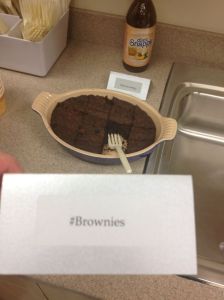
Aerohive was waiting for us with a smile and a handshake from the very start. The never-shy Devin Akin (@DevinAkin) welcomed us all to the Aerohive offices while we descended on the breakfast we were going to need to fuel the Tech Field Day “Firehose of Information”™. I must take a second here to highlight one of the best puns I’ve seen in a very long time:
#Brownies? Well played, Jeni. Well played.
Once settled with food, we were invited to take a shot of the Devinator’s favorite liquid substance, Diet Peach Tea Snapple, which I should probably start referring to as “Aerohive Kool-Aid” Our first presenter was Matthew Gast (@MatthewSGast), one of the chief archtects at Aerohive as well as a member of the 802.11 committees that drive wireless standards. His presentation was very technical, diving deep into concerns about 802.11n and issues that are already being seen with throughput on controllers today. This segued into the future of Wi-Fi, 802.11ac Gigabit Wireless, and the impact that Aerohive’s design philosophies have on the increased capabilities that wireless devices will have in the near term once 802.11ac sees wider adoption. Matthew really cranked up the Nerd Meter on this one, and I thank him for letting us get our hands dirty with all the talk about layer 1 discussion, which is probably one of the most neglected layers of the OSI model when it comes right down to it.
After Matthew finished melting my brain, we moved on to the newest Aerohive product, the BR100 branch router. Aerohive had given me a briefing on this device before, so much of it was a review. I like the form factor of the BR100, especially for remote offices or teleworkers that don’t need anything more fancy that simple connectivity. My personal use case would be something along the lines of having it available for trips to allow secure wireless connectivity in my hotel room without the need to rely on the hotel’s often-unstable wireless solution. We went through some more particulars of the device, mostly around the new options enabled by the additions to the Aerohive HiveManager interface that allow networking configuration on top of the wireless configuration options.
As the live demo was readied, we got hit with our Aerohive Oprah Moment – chocolate covered bacon! I must say that this was a first for me as a bacon fan. The hog parts were high quality, and the chocolate added a sweet compliment. I doubt it’s something I’m going to eat every day though. Thanks Aerohive for giving me the opportunity (and the extra cholesterol). We also got an Aerohive backpack filled with goodies. An Aerohive water bottle, notepad and pen set, and…a BR100! Yes, I now have a little Aerohive branch router to try out. I plan on putting this little guy through his paces. The unexpected Oprah moments really help me get a chance to evaluate the equipment.
The 15 minute, 15 branch deployment demo from an iPad was pretty impressive. The ability to have no restriction on the configuration device interface is a welcome change from the Java/Flash/client restrictions from other vendors, and it appears to be becoming a drive in the industry to provide that kind of flexibility. A word of caution, however, to those thinking of doing live demos at presentations or other events: Be sure to keep your audience engaged and riveted on the demo. It’s very easy to lose your audience with demos. Not that Aerohive did, but I noticed we were getting a little restless toward the end.
The restlessness seemed to trigger the Devinator’s Oprah Gland again, because he announced that we had reached the end of the presentation and that it was time to award the coveted Gregor Awards. We didn’t know it, but Gregor Vučajnk (@GregorVucajnk) had been monitoring the #WFD2 hashtag during the Aerohive presentation and handed out the awards for the best tweeters. Somehow, I managed to win! I guess the extra snark I packed in my carry-on helped my out on this one. I got an Aerohive AP 350 for causing so much trouble. This impressive piece of hardware is going to get a great workout both at home and the office, as I now have my own “hive” of APs to test and play around with.
If you’d like to learn more, you can check out their website at http://www.aerohive.com. You can also follow them on Twitter as @Aerohive.
Tom’s Take
Overall, Aerohive was a great start to Wireless Field Day 2. I enjoyed the interaction with Matthew Gast and the ability to pick his brain about the nerd knobs of wireless. While the information about the BR100 wasn’t necessarily new, I think this speaks volumes about Aerohive’s ability to keep bloggers and technical people in the loop about new developments and keep their products fresh in our minds. While the Oprah Moments are never a required part of Tech Field Day, it’s nice to see that companies like Aerohive believe so strongly in their products that they are willing to put a few out there in the hands of people that will pick them apart and tell you the good and bad without reservation. That’s a lot of confidence, folks. Something that I’ve never sensed that Aerohive is short on. Keep up the good work, Aerohive. And keep drinking that Diet Peach Tea Snapple Aerohive Kool-Aid.
Wireless Field Day 2 Disclaimer
Aerohive was a sponsor of Wireless Field Day 2. As such, they were responsible for covering a portion of my travel and lodging expenses while attending Wireless Field Day 2. In addition, they provided me with an Aerohive backpack, water bottle, pen and notepad set, an Aerohive BR100 evaluation unit, and an Aerohive AP 350 evaluation unit. They did not ask for, nor where they promised any kind of consideration in the writing of this review/analysis. The opinions and analysis provided within are my own and any errors or omissions are mine and mine alone.
Congratulations to Chris Martin, CCIE# 34310, according to IPExpert’s Successful Candidates page. Thanks to Windows Calculator and my non-binary math skills, that means we’ve had 5,000 new numbers since my pass back in June. That’s not counting the repeat passes that keep the same number. The new numbers have been skyrocketing in the last 3 months, shooting up over 2,000 since Blake Krone passed his lab at the end of October.
I’ve heard a lot of interesting theories in the past couple of weeks about why the numbers are shooting up so quickly. Some attribute it to the official Cisco 360 training program churning out candidates left and right. There are also those that believe there is something hinkey is going on with the numbering scheme. Is Cisco pre-allocating numbers to each lab seat every day and then discarding them if the lab isn’t passed? Are they counting by even numbers now? Is the numbering now logarithmic? Add in the recent troubles that Marc La Porte has had with Cisco and his unofficial CCIE Hall of Fame Webpage and the conspiracy theories started spreading like wildfire. Why is Cisco trying to take down the page? Are they trying to hide something?
After listening to all the theories and rumors and some of the more outlandish theories that I didn’t even bother to put down, I keep thinking back to a conversation that I had with Terry Slattery back at Cisco Live 2011. Being the fanboy that I am, I had a chance to ask Terry what he thought about the CCIE numbers climbing ever so higher. Some of the thoughts he shared with me were rather intriguing and got me to thinking about things in a light that I hadn’t really considered before. With the acceleration of the new numbers being spit out, I think now more than ever that Terry might have been on to something.
Let’s say for the sake of argument that there isn’t anything funny going on with the numbers. Let’s also assume that there isn’t rampant cheating going on, as some have suggested to me. That means that we have a large number of people taking and passing the lab. But we aren’t hearing about them. They don’t have blogs or spend time on Groupstudy or post success stories on LinkedIn. There isn’t any information about them out there. Almost as if they didn’t really have a big presence on the Internet. As if they weren’t really looking to market their skills to others and instead were either already at jobs that required the CCIE or had one lined up and ready to go. Where would such a thing be possible?
China.
Stop and think about it for a minute. According to Cisco, China is seeing explosive growth in networking, everything ranging from power systems to survellience. They’re ramping up and infrastructure that’s going to need to support over a billion people all looking to get connected somehow. China is leading the way in deploying IPv6 internally as a way to alleviate the exhaustion of IPv4 addresses. Ask yourself then: Where are they getting all these engineers? How many of your friends and colleagues are flying to China to work on these massive projects? I’m guessing hardly any. Why’s that? Where is the supply coming from to meet this massive demand?
I believe that there are sponsored learning facilities inside China that are essentially functioning like advanced technology vocational technology centers in an effort to train a workforce to go out and assume the roles needed to build and maintain advanced networking and computing infrastructures. That way, they don’t need to sort out all the details of arranging for a large number of visas to allow foreign engineers to come and work for months at a time. They also don’t have to worry about bad press from said foreign engineers coming back home and discussing things like the Internet filtering policies. Instead, they can focus on creating a highly-skilled group of workers to go out and tackle these huge projects. Because these facilities are likely sponsored or run by the government, profit is of less concern than results. And if you have a populace that is willing to clamor toward a job that doesn’t involve manual labor or other undesirable work, you would have a motivated pool of talent to pick from. Taking into account the mind-bending numbers of people available for these jobs, passing even 1,000 extra CCIEs into the global pool is a blip on the radar for China.
One other thing that I’ve mentioned before lends credence to the Chinese CCIE theory in my mind. Remember those dastardly Open Ended Questions that I hated so much? Guess which testing facility instituted the in-person interview process that led to the OEQs before the new troubleshooting section? That’s right, Beijing. I’m not accusing anyone of wrongdoing. But the fact that the OEQ program originated there means they must have had a very high pass rate they were suspect of in the first place. What if the pass rate is still legitimately high even with the new safeguards against impropriety? Since Cisco doesn’t release numbers on pass rate per lab, I guess we’ll never know.
Tom’s Take
At this rate, we’re looking at seeing CCIE 40,000 before the end of the year. That’s really going to hit home for people if it took almost 3 years to go from 20,000 to 30,000 and then only takes a year to climb up to 40,000. I don’t like to think about the idea that lab cheating is so rampant that Cisco has given up trying to protect the value of the CCIE. Quite the contrary, I’ve heard rumors that the difficulty of the lab is as strong as ever and people are working as hard as they can to get their digits. To me, that says there is a large contingent of people passing the lab and not talking about it, either by their own choice or the choice of someone above them. And since we in the U.S. aren’t seeing the workforce flooded with new CCIEs daily, that must mean those passing are someone other than the U.S. (or Europe). Add in the fact that there aren’t many network rock stars studying Mandarin or watching Ni How Kai-Lan and I am guessing that means that many of our new unknown CCIE brethren are from the Orient. No crazy conspiracies or funny math. Just a group of dedicated people doing their best to make it in the world.
Before I get into the Wireless Field Day 2 posts coming up next week, I wanted to take a second and clarify the commenting policy I have on my blog. That way there isn’t any confusion about comment approvals and such.
I have a pretty open policy when it comes to commenting. If you take the time to post a comment, I will usually approve it. I respect the opinions of those that read my blog and welcome any and all feedback. If a particular post inspires you enough for you to take the time to put keyboard to phosphors and create a response, it is my duty as a blogger to make sure that your voice is heard. It doesn’t matter if your opinion is different that mine or if you are correcting misinformation. I will publish all comments in my queue. There are two exceptions, however:
1. Spam – I detest spam comments with the fury of a thousand fiery suns. I don’t need magic pills, Free*** devices (where *** is a ton of crap restrictions and offer signups) or SEO tips, thank you very much. I have managed my blog so far without your help kind marketing people of the underbelly of the Internet. I think I’ll make it a few more posts without you as well. Comments that are definitely spam are approved to /dev/null and forgotten. I will usually err on the side of caution when it comes to non-obvious comments. I also go through the spam folder regularly and rescue non-spam comments. I do see every one of them at some point, so the bad stuff is really bad stuff in my mind, not just a sorting algorithm.
2. Hateful Comments – I don’t mind a good discussion, even a heated one. Hell, I’ve even made a couple of pointed comments myself. But, there has to be a point to the pointedness. If you disagree with a particular position and can elucidate that point, even with some harsh or off-color language, I’ll likely approve your point of view. If your comment is nothing more than “F*** off and die you stupid a**h***!!!!!111!!!”, I will delete it. That comment adds nothing to the discussion and only seeks to inflame people into being dragged down to a low level of name calling. When in doubt, remember that even during the height of the American Civil War, when states were shooting at each other, the members of Congress still referred to each other as “The Distinguished Gentlemen from […]” even as they were yelling obscenities. A little decorum goes a long way to ensuring your voice is heard, even if it is a bit antagonistic.
With that said, there are times when things slip through or are taken out of context. While I approve every comment without (much) reservation, I also feel it is my duty to leave comments up and not delete them out of spite. I will, however, agree to delete a comment should the commentor contact me with the request to remove a specific comment. I want to be sure that the opinions and positions expressed are accurate for all represented parties. In the event that a comment reply chain spirals out of control, I reserve the right to remove comments of both parties back to the point where the flaming started. I’ll leave the original comments unless otherwise asked to remove them.
I’m not a journalist. I’m not a celebrity blogger. I’m just some random nerdy guy with a keyboard and some thoughts that I want to share. Many of you readers out there want to share your thoughts on my thoughts as well. This post just ensures that we’re all on the same page when it comes to what gets approved and what doesn’t.