I will be attending the Packet Pushers OpenFlow Symposium at Network Field Day 2 next week in San Jose, CA. OpenFlow is a disruptive technology that looks to change the way the many of us think about network traffic and how flows are distributed. It’s still very early in the development phase, but thanks to Ethan Banks and Greg Ferro I’m going to get the change to listen to companies like Google and Yahoo talk about how they are using OpenFlow as well as hearing from network Vendors current supporting OpenFlow initiatives, like NEC, Juniper, and Big Switch Networks.
If you would like to brush up on some OpenFlow topics ahead of the symposium on Wednesday, October 26th, here are some great links to information about the ins and outs of OpenFlow:
Big Switch Network, OpenFlow, and Virtual Networking – Derick Winkworth has done a great job at the Packet Pushers blog site going into depth about OpenFlow. He’s an evangelist and has a lot of hope for what OpenFlow can do. All of his articles are great, but this one in particular shows how one vendor is using OpenFlow.
IOS Hints Open Flow Posts – I’m just going to go ahead and link to the entire list of Ivan Pepelnjak’s OpenFlow posts. He plays more of the realist and does a great job of digging deep into the current state of OpenFlow. He’s also quick to keep us grounding in the fact that OpenFlow is still very young and has lots of potential if it ever takes off. Worth a read after you’ve caught up on what OpenFlow is from the above sources.
If you have any questions about OpenFlow that you would like asked at the symposium, feel free to leave them in the comments and I’ll try to bring them up to the panel. I look forward to attending this great event and learning more about the future of networking.
Day two of Wireless Tech Field Day started off with HP giving us a presentation at their Executive Briefing Center in Cupertino, CA. As always, we arrived at the location and then immediately went to the Mighty Dirty Chai Machine to pay our respects. There were even a few new converts to the the Dirty Chai goodness, and after we had all been properly caffeinated, we jumped into the HP briefing.
The first presenter was Rich Horsley, the Wireless Products and Solutions Manager for HP Networking. He spoke a bit about HP and their move into the current generation of controller-based 802.11n wireless networks through the acquisition of Colubris Networks back in 2008. They talked at length about some of the new technology they released that I talked about a couple of weeks ago over here. Rather than have a large slide deck, they instead whiteboarded a good portion of their technology discussion, fielding a number of questions from the assembled delegates about the capabilities of their solutions. Chris Rubyal, a Wireless Solutions Architect, helped fill in some of the more technical details.
HP has moved to a model where some of the functions previously handled exclusively by the controller have been moved back into the APs themselves. While not as “big boned” as a solution from Aerohive, this does give the HP access points the ability to segment traffic, such as the case where you want local user traffic to hop off at the AP level to reach a local server, but you want the guest network traffic to flow back to the controller to be sent to a guest access VLAN. HP has managed to do this by really increasing the processor power in the new APs. They also have increased antenna coverage on both the send and receive side for much better reception. However, HP was able to keep the power budget under 15.4 watts to allow for the use of 802.3af standard power over Ethernet (PoE). I wonder if they might begin to enable features on the APs at a later date that might require the use of 802.3at PoE+ in order to fully utilize everything. Another curious fact was that if you want to enable layer 3 roaming on the HP controller, you need to purchase an additional license. Given the number of times I’ve been asked about the ability to roam across networks, I would think this would be an included feature across all models. I suppose the thinking is that the customer will mention their desire to have the feature up front, so the license can be included in the initial costs, or the customer will bring it up later and the license can be purchased for a small additional cost after the fact. Either way, this is an issue that probably needs some more visiting down the road as HP begins to get deeper into the wireless market.
After some more discussion about vertical markets and positioning, it was time for a demo from Andres Chavez, a Wireless Solutions Tester. Andres spends most of his time in the lab, setting up APs and pushing traffic across them. He did the same for us, using an HP E-MSM460 and iPerf. The setup worked rather well at first, pushing 300Mbits of data across the AP while playing a trailer for the Star Wars movie on Blu-Ray at full screen in the background. However, as he increased the stream to 450Mbits per second, Mr. Murphy reared his ugly head and the demo went less smooth at that point. There were a few chuckles in the audience about this, but you can’t fault HP for showing us in real time what kinds of things their APs are capable of, especially when the demo person wasn’t used to being in front of a live video stream. One thing that did make me pause was the fact that the 300Mbit video stream pushed the AP’s processor to 99% utilization. That worried me from the aspect that we were only pushing traffic across one SSID and had no real policies turned on at the AP level. I wonder what might happen if we enable QoS and some other software things when the AP is already taxed from a processor perspective, not to mention putting 4-clients on at the same time. When I questioned them about this, they said that there were actually two processor cores in the AP, but one was disabled right now and would be enabled in future updates. Why disable one processor core instead of letting it kick in and offload some of the traffic? I guess that’s something that we’ll have to see in the future.
After a break, the guys from HP sat down with the delegates and had a round table discussion about challenges in wireless networking today and future directions. It was nice to sit down for once and have a discussion with the vendors about these kinds of topics. Normally, we would have a round table like this if a session ended early, but having it scheduled into our regular briefing time really gave us a chance to explore some topics in greater depth than we might have been able to with only a 5-10 minute window. Andrew vonNagy brought up an interesting topic about needed better management of user end-node devices. The idea that we could restrict what a user could access based on their client device is intriguing. I’d love to be able to set a policy that restricted my iPhone and iPad users to specific applications such as the web or internal web apps. I could also ensure that my laptop clients had full access even with the same credentials.
Tom’s Take
HP is getting much better with their Field Day presentations. I felt this one was a lot better than the previous one, both from a content perspective and from the interaction level. Live demos are always welcome, even if they don’t work 100%. Add to that the ability to sit down and brainstorm about the future of wireless and you have a great morning. I think HP’s direction in the wireless space is going to be interesting to watch in the coming months. They seem to be attempting to push more and more of the functions of the APs back into the APs themselves. This will allow for more decisions to be made at the edge of the network and keep traffic from needing to traverse all the way to the core. I think that HP’s transition to the “fatter” AP at the edge will take some time, both from a technology deployment perspective and to ensure that they don’t alienate any of their current customers by reducing the effectiveness of their currently deployed equipment. I’m going to be paying attention in the near future to see how these things proceed.
HP was a sponsor of Wireless Tech Field Day, and as such they were responsible for a portion of my travel expenses and hotel accommodations. In addition, they provided lunch for the delegates, as well as a pen and notepad set and a travel cooler with integrated speakers. At no time did they ask for nor where they promised any kind of consideration in the writing of this review. The analysis and opinions presented here are given freely and represent my own thoughts.
Our third presentation at Wireless Tech Field Day was from Aerohive. We arrived at their office in the afternoon to round out day one. Once at the front door, we were greeted by Devin Akin. He warmly greeted everyone and shook our hands as we walked in. Once inside our meeting room, we were presented with a package containing an Aerohive polo shirt, notebook, chocolate bar, and a plastic shamrock necklace to wear in honor of St. Patrick’s Day. As soon as we all were seated and settled, Devin jumped right into a special presentation before we got started properly. In honor of Andrew von Nagy’s recent success on the CCIE Wireless lab exam, Devin and the Aerohive crew presented him with a sash in Aerohive gold bearing his CCIE number in glitter. Andrew was a great sport and accepted his special gift proudly.
After the very special presentation, we dove headlong into Aerohive. I’d like to mention a few words about Devin. His energy during our visit was off the charts. He seems to enjoy the world of wireless networking, and based on conversations I’ve had with the other delegates, his name carries quite a bit of weight in the wireless world. I read some of his blog posts before I left for Tech Field Day, and he strikes me as a person who isn’t afraid to put his opinion out there for the world to see. He also “gets” Tech Field Day. When we walked into the room, he had the Twitter stream for the #TechFieldDay hashtag projected on the wall of the room for everyone to see. That way, the presenters could glance over and get instant feedback about how things were going. They could also get immediate feedback from the audience not directly in front of them. These kinds of little touches go a long way toward making a successful presentation at Tech Field Day.
We got to hear from Bob O’Hara, who is a legend in the wireless area. He is the founder of Airespace, which was snatched up by Cisco and he is generally credited with creating the whole movement behind controller-based access points (APs). Bob talked for a few minutes about some of the history he helped create, as well as why he has worked with Aerohive to move away from the controller-based AP model and into something different.
After Bob, Mr. Energy Devin Akin jumped in and sped through the perfunctory intro/framing slides. He talked about the market position of Aerohive and what differentiates them from the competition in the market. While the other vendors in the market are using relatively “dumb” radios that send traffic back toward the controller for processing, Aerohive has taken a very different approach. Using merchant silicon, they have made their APs much smarter while keeping their price reasonable. This means that there is no need for a controller to direct the APs. Instead, the management software can be loaded on a small appliance, a virtual machine (VM) or even…the cloud. The APs themselves have a great feature set to allow things like mesh operation, fast layer 3 roaming across subnets, and even some layer 2 MAC routing. The management software for the APs allows for some additional interesting features, such as private pre-shared keys (PPSK) which give you the ability to issue a PSK per user that has an expiration date and allows a certain number of devices per AP. That way, your laptop, iPhone, and iPad can all join from a single key. There is also support for a teacher based view that allows instructors to lock out all or a portion of access to network and Internet resources. This is a great feature for the K-12 education environment, as it ensures the teacher determines exactly where the students can go, and due to the granularity of the controls, even allowing students a reward of some additional Internet surfing after their work is completed.
One of the more impressive features involved a full setup demo. All of the APs were set back to defaults and removed from the manager. Then, in front of the delegates, a new highly secure network was built in about 15 minutes. It was very straight forward, and once the details of the network were provisioned the configurations were pushed out the members of the “hive”, which is the Aerohive term for the collection of APs in the network.
After the demos were over, it was time for a delegate demo. Devin informed us that there was an AP somewhere in the building broadcasting an SSID of “Find Me” at 1 mW, which made it practically invisible. Under that AP was an “Oprah Moment” for the delegates. Devin suggested we use our newly-acquired MetaGeek Wi-Spy scanners to see if we could find the AP. This again was a great touch. Devin had been paying attention and knew what we were now capable of doing, so he decided to build on it and make us work for it. Having only brought lightweight devices like my ChromeOS CR-48 and my iPad, I couldn’t participate in this little Easter egg hunt, but after a few minutes the delegates located the prize – an Aerohive HiveAP110 and 3 years of access to the cloud-based Hive Manager software to provision it.
Tom’s Take
I was quite impressed with Aerohive. They have a great product and a wonderful staff developing it. While it appears that their primary vertical right now is in the education space, I have no doubt that their feature set has appeal to medical and other verticals as well. I think they with the industry focusing right now on the controller-based architecture, Aerohive can carve itself a very comfortable niche for the controller-less technology they have created. Other information that I’ve encountered leads me to believe that some vendors are beginning to look at locating more intelligence in the AP/edge once again, which means that when they finally move back toward that strategy they will no doubt find Aerohive staring back at them as a leader in that particular space. I’m going to spend some more time evaluating the HiveAP capabilities thanks to Devin and his team. I hope to have more to write about it in the near future.
If you would like to learn more about Aerohive, you can check out their website at http://www.aerohive.com. You can also follow them on Twitter as @Aerohive
Disclaimer
Aerohive was a sponsor of Wireless Tech Field Day, and as such they were responsible for paying a portion of my travel expenses and hotel accommodations. In addition, they provided the delegates a package including an Aerohive polo shirt, note book, candy bar (which was consumed during the writing of this review and was delicious), and St. Patrick’s Day themed button and necklace. The delegates were also provided with an Aerohive HiveAP 110 and 3 years access to the cloud-based Hive Manager software for evaluation. At the conclusion of the session, Aerohive provided all attendees a selection of beers with Irish themes, such as Guinness, Harp, and Smithwick’s. At no time did they ask for nor were they granted any kind of consideration in this review. The analysis and conclusions outlined here are mine and mine alone. They are offered freely and willingly.
The second company to present at Tech Field Day was Cisco. This is the company that I’ve had the most experience with in my wireless career, so getting to hear from them in this setting held some wonderful appeal. While I was fairly familiar with the product line, I hoped that Cisco would give me some insight into things.
Upon arrival at the Cisco campus on Tasman Drive, we started walking through the building to our meeting room. The wireless people were taking pictures of all the antennas in the area and geeking out about all the equipment around the building. After we reached our briefing room, we got seated and started listening to our first presenter, Jim Florwick, who was remote and presenting over Webex. As he went over the basic outline of Cisco wireless strategy and philosophy, it started to dawn on me that I’d seen much of this material before. I followed along as we talked about the congestion in the 2.4 GHz spectrum and the need to start moving clients into the 5GHz range for additional throughput gains. We got a quick overview of Cisco’s CleanAir technology, which is the technology acquired from the Cognio purchase embedded into the 3502 access point (AP) line. This overview felt a little more like marketing, which is not necessarily the thing to bring to a Field Day.
Around about the time the first presenter started wrapping up, there were murmurs amongst the wireless delegates. I asked Jennifer Huber what all the fuss was about, and she told me, “Do you know where we are? This is THE Building 14!” The importance of our location was quickly apparent when someone pulled up a screenshot of the Wireless Control Server from Cisco’s website and just as plain as day, there was the third floor of the building we were currently occupying. Since building 14 is where the bulk of the wireless development and testing occurs, it makes total sense the the majority of the example screenshots on Cisco’s website would be of that building. For the wireless nerds, I suppose it was really like returning home.
The next presentation was from David Stiff, who is the Senior Product Manager for the Wireless Networking Business Unit for Cisco. He went over a lot of the same material that we had just discussed, only more in depth. He talked about technologies such as Client Link and CleanAir. The only problem with this type of presentation is that it loses the delegates attention. Compared to the MetaGeek or Aerohive presentations, this one felt more like a lecture. I don’t doubt the that the information was great and wonderful to know, but since it was a lot of the same as what I’ve seen before, it didn’t hold as much appeal as the MetaGeek demo or the Aerohive show-and-tell. In some ways, it felt more like a presentation that would be given to people less familiar with the ins and outs of wireless networking. As Jennifer remarked to me later, “Not only have I heard that presentation before several times, I’ve given it several times as well.”
After lunch, we got to hear about the in-building cellular technology that Cisco is partnering to bring to the market. This presentation felt a little out of place for this crowd. A couple of the delegates mentioned that they had looked at it before, but the need for it was spotty at best and the market was pretty thin. To me, this is the explanation for why Cisco is partnering to bring it to the market rather than developing it in house or buying the developer outright. The idea behind in-building cellular is using the existing category 5/6 cabling in the building to help amplify cellular signals in areas where there is severe signal degradation. I’m betting that this technology is designed to be marketed to healthcare, where the wireless spectrum is congested and cell phones barely work as it is. Another possible option is a rural areas where cell coverage is spotty at best, like the second floor of my house only on a larger scale. All in all, I think in-building cellular is a little too much of a niche product to be useful to me in the near future.
Next up was David Stephenson talking about next generation hotspots. David was one of the people responsible for the 802.11u amendment, and it was apparent that he knew his stuff. 802.11u deals with scenarios where the user isn’t necessarily authorized for access to a given wireless network. Think about being at the airport and seeing that there are tons of wireless networks to join, but you don’t know any of the keys to join them. This is where the free hotspot idea comes in. But since free hotspots are not necessarily available everywhere, a different idea must be considered. 802.11u addresses this by creating what looks to me like a hotspot federation or roaming agreement. Similar to the agreements that allow cellular coverage across different provider towers, 802.11u would allow users to log in using credentials for the networks they are authorized for, and in return gain the ability to access certain services on a given network. For instance, a user authorized to use AT&T hotspots may be able to use some internet services on a Boingo network. For those that wish to restrict things much more, you can limit access to very basic things like emergency services. One of the use cases that David talked about was using this next generation hotspot to allow users to log into wireless networks in a retail environment and receive coupons on their smartphones based on their login credentials. Exciting stuff to hear about, and lots to look forward in the future.
The last presenter was Jameson Blandford, a Cisco TME who is somewhat famous for a competitive analysis video on Youtube:
Jameson’s portion of the presentation was NDA’d due to a lot of restricted competitive analysis. Based on what he said and things that I observed later during Tech Field Day, I’ve got a lot of thinking and analysis to do about the current state of the arms race amongst the various wireless vendors.
Tom’s Take
As a Cisco partner engineer, I get to hear from Cisco quite a bit. Their presentation methodology is polished and crisp. However, in the case of Tech Field Day I think they were just a bit off the mark. As I’ve said before , Tech Field Day delegates aren’t your usual group of decision makers and slightly technical people. We’re nerds and geeks. We like seeing how things work and hearing about the gory details. Cisco has always presented good opportunities in the past to get into the nuts and bolts of how things work. Maybe a demo of CleanAir healing a network, similar to the video above. Or perhaps an opportunity for us to see even a canned demo of a next generation hotspot. Something to keep our attention rather than the endless parade of Powerpoint slides. I never want presenters at Tech Field Day to have a bad outing, so I’m hoping that my words here will help encourage Cisco to step up next time and hit one out of the park. Most of the info was great, but knowing how to reach your captive Tech Field Day audience is just as key.
If you’d like to learn more about Cisco and their wireless technology, head on over to http://www.cisco.com/go/wireless. In addition, you can follow their wireless information on Twitter at @cisco_mobility
Disclaimer
Cisco was a sponsor of Tech Field Day, and as such was responsible for a portion of my travel expenses and hotel accommodations. In addition, they provided lunch for the delegates on Thursday afternoon. They were not promised, nor were they offered any consideration in the writing of this review. All of the opinions and analysis offered here are mine and mine alone and are given freely and without reservation.
The first Tech Field Day presenter that we heard from was MetaGeek. I’ve been a fan of their free InSSIDer product for a while now. At the time, my needs were fairly simple when it came to wireless spectrum scanning. I simply looked for the SSID network names and used a little interpolation to help me find access points. However, the 2.4 GHz spectrum where most client devices now operate has become congested with devices and sources of non-WiFi interference, so little tricks aren’t going to cut it any longer. You need a serious tool to help you make sense of things. MetaGeek offers a solution to help you find out a little more about the space around you.
The presentation started out with a quick recap about the founding of the company. Once nice thing that I saw was that the head geek and founder, Ryan Woodings, saw a need and capitalized on it. His original device was designed to scan wireless mice for interference. He expanded it to include more and more sources of wireless transmission. Much like any geek or nerd I know, he started peeling back the layers and diving deeper into the problem. A couple of fun pictures about the first MetaGeek offices and their exposure on Engadget leading to their success today had me feeling a little nostalgic. It’s always nice to see a company come from humble beginnings and enjoy great success.
Once the short and fun history lesson was out of the way, it was time for the real payoff – a demonstration of the flagship Wi-Spy DBx analyzer tool and the associated Chanalyzer Pro analysis software. The Tech Field Day delegates also recieved a Wi-Spy and copy of Chanalyzer Pro so that we could follow along with the geeks as they laid out their program and it’s capabilities.
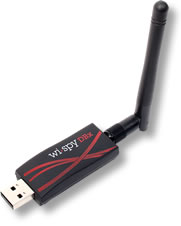
WiSpy DBx (Image courtesy of MetaGeek)
The Wi-Spy DBx is a very unassuming piece of hardware, a USB adapter with an RP-SMA connector on the end. The small form factor allows it to be plugged in just about anywhere quickly and easily. The DBx model allows you to scan both the 2.4 GHz spectrum where 802.11b and 802.11g networks operate and the 5 GHz spectrum where 802.11a networks are prevalent. Note that the Wi-Spy can’t scan both network simultaneously, so if you want to do captures on both at the same time you’ll need two DBx units, or one DBx and one 2.4GHz-only unit like the Wi-Spy 2.4x. There is also a patch antenna option that allows you to be a little more specific about the direction of the signal detection.
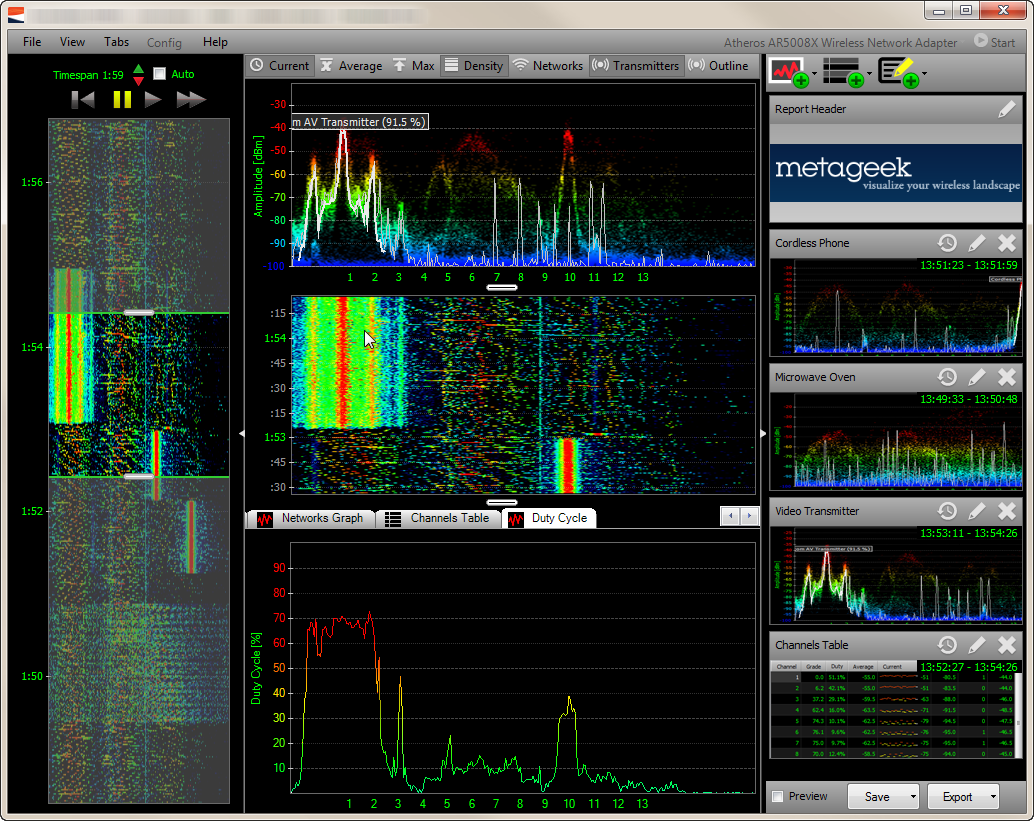
Chanalyzer Pro (Image courtesy of MetaGeek)
The Chanalyzer Pro application is where you are going to spend most of your time. It gives you a great visual representation of the information the Wi-Spy will be passing along to you. The application packs a lot of information into a small space. The line graph at the top center shows you the utilization for the spectrum currently being scanned. There are options to turn on/off the average and peak utilization, as well as the intensity of signals in color. This is where you will notice the utilization of a given frequency or channel. The middle pane show the ‘waterfall’ view, which is the representation of the top pane over time. This gives you the opportunity to see any sources of interference as they appear and persist. The bottom pane gives you more specific detail to drill into, such as SSID overlay or duty cycle information. This is painted in both a specific graph on the bottom and in the case of the SSID, overlaid on the top graph to allow you to see that there are too many access points (APs) on the same channel in your vicinity. The large graph on the left side of the window extends the waterfall view over time, but also allows you to move the graph to any point during the time of the packet capture. This is a great feature for sources of interference that are transient. You can rewind and fast forward much like a DVR. This is great if you were preoccupied when the interference happened or you need to review it again to profile the specifics for later classification.
During our great demo, Ryan and Trent Cutler were showing us some of the more interesting interference sources they have seen and classified. Much like any good investigator, they can recognize things like the difference between 802.11b and 802.11g APs on sight, as well as being able to tell you the difference between a microwave and a cordless phone. For those of us not as gifted in the art of interference profiling, the Chanalyzer application includes preset waveforms that allow you to overlay them on the graph to tell you the difference between your cordless phone and a wireless video camera. Very handy for nerds like me that need a little more time in the saddle before we can spot the trouble from the line graph itself. You can also take captures of interference sources and send them to Trent and he’ll help identify them if it’s something that hasn’t been seen before. He keeps a collection of the odd and interesting captures he’s gotten, like a fun version of a stamp collection. I think my favorite was the ceiling fan mounted audio system.
Tom’s Take
The MetaGeeks really knocked it out of the park for the first batter up at the plate. They looked a little nervous at first, but once into their element, they really shined at showing the delegates what their tool was capable of doing. I was very impressed by the power of their software along with the ease of use. So much so that after I returned from Tech Field Day, I spent a whole evening running around my house with my Wi-Spy turning on microwaves and cordless phones and being amazed at what I saw. The other spectrum analyzers I’ve seen run in the thousands of dollars, which makes the Wi-Spy an incredible value for those wanting to jump into the spectrum analysis arena without needed to sacrifice a kidney in the process. I plan on giving the Wi-Spy a real run for it’s money in the near future to see how well I can integrate it into what I do every day. I even plan on getting some interesting spectrum captures to see if I can stump Ryan and Trent.
If you’d like to learn more about MetaGeek and their product lines, you can check them out at http://www.metageek.net. You can also follow them on twitter as @metageek.
Disclaimer
MetaGeek was a sponsor of Tech Field Day, and as such they were responsible for paying a portion of my travel costs and hotel expenses. In addition, they provided a package to the delegates containing a Wi-Spy DBx with Chanalyzer Pro as well as Chanalyzer Lab and a Device Finder patch antenna option. There was also a WiFi Interference Detection Kit (a bag of microwave popcorn) included in the black lunchbox that housed the rest of the equipment. This package was provided to the delegates for evaluation purposes and was in no way intended to curry favor. They did not ask for, nor were they promised any consideration in any review. Any and all opinions and conclusions in this review were provided freely and clearly and reflect my own thoughts on the product.
Group pictures always take longer when you use cameras with film
The mythical HP Dirty Chai machine brings pilgrims from far and wide
iPerf is a great way to cause AP meltdown
Roundtables are great, even if they take place at square tables
AirMagnet needs a laptop with a minimum of 8 USB ports to really rock it
Do not underestimate the power of Diet Snapple Peach Iced Tea
Hands-on demos rock the party
Fountain pens hold the key to my future lottery success
The Underhill account is alive and well at Antonella’s
Picking up the Tech Field Day tab is an expensive proposition at best
And so ends another fine day of tech-y fieldness in partly cloudy California. Good times were had by all. New friends were made. Old friends were rekindled. Alcohol was consumed on occasion. Last but not least, knowledge was disseminated and consumed by all the delegates to be digested slowly over the course of the next few days, like a fine meal of gnocchi and cannolis.
I have a lot to write about and a lot to catch up on. Thanks to the graciousness of the crew from Wireless Tech Field Day, I have the opportunity to learn more about something that interests me and can be useful to many. I will spend the next few weeks talking about all the things I’ve learned in the past 48 hours and hopefully giving you some insights and discussion topics.
Tom’s Take
Tech Field Day isn’t about technology, or vendors, or fine Italian dining. It’s about people. Meeting great people and talking about topics ranging from wireless spectrum analyzation to animated GIF manufacturing is what really makes this event so special. If you are at all interested in being involved, get over to the Gestalt IT website and let us know. It’s the first step into a much more connected community and the kind of comradery that makes our little industry so much fun to be involved in.
Tech Field Day Wireless Day 1 is in the books. Lots of good info, amped presenters, and engaging demos all around. I once again learned that I have a lot to learn, even about something I thought I was comfortable with. The amount of knowledge that I am osmosing from the excellent delegates is going to give me a lot to think about and chew on for a while to come. It’s a very different feel here versus TFD #5, what with all the wireless knowledge concentrated into one room. Vertical Field Days are a hoot.
If you would like to follow along with the rest of the gang, there are several ways to get engaged. You can head over to http://www.techfieldday.com and watch the live video stream to see if I’ve lost any more hair this time around. You can also follow the official Tech Field Day twitter account @TechFieldDay for updates about what’s going on. If you search for the hastag #TechFieldDay on Twitter, you can see the delegates discussing the presentations in real time as well as seeing the feedback from the presenting companies. If you have any questions or comments about what you see, don’t hesitate to use the #TechFieldDay hastag to get our attention. Don’t forget the Tech Field Day is as much about you as it is anything else. The more knowledge that you can contribute to the gestalt, the better it gets.
I guess I made an impression on someone in San Jose. Either that, or I’ve got some unpaid parking tickets I need to take care of. At any rate, I have been invited to come to San Jose March 16th-18th for the first ever Wireless Field Day! This event grew out of Tech Field Day thanks to the influence of Jennifer Huber and Stephen Foskett. Jennifer and Stephen realized that having a Field Day focused on wireless technologies would be great to gather the leading wireless bloggers in the industry together in one place and see what happens. That very distinguished list includes:
List HERE. This list is also a handy one in case you need people to follow on Twitter that are wireless gurus. I’m hoping that I can pick their brains during our three days together to help refine my wireless skills, as I am becoming more and more involved in wireless designs and deployments.
After our last Tech Field Day, a couple of people wondered why we bothered flying everyone out to California to listen to these presentations when this was something that could easily be done over streaming video and chat room questions or perhaps Webex. I agree that many of the presentations were something that could have been done over a presence medium. However, many of the best reasons to have a Tech Field Day never made it on camera. By gathering all of these minds together in one place to discuss technologies, you drive critical thinking and innovation. For instance, I had taken for granted that most people in the IT industry knew we needed to move to IPv6. However, Curtis Preston opened my eyes to the server admin side of things during a non-televised lunch discussion at TFD 5. Some of our roundtable discussions were equally enlightening. The point is that Tech Field Day is more than just the presentations. Ask yourself this: Given a chance to have a Webex with the President of the US or flying to Washington D.C. and meeting him in person, which would you rather do? You can have the same discussion with him over the Internet, but there’s just something about meeting him in person that can’t be replicated over a broadband link.
How Do I Get Involved With Tech Field Day?
I’m going to spill some secret sauce here. The secret to getting into a Tech Field Day doesn’t involve secret payoffs or a good-old-boy network. What’s involved is much easier than all that.
1. Read the TFD FAQ and the Becoming a Field Day Delegate pages first and foremost. Indicate your desire to become a delegate. You can’t go if you don’t tell someone you want to be there. Filling out the delegate form submits a lot of pertinent information to Gestalt IT that helps in the selection process.
2. Realize that the selection process is voted upon by past delegates and has selection criteria. In order to be the best possible delegate for a Tech Field Day, you have to be an open-minded blogger willing to listen to the presentations and think about them critically. There’s no sense in bringing in delegates that will refuse to listen to a presentation from Arista because all they’ve ever used is Force10 and they won’t accept Arista having good technology. If you want to learn more about all the products and vendors out in the IT ecosystem, TFD is the place for you.
3. Write about what you’ve learned. One of the hardest things for me after Tech Field Day 5 was consolidating what I had learned into a series of blog posts. TFD is a fire hose of information, and there is little time to process it as it happens. Copious notes are a must. As is having the video feeds to look at later to remember what your notes meant. But it is important to get those notes down and put them up for everyone else to see. Because while your audience may have been watching the same video stream you were watching live, they may not have the same opinion of things. The hardest part of TFD 5 for me wasn’t writing about Druva and Drobo. It was writing about Infoblox and HP. These reviews had some parts where I was critical of presentation methods or information. These were my feelings on the subjects and I wanted to make sure that I shared them with everyone. Tech Field Day isn’t just about fun and good times. Occasionally, the delegates must look at things with a critical eye and make sure they let everyone know where they stand.
Be sure to follow @TechFieldDay on Twitter for more information about Wireless Field Day as the date approaches in mid-March. You can also follow the #TechFieldDay hash tag for updates live as the delegates tweet about them. For those of you that might not want to see all the TFD-related posts, you can also use the #TechFieldDay tag to filter posts in most major Twitter clients. I’m also going to talk to the delegates and see if having an IRC chatroom is a good idea again. We had a lot of good sidebar discussion going on during the presentations, but I only want to keep this aspect of things if it provides value for both the delegates and those following along online. If you have an opinion about methods that the Internet audience can get involved, don’t hesitate to let me know.
Tech Field Day Disclaimer
Tech Field Day is made possible by the sponsors. Each of the sponsors of the event is responsible for a portion of the travel and lodging costs. In addition, some sponsors are responsible for providing funding for the gatherings that occur after the events are finished for the day. However, the sponsors understand that their financing of Tech Field Day in no way guarantees them any consideration during the analysis and writing of reviews. That independence allows the delegates to give honest and direct opinions of the technology and the companies that present it.
The final presenters for Tech Field Day 5 were from HP. HP presented on two different architectures that at first seemed to be somewhat unrelated. The first was their HP StoreOnce data deduplication appliances. The second was an overview of the technologies that comprise the HP Networking converged networking solutions. These two technologies are very intrinsic to the future of the datacenter solutions offered by HP.
After a short marketing overview about HP and their direction in the market, as well as reinforcement of their commitment to open standards (more on this later), we got our first tech presentation from Jeff DiCorpo. He talked to us about the HP StoreOnce deduplication appliances. These units are designed to sit inline with your storage and servers and deduplicate the data as it flies past. The idea of inline dedupe is quite appealing to those customer that have many remote branch offices and would prefer to reduce the amount of data being sent across the wire to a central backup location. By deduping the data in the branch before sending it along, the backup windows can be shorter and the costs associated with starving other applications with high data usage can be avoided. I haven’t really been delving into the backup solutions focused on the datacenter, but as I heard about what HP is doing with their line of appliances, it started to make a little more sense to me. The trend to me appears to be one where the data is being centralized again in one location, much like the old days of mainframe computing. For those locations that don’t have the ability or the need to centralize data in a large SAN environment, the HP StoreOnce appliances can shorten backup times for that critical remote site data. The appliances can even be used internal to your datacenter to dedupe the data before it is presented to the backup servers. The limits of the things that can be done with deduplication seem to be endless. My networking background tends to have me thinking about data in relatively small streams. But as I start encountering more and more backup data that needs priority treatment, the more I think that some kind of deduplication software or hardware is needed to reduce those large data streams. There was a lot of talk at Tech Field Data about dedupe, and the HP solution appears to be an interesting one for the datacenter.
Afterwards, Jay Mellman of HP Networking talked to us about the value proposition of HP Converged Networking. While not a pure marketing overview, there were the typical case studies and even a “G” word printed in the bottom corner of one slide. Once Jay was finished, I did ask a few questions about the position of HP Networking in regards to their number one competitor, Cisco. Jay admitted that HP is doing its best to force Cisco to change the way they do business. The Cisco quarterly results had been released while I was at TFD, and the fact that there was less revenue was not lost on HP. I asked Jay about the historical position of HP Network (formerly Procurve) and his stance that the idea of an edge-centric design was a better model than Cisco’s core-focused guidelines. Having worked with both sets of hardware and seen reference documentation for each vendor, I can say that there is most definitely disagreement. Cisco tends to focus its designs around strong cores of Catalyst 6500 or Nexus 7000 switches. The access layer tends to be simple port aggregation where few decisions are made. This is due to the historical advantage Cisco has enjoyed with its core products. HP has always maintained that keeping the intelligence of the network out in the edge, what Cisco would term the “access layer”, is what allows them to be very agile and keep the processing of network traffic closer to the intended target. I think part of this edge-centric focus has been because the historic core switching offerings from HP have been somewhat spartan compared to the Cisco offering. I think this situation was remedied with the acquisition of 3Com/H3C and their A-series chassis switches. This gives HP a great platform to launch back into the core. As such, I’ve seen a lot more designs from HP that are beginning to talk about core networking. Who’s right in all this? I can’t say. This is one of those OSPF – IS-IS kind of arguments. Each has their appeal and their deficiencies.
After Jay, we heard from Jeff about the tech specs of the A-series switches. He talked about the support HP has for the open standards in the datacenter. Casually mentioned was the support for standards such as TRILL and QCN, but not for Cisco FabricPath. As expected, Jeff made sure to point out that FabricPath was Cisco proprietary and wasn’t supported by the A-series. He did speak about Intelligent Resilient Framework (IRF), which is a technology used by HP to unify the control plane of a set of switches to make it appear as one unified fabric. To me, this sounds a lot like the VSS solution that Cisco uses on their core switches. HP is positioning this as an option to flatten the network by creating lots of trunked (Etherchanneled) connections between the devices in the datacenter. I specifically asked if they were using this as a placeholder until TRILL is ratified as a standard. The answer was ‘yes’. As IRF is a technology acquired from the H3C purchase, it only runs on the A-series switches. In addition, there are enhancements above and beyond those offered by TRILL that will ensure IRF will still be used even after TRILL is finalized and put into production. So, with all that in mind, allow me to take my turn at Johnny Carson’s magnificent Karnac routine:
The answer is: Cisco FabricPath OR HP IRF
The question? What is a proprietary technology used by a vendor in lieu of an open standard that allows a customer to flatten their datacenter today while still retaining several key features that will allow it to be useful even after ratification of the standard?
The presentation continued to talk about the trends and technolgy in the datacenter for enabling multi-hop Fiber Channel over Ethernet (FCoE) and the ability of the HP Flexfabric modules to support many different types of connectivity in the C7000 blade chassis. I think that this is where the Cisco/HP battle is going to be won or lost. By racing towards a fast and cost-effective multi-hop FCoE solution, HP and Cisco are hoping to have a large install base ready for the standards to become totally finalized. When that day comes, they will be able to work alongside the standard and enjoy the fruits of a hard-fought war. Time will tell whether or not this approach will work or who will come out on top, if anyone.
I think HP has some interesting arguments for their datacenter products. They’ve also been making servers for a long time and they have a very compelling solution set for customers that incorporates storage, which is something Cisco currently lacks without a partner like EMC. What I would like to see HP focus more on in their solution presentation is telling me what they can do and what the are about. Conversely, they should spend a little less time comparing themselves to Cisco and taking each opportunity to mention how Cisco doesn’t support standards and has no previous experience in the server market. To be honest, I don’t hear that from Cisco or IBM when I talk to them about servers or storage or networking. I hear what they have to offer. HP, if you can give me all the information I need to make my decision and your product is the one that fits my needs the best, you shouldn’t have to worry about what my opinion of your competitors is.
Tech Field Day Disclosure
HP was a sponsor of Tech Field Day 5, and as such was responsible for a portion of my airfare and hotel accommodations. In addition, HP provided their Executive Briefing Center in Cupertino, CA for the Friday presentations. They also served a great hot breakfast and allowed us unlimited use of their self-serve Starbucks coffee, espresso and chai machine. We returned the favor by running it out of steamed milk for use in the yummy Dirty Chai. HP also provided the delegates with a notepad and pen. At no time did HP ask for nor were they promised any kind of consideration in this article. Any and all analysis and opinions are mine and mine alone.
Infoblox was our second presenter on Day 2 of Tech Field Day 5. They came into the HP Executive Briefing Center and instead of firing up the overhead projector, they started pulling the whiteboard over to the center of the room. Once they got started, the founder and CTO, Stu Bailey, informed us that they would have zero slides. No slides? Yay! Here’s someone that was paying attention to Force 10 from Net Field Day. No slides, just a whiteboard and some really brilliant guys.
As I am sitting here typing this article, I’m listening to the audio of the presentation in the background. I think Stu is probably a very brilliant guy, and starting a company is one of the most challenging things a person can do. With that being said, I think Stu suffers from a problem I have from time to time: Resolution. I often tell stories to people and I misjudge the resolution of the information I’m imparting. My stories are utterly fascinating and I love giving out the little details and settings. However, my audience is less impressed with my story. They get distracted and lost waiting for me to wrap things up. I get caught up in the minutia and forget to tell the story. I freely admit that I have this problem, and I do my best to avoid it when I’m giving presentations. As I listen to the audio of the session, I’m reminded of this. I love history lessons more than anyone else in the world. In fact, I have the History Channel on my favorites list. However, in this kind of technical session with no slides to keep my focus, the firehose of the history of Infoblox is kind of overwhelming. Whiteboarding works really well when you are putting topics out there that your audience is going to ask questions about so you can demonstrate and expand topics on the fly. During a history lesson, many of the things that you are discussing are pretty much agreed upon by people, so you don’t have any real explanation to display. I think some of the people started tuning out since the what of Infoblox was getting lost in the why of Infoblox. Stu, if you want to help yourself for the next presentation, you need to hook your audience. Give us the problem up front in a couple of minutes. Let me try based on what I heard and saw:
In today’s world, network infrastructure is siloed and hard to manage. The number of people required to be involved in new system deployments and change management makes it difficult to coordinate these activities. In addition, the possibility exists that a misconfiguration or forgotten step could create downtime beyond expectations. What Infoblox is trying to bring to the table is the ability to automate these processes so that the deployment and management of the network and its associated services can be streamlined. Changes can be delegated to less skilled personnel so that the network is no longer entirely dependent on one person’s knowledge of a particular service or configuration. Infoblox allows you to concentrate on making your network run optimally through standard repeatable processes. Infoblox also allows you to see your network and service configurations at a glance.
Folks, that is Infoblox in a nutshell, at least as I see it. Infoblox draws all of your DHCP and DNS servers together into an automated database that allows you to make changes across your network and it’s services instantly without the need to make the changes individually. This would have been a great lead-in to the second part of the presentation, where we got to see how Infoblox works. Based on discussions I had with my networking and systems brethren, it appears that Infoblox is attacking the aspect of a network that doesn’t have standardized procedures for implementation and change management. In a mid-to-large size company, bringing a new DNS server online or implementing a branch office server are step-by-step processes that follow a detailed checklist. Once all the checks are made, the change or implementation is complete. Infoblox automates the checklist so that a few clicks can make those changes without the chance of missing a step. Whether or not your environment needs that kind of oversight is a question you have to answer for yourself. I can see applications where some or all of the features of Infoblox would be a godsend. To be honest, I’d really like to see it in action before I pass total judgement on the software itself. I just wish this message would have been put out there for us to digest as we investigated the whys of Infoblox. A history lesson explaining the need for each piece of Infoblox should have been tied back to an overview similar to the one above, where each piece was introduced. As the history of the individual pieces is revealed, they can be tied back to the relevant section of the overview. Think about it like a Chekov’s Gun for Presentations: The DNS IPAM seen in section two, minute one should first be seen no later that section one, minute two.
After the Infoblox presentation, the next product on the block was NetMRI. Now, I’ve heard of this product before. However, the last time I heard about it, the association was with Netcordia and Terry Slattery, CCIE #1026. As soon as I heard that Infoblox had purchased Netcordia and the NetMRI software, the sudden move of Terry to Chesapeake Netcraftsmen made a little more sense to me. NetMRI is a great tool and appears to be the heart of the Infoblox offerings upon which things like IPAM for DNS/DHCP and the Infoblox Grid use to make the network changes. Those familiar with NetMRI know that it allows you to collect statistics on your devices and monitor changes to the configurations of those devices. By leveraging the NetMRI tools into the Grid product, Infoblox allows you to monitor and make changes to a wide variety of devices as needed. This helps add more to their existing IPAM offerings.
If they really want to kill the market with this, they really need to drive home the need of IPAM and network configuration management to their customers. Most people are going to look at this and say, “Why do I need it? I can do everything with Windows tools or Excel spreadsheets.” That is the historical kind of thinking that has allowed networks to spiral out of control to the point where the need complex management tools to keep them running at peak efficiency. I’m sure Terry saw this when he created NetMRI and made it his mission to get this kind of thing put into the network devices. By adding this product to their portfolio, Infoblox needs to drive home the need for ALL devices to be managed and documented. If they can do that, I think they’re going to find their message much more succinct and the value and lot easier to present. I think you guys have a great product that is needed. You just have to let me know why I need it, not just why you made it.
If you’d like to learn more about the offerings from Infoblox, head over to their website at http://www.infoblox.com. You can also follow them on Twitter as @infoblox.
Tech Field Day Disclaimer
Infoblox was a sponsor of Tech Field Day 5, and as such they were reponsible for a portion of my airfare and hotel accommodations. They did not ask for nor were they promised any kind of consideration in the writing of this article. Any and all of the opinions and analysis expressed herein are mine and mine alone.












 The Networking Nerd