Unknown's avatar

About networkingnerd

Tom Hollingsworth, CCIE #29213, is a former network engineer and current organizer for Tech Field Day. Tom has been in the IT industry since 2002, and has been a nerd since he first drew breath.

CPE Credits for CCIE Recertification

conted

Every year at Cisco Live the CCIE attendees who are also NetVets get a special reception with John Chambers where they can ask one question of him (time permitting).  I’ve had hit-or-miss success with this in the past so I wanted to think hard about a question that affected CCIEs the world over and could advance the program.  When I finally did ask my question, no only was it met with little acclaim but some folks actually argued against my proposal.  At that moment, I figured it was time to write a blog post about it.

I think the CCIE needs to adopt a Continuing Professional Education (CPE) route for recertification.

I can hear many of you out there now jeering me and saying that it’s a dumb idea.  Hear me out first before you totally dismiss the idea.

Many respected organizations that issue credentials have a program that records CPEs in lieu of retaking certification exams.  ISACA, (ISC)^2, and even the American Bar Assoication use continuing education programs as a way of recertifying their members.  If so many programs use them, what is the advantage?

CPEs ensure that certification holders are staying current with trends in technology.  It forces certified individuals to keep up with new advances and be on top of the game.  It rewards those that spend time researching and learning.  It provides a method of ensuring that a large percentage of the members are able to understand where technology is headed in the future.

There seems to be some hesitation on the part of CCIEs in this regard.  Many in the NetVet reception told me outright I was crazy for thinking such a thing.  They say that the only real measure of recertification is taking the written test.  CCIEs have a blueprint that they need to know and they is how we know what a CCIE is.  CCIEs need to know spanning tree and OSPF and QoS.

Let’s take that as a given.  CCIEs need to know certain things.  Does that mean I’m not a real CCIE because I don’t know ATM, ISDN, or X.25?  These were things that have appeared on previous written exams and labs in the past.  Why do we not learn them now?  What happened to those technologies to move them out of the limelight and relegate them to the same pile that we find token ring and ARCnet?  Technology advances every day.  Things that we used to run years ago are now as foreign to us as steam power and pyramid construction.

If the only true test of a CCIE is to recertify on things they already know, why not make them take the lab exam every two years to recertify?  Why draw the line at simple multiple choice guessing?  Make them show the world that they know what they’re doing.  We could drop the price of the lab for recertification.  We could offer recert labs in other locations via the remote CCIE lab technology to ensure that people don’t need to travel across the globe to retake a test.  Let’s put some teeth in the CCIE by making it a “real” practical exam.

Of course, the lab recert example is silly and a bit much.  Why do we say that multiple choice exams should count?  Probably because they are easy to administer and grade.  We are so focused on ensuring that CCIEs retrain on the same subjects over and over again that we are blind to the opportunity to make CCIEs the point of the spear when it comes to driving new technology adoption.

CCIE lab revamps don’t come along every six months.  They take years of examination and testing to ensure that the whole process integrates properly.  In the fourth version of the CCIE lab blueprint, MPLS appeared for the first time as a lab topic.  It took years of adoption in the wider enterprise community to show that MPLS was important to all networkers and not just service provider engineers.  The irony is that MPLS appears in the blueprint right alongside Frame Relay, a technology which MPLS is rapidly displacing.  We are still testing on a twenty-year-old technology because it represents so much of a networker’s life as it is ripped out and replaced with better protocols.

Where’s the CCIE SDN? Why are emerging technologies so underrepresented in the CCIE?  One could argue that new tech needs time to become adopted and tested before it can be a valid topic.  But who does that testing and adoption?  CCIEs?  CCNPs? Unwitting CCNAs who have this thrust upon them because the CIO saw a killer SDN presentation and decided that he needed it right now!  The truth is somewhere in the middle, I think.

Rather than making CCIEs stop what they are working over every 18 months to read up and remember how 802.1d spanning tree functions or how to configure an NBMA OSPF-over-frame-relay link, why not reward them for investigating and proofing new technology like TRILL or OpenFlow?  Let the research time count for something.  The fastest way to stagnate a certification program is to force it in upon itself and only test on the same things year after year.  I said as much in a previous CCIE post which in many ways was the genesis of my question (and this post).  If CCIEs know the only advantage of studying new technology is gaining a leg up with the CxO comes down to ask how network function virtualization is going to benefit the company then that’s not much of an advantage.

CPEs can be anything.  Reading an article.  Listening to a webcast.  Preparing a presentation.  Volunteering at a community college.  Even attending Cisco Live, which I have been informed was once a requirement of CCIE recertification.  CPEs don’t have to be hard.  They have to show that CCIEs are keeping up with what’s happening with modern networking.  That stands in contrast to reading the CCIE Certification Guide for the fourth or fifth time and perusing 3-digit RFCs for technology that was developed during the Reagan administration.

I’m not suggesting that the CPE program totally replace the test.  In fact, I think those tests could be complementary.  Let CPEs recertify just the CCIE exam.  The written test could still recertify all the existing CCNA/CCNP level certifications.  Let the written stand as an option for those that can’t amass the needed number of CPE credits in the recertification period.  (ISC)^2 does this as do many others.  I see no reason why it can’t work for the CCIE.

There’s also the call of fraud and abuse of the system.  In any honor system there will be fraud and abuse.  People will do whatever they can to take advantage of any perceived weakness to gain advantage.  Similarly to (ISC)^2, an audit system could be implemented to flag questionable submissions and random ones as well to ensure that the certified folks are on the up and up.  As of July 1, 2013 there are almost 90,000 CISSPs in the world.  Somehow (ISC)^2 can manage to audit all of those CPE submissions.  I’m sure that Cisco can find a way to do it as well.


Tom’s Take

People aren’t going to like my suggestion.  I’ve already heard as much.  I think that rewarding those that show initiative and learn all they can is a valuable option.  I want a legion of smart, capable individuals vetting new technology and keeping the networking world one step into the future.  If that means reworking the existing certification program a bit, so be it.  I’d rather the CCIE be on the cutting edge of things rather than be a laggard that is disrespected for having its head stuck in the sand.

If you disagree with me or have a better suggestion, I implore you leave a comment to that affect.  I want to really understand what the community thinks about this.

Accelerating E-Rate

ERateSpeed

Right after I left my job working for a VAR that focused on K-12 education and the federal E-Rate program a funny thing happened.  The president gave a speech where he talked about the need for schools to get higher speed links to the Internet in order to take advantage of new technology shifts like cloud computing.  He called for the FCC and the Universal Service Administration Company (USAC) to overhaul the E-Rate program to fix deficiencies that have cropped up in the last few years.  In the last couple of weeks a fact sheet was released by the FCC to outline some of the proposed changes.  It was like a breath of fresh air.

Getting Up To Speed

The largest shift in E-Rate funding in the last two years has been in applying for faster Internet circuits.  Schools are realizing that it’s cheaper to host servers offsite either with software vendors or in clouds like AWS than it is to apply for funding that may never come and buy equipment that will be outdated before it ships.  The limiting factor has been with the Internet connection of these schools.  Many of them are running serial T-1 circuits even today.  They are cheap and easy to install.  Enterprising ISPs have even started creating multilink PPP connections with several T-1 links to create aggregate bandwidth approaching that of fiber connections.

Fiber is the future of connectivity for schools.  By running a buried fiber to a school district, the ISP can gradually increase the circuit bandwidth as a school increases needs.  For many schools around the country that could include online testing mandates, flipped classrooms, and even remote learning via technologies like Telepresence.  Fiber runs from ISPs aren’t cheap.  They are so expensive right now that the majority of funding for the current year’s E-Rate is going to go to faster ISP connections under Priority 1 funding.  That leaves precious little money left over to fund Priority 2 equipment.  A former customer of mine spent the Priority 1 money to get a 10Gbit Internet circuit and then couldn’t afford a router to hook up to it because of the lack of money leftover for Priority 2.

The proposed E-Rate changes will hopefully fix some of those issues.  The changes call for  simplification of the rules regarding deployments that will hopefully drive new fiber construction.  I’m hoping this means that they will do away with the “dark fiber” rule that has been in place for so many years.  Previously, you could only run fiber between sites if it was lit on both ends and in use.  This discouraged the use of spare fiber, or dark fiber, because it couldn’t be claimed under E-Rate if it wasn’t passing traffic.  This has led to a large amount of ISP-owned circuits being used for managed WAN connections.  A very few schools that were on the cutting edge years ago managed to get dedicated point-to-point fiber runs.  In addition, the order calls for prioritizing funding for fiber deployments that will drive higher speeds and long-term efficiency.  This should enable schools to do away with running multimode fiber simply because it is cheap and instead give preferential treatment to single mode fiber that is capable of running gigabit and 10gig over long distances.  It should also be helpful to VARs that are poised to replace aging multimode fiber plants.

Classroom Mobility

WAN circuits aren’t the only technology that will benefit from these E-Rate changes.  The order calls for a focus on ensuring that schools and libraries gain access to high speed wireless networks for users.  This has a lot to do with the explosion of personal tablet and laptop devices as opposed to desktop labs.  When I first started working with schools more than a decade ago it was considered cutting edge to have a teacher computer and a student desktop in the classroom.  Today, tablet carts and one-to-one programs ensure that almost every student has access to some sort of device for research and learning.  That means that schools are going to need real enterprise wireless networks.  Sadly, many of them that either don’t qualify for E-Rate or can’t get enough funding settle for SMB/SOHO wireless devices that have been purchase for office supply stores simply because they are inexpensive.  It causes the IT admins to spend entirely too much time troubleshooting these connections and distracting them from other, more important issues. It think this focus on wireless will go a long way to helping alleviate connectivity issues for schools of all sizes.

Finally, the FCC has ordered that the document submission process be modernized to include electronic filing options and that older technologies be phased out of the program. This should lead to fewer mistakes in the filing process as well as more rapid decisions for appropriate technology responses.  No longer do schools need to concern themselves with whether or not they need directory assistance on their Priority 1 phone lines.  Instead, they can focus on their problem areas and get what they need quickly.  There is also talk of fixing the audit and appeals process as well as speeding the deployment of funds.  As anyone that has worked with E-Rate will attest, the bureaucracy surrounding the program is difficult for anyone but the most seasoned professionals.  Even the E-Rate wizards have problems from year to year figuring out when an application will be approved or whether or not an audit will take place.  Making these processes easier and more transparent will be good for everyone involved in the program.


Tom’s Take

I posted previously that the cloud would kill the E-Rate program as we know it.  It appears I was right from a certain point of view.  Mobility and the cloud have both caused the E-Rate program to be evaluated and overhauled to address the changes in technology that are now filtering into schools from the corporate sector.  Someone was finally paying attention and figured out that we need to address faster Internet circuits and wireless connectivity instead of DNS servers and more cabling for nonexistent desktops.  Taking these steps shows that there is still life left in the E-Rate program and its ability to help schools.  I still say that USAC needs to boost the funding considerably to help more schools all over the country.  I’m hoping that once the changes in the FCC order go through that more money will be poured into the program and our children can reap the benefits for years to come.

Disclaimer

I used to work for a VAR that did a great deal of E-Rate business.  I don’t work for them any longer.  This post is my work and does not reflect the opinion of any education VAR that I have talked to or have been previously affiliated with.  I say this because the Schools and Libraries Division (SLD) of USAC, which is the enforcement and auditing arm, can be a bit vindictive at times when it comes to criticism.  I don’t want anyone at my previous employer to suffer because I decided to speak my mind.

Just One More Slide

OneMoreSlideScreen

More than one presentation that I’ve been too has been a festival of slides.  People cycle through page after page of graphics and eye chart text.  The problem with those kinds of slides is that they tend to bore the audience.  When the audience gets bored, their attention span tends to wander.  And when it does, you get people asking to move through the presentation a bit faster.  They might even ask you to skip to the end.  That’s when you sometimes hear the trademark phrase of a marginal presenter:

“But, I just have one more slide.”

I really don’t like this phrase.  This smacks of a presentation that is more important than it needs to be.  I think back to a famous quote by Coco Chanel:

“Before you leave the house, look in the mirror and take something off.”

Coco has a great point here.  No matter how beautiful you think something might be, something can almost always be removed.  In the same way, there’s almost always a slide that can be removed in any presentation.  Based on some presentations that I’ve been forced to sit through in a former life, there are usually many slides that can be removed.  The point is that no one slide should be that critical to your presentation.

One More Slide is the siren call of a nervous presenter.  When someone has spent all their free time practicing a presentation because they don’t feel totally comfortable speaking in front of people they tend to obsess over details.  They spend all their time practicing their delivery over and over again down to making the same jokes to be sure they don’t sound rehearsed.  That’s how they plan on making it through their presentation – by making sure that nothing can derail them.  When the time comes to present to the group they feel like they must go through every slide in the order that they were rehearsed otherwise they will fail.  They have absolutely no faith in their ability to ad lib if needed.

At any point during a presentation, you need to feel comfortable enough with your speaking ability to jettison the slide deck and just talk if needed.  Good speakers can work from a minimal slide deck.  The best speakers don’t need one at all.  Being able to give your presentation without your slide deck is the sign of a well prepared person.  But being able to move around in your presentation deck to different subjects shows an even greater ability.  If you get caught up in making sure that your audience sees everything that you’ve put on the screen you’ve made yourself no better than a boring presenter that reads the bullet points back to the audience.  Each slide should be a self contained unit unto itself that allows you to move on without it and not lose the whole point of the presentation.

Try this next time you want to practice: Do your presentation backwards.  Does is still make sense?  Does it still flow easily from slide to slide without a lot of exposition?  If so, you’ve reached the point where you can skip slides with no ill effects.  If you have slides that lead into other slides you should ask yourself what’s included on those first slides that can’t be included on the later ones.  In the event you have to ditch the last half of your presentation will thing still make sense even if you have to stop in the middle of a slide?  Slides that tease the audience by doing things like asking rhetorical questions or attempt to engage the audience usually fall into the category of Leave It Out.  If you have to ask the audience a question to get them engaged, you never had their full attention in the first place.


Tom’s Take

I have a rule of thumb when I present.  If I can’t do my presentation without a network connection, laptop, or even a projector then I’m not ready to do it yet.  My slides serve as much as my notecards as they do to keep the audience focused.  I need to be prepared to do my talk with just my voice and my hands.  That way if I’m forced to jettison my prepared notes to explore a discussion topic or I need to shorten my presentation to rush to the airport to beat a blizzard I’m more than ready.  When you can give a presentation without needing to rely on aids then you are truly ready to go without one more slide.

Poaching CCIEs

CCIEIce

During the CCIE Netvet Reception at Cisco Live 2013, a curious question came up during our Q&A session with CEO John Chambers. Paul Borghese asked if it was time for the partner restriction on CCIE tenure to be lifted in order to increase the value of a CCIE in the larger market. For those not familiar, when a CCIE is hired by a Cisco partner, they need to attach their number to the company in order for the company to receive the benefits of having hired a CCIE. Right now, that means counting toward the CCIE threshold for Silver and Gold status. When a CCIE leaves the the first company and moves to another partner their number stays associated with the original company for one year and cannot be counted with the new company until the expiration of that year.

There are a multitude of reasons why that might be the case. It encourages companies to pay for CCIE training and certification if the company knows that the newly-minted CCIE will be sticking around for at least a year past their departure. It also provides a lifeline to a Cisco partner in the event a CCIE decides to move on. By keeping the number attached to the company for a specific time period, the original company has the time necessary to hire or train new resources to take over for the departed CCIE’s job role. If the original partner is up for any contracts or RFPs that require a CCIE on staff, that grace period could be the difference between picking up or losing that contract.

As indicated above, Paul asked if maybe that policy needed to change. In his mind, the restriction of the CCIE number was causing CCIEs to stay at their current companies because their inability to move their number to the new company in a timely manner made them less valuable. I know now that the question came on behalf of Eman Conde, the CCIE Agent, who is very active in making sure the rights and privileges of CCIEs everywhere are well represented. I remember meeting Eman for the first time back at Cisco Live 2008 at an IPExpert party, long before I was a CCIE. In that time, Eman has worked very hard to make sure that CCIEs are well represented in the job market.  It is also in Eman’s best interests to ensure that CCIEs can move freely between companies without restriction.

My biggest fear is that removing the one-year association restriction for Cisco Partners will cause partners to stop funding CCIE development.  I was very fortunate to have my employer pay the entire cost of my CCIE from beginning to end.  In return, I agreed in principle to stay with them for a period of time and not seek employment from anyone else.  There was no agreement in place.  There was no contract.  Just a handshake.  Even after I left to go work with Gestalt IT, my number is locked to them for the next year.  This doesn’t really bother me.  It does make them feel better about moving to a competitor.  What would happen if I could move my number freely to the next business without penalty?

Could you imagine a world where CCIEs were being paid top dollar to work at a company not for their knowledge but because it was cheaper to buy CCIEs that it was to build them?  Think of a sports team that doesn’t have a good minor league system but instead buys their talent for absurd amounts of money.  If you had pictures of the New York Yankees in your head, you probably aren’t far removed from my line of thinking.  When the only value of a CCIE is associating the number to your company then you’ve missed the whole point of the program.

CCIEs are more valuable than their number.  With the exception of the Gold/Silver partner status their number is virtually useless.  What is more important is the partner specializations they can bring it.  My CCIE was pointless to my old employer since I was the only one.  What was a greater boon was all the partner certifications that I brought for unified communications, UCS implementation, and even project management.  Those certifications aren’t bound to a company.  In fact, I would probably be more marketable by going to a small partner with one CCIE or going to a silver partner with 3 CCIEs and telling them that I can bring in new lines of partner business while they are waiting for my number to clear escrow.  The smart partners will realize the advantage and hire me on and wait.  Only an impatient partner that wants to build a gold-level practice today would want to avoid number lock-in.

I don’t think we need to worry about removing the CCIE association restriction right now.  It serves to entice partners to fund CCIEs without worrying about them moving on as soon as they get certified.  Termination results in the number being freed up upon mutual agreement.  Most CCIEs that I’ve heard of that left their jobs soon after certification did it because their company told them they can’t afford to pay a CCIE.  Forcing small employers to let CCIEs walk away to bigger competitors with no penalty will prevent them from funding any more CCIE training.  They’ll say, “If the big partners want CCIEs so badly that they’ll pay bounties then let the big partners do all the training too.”  I don’t even think an employer non-compete would fix the issue as those aren’t enforceable in many states.  I think the program exists the way it does for a reason.  With all due deference to Eman and Paul, I don’t think we’ve reached the point where CCIE free agency is ready for prime time.

Under the Influencers

DominoFinger

I’ve never really been one for titles or labels.  Pejorative terms like geek or nerd never bothered me growing up.  I never really quibbled over being called a technician or an engineer (or rock star).  And when the time came to define what it was that I did in my spare time in front of a monitor and keyboard I just settled on blogger because that was the most specific term that described what I did.  All that changed this year.

When I went to VMware Partner Exchange, I spent a lot of time hanging out with Amy Lewis (@CommsNinja) from Cisco.  Part of this was due to my filming of an IPv6-focused episode of Engineers Unplugged.  Afterwards, I spent a lot of time as a fly on the wall listening to conversations among the assembled folks.  I saw how they interacted with each other.  I took copious notes and tried to stay out of the way as much as possible.  Not that Amy made that easy at all.  She went out of her way to pull me out of the shadows and introduce me to people that mattered and made decisions on a much grander scale than I was used to.  What struck me is not that she did that.  What made me think was how she introduced me.  Not as a nerd or an engineer or even as a blogger.  She used a very specific word.

Influencer

It took some time before the enormity of what Amy was doing sank in.  Influencers are more than just a blog or a Facebook page or a Twitter handle.  They take all of those things and wrap them into a package that is greater than the sum of its parts.  They say things that other people listen to and consider.  The more I thought about it, the more it made sense.

I think of influencers as people like Stephen Foskett (@SFoskett), Greg Ferro (@etherealmind), or Ivan Pepelnjak (@IOSHints).  When those guys speak, people listen.  When the publish a podcast or write a product review that turns heads.  Every field has influencers.  Wizened people that have been there and done just about everything.  Those people then spend their time educating the greater whole to avoid making the same mistakes all over again or to help those with ability to find the vision needed to do great things.  They don’t hold that knowledge to themselves and use it as capital to fight political battles or profit from those that don’t know any better.  Being a blogger or technical person on the various social media outlets invovles a bit of give and take.  It requires a selfless type of attitude.  Too many analyst firms live by the maxim “Don’t give away the farm” when it comes to social media interaction.  Those firms don’t want their people giving away advice that could be locked into a report and assigned a price.  In my mind, true influencers are the exact opposite.

It struck me funny when Amy referred to me in the same way that thought of others in the industry.  What had I done to earn that moniker?  Who in their right mind would listen to me?  I’m some kid with a keyboard and a WordPress account.  However, the truth of things was a little beyond what I was initially thinking.  It didn’t really hit me until my trip to Cisco Live.

Everyone is an influencer.

Influencers aren’t just luminaries in the industry.  They aren’t the wise old owls that dispense advice like a fortune cookie.  Instead, influencers are people that offer knowledge without reservation for the sole purpose of making the world better off than it was.  You don’t have to have a blog or a Twitter handle to be an influencer.  Those things just make it easy to identify the chatty types.  To really be an influencer, you only need have the desire to speak up when someone asks a question that you have insight into.  If two people are having a conversation about the “best” way to configure something, an influencer will share their opinion freely without reservation.  It might not be much.  A simple caution about a technology or an opinion about where the industry is headed.  But the influence comes because those people take what you’ve said and incorporate it into their thinking.

I’ve been trying to champion people when it comes to writing and speaking out on social media.  I want more bloggers and Tweeters and Facebookers.  I’ve taken to collectively calling them influencers because of what that term really represents.  I want more influencers in the world.  I want intelligent people giving freely of themselves to advance the industry.  I want to recognize them and tell others to listen what these people are saying.  Sure, having a blog or a Twitter handle makes it easier to point them out.  But I’m not above telling someone “Go talk to Bob.  He knows a lot about what’s troubling you”.


Tom’s Take

It doesn’t take a lot to be an influencer.  Helping someone decide between detergent at the grocery store makes you an influencer.  What’s important is taking the next step to make it bigger and better.  Make your opinions and analysis heard.  Be public.  Sure, you’re going to be wrong sometimes.  But when you’re right people will start to listen.  Not just people wanting to know the difference between Tide and Gain.  People that have C-level titles.  Product managers.  People that want to know what the industry is thinking.  When you see that something you’ve said or done has a a real impact on a tangible thing, like a website or a product look, you can rest easy at night knowing that you have influence.

A Guide to SDN Spirit Animals

The world of computers and IT has always been linked with animals.  Whether you are referring to Tux the Penguin from the world of Linux or the various zoological specimens that have graced the covers of the O’Reilly Media library you can find almost every member of the animal kingdom represented.  Many of these icons have become mascots for their users.  In the world of software defined networking (SDN), we have our own mascot as well.  However, I’m going to propose that we start considering a few more as well.

The Horned Wonder

If you’ve read any kind of blog post about SDN in the last year, you’ve probably seen reference to a unicorn at some point.  Unicorns are mythical creatures that are full of magic and wonder.  I referenced them once in a post concerning a network where I had trouble understanding how untagged packets were traversing VLANs without causing a meltdown.  When the network admin asked me how it was happening I replied, “They must be getting ferried around on the backs of unicorns!”  That started my association of magical things happening in networks and their subsequent attribution to unicorns.  Greg Ferro (@etherealmind) is fond of saying that new protocols without sufficient documentation must be powered by “unicorn tears”.  Ivan Pepelnjak (@ioshints) is also a huge fan of the unicorn, as evidenced by this picture:

Ivan rides his steed into battle

Ivan rides his steed into battle

The unicorn is popular because it represents a fantastic explanation for a difficult problem.  However, people that I’ve talked to recently are getting tired of attributing mythical properties of various SDN-related technologies to the mighty unicorn.  I thought about it and realized that there are more suitable animals depending on what technology you’re talking about.

King of Beasts

griffin

If you ask most SDN companies, they’ll tell you that their spirit animal is the griffin.  The griffin is a mythical creature with the body and hindquarters of a lion combined with the head, wings, and front legs of an eagle.  This regal beast is regarded as a stately amalgam of the king of beasts and the king of birds.  It typically guards important and sacred treasures.  It is also a popular animal in heraldry, where it represents courage and boldness.

You can tell from that description that anyone writing an API for their existing OS or networking stack probably has one of these things hanging in their cubicle.  It stands for the best possible joining of two great ideas.  Those APIs guard the sacred treasures for those that have always wanted insight into the inner workings of a network operating system.  The griffin is the best case scenario for those that want to write an effective API or access methodology for enabling SDN.  But as we all know, something the best strategies are sometimes poorly implemented.

Design by Committee

Chimera

The opposite of the griffin would have to be the chimera.  A chimera is a mythical beast that has the body, head, and front legs of lion.  It has a goat’s head jutting from the middle of the body and a snake’s head for a tail, although some sources say this is a dragon head with the associated dragon wings as well.  This nightmarish beast comes from Greek mythology where it was an omen of disaster when spotted.

The chimera represents what happens when you try to combine things and end up with the worst possible combination.  Why is there a goat’s head in the middle?  What good does a snake head for a tail really do?  In much the same way, companies that are trying to create SDN strategies by throwing everything they can into the mix will have end results that should use a chimera for a mascot.  Rather than taking the approach of building the product with the best and most useful features, some designers feel the need to attach every thing they can in an effort to replicate existing non-useful functionality.  “Better to have it and not need it” is the rallying cry most often heard.  This leads to the kind of unwieldy and bloated applications that scare people away from SDN and back to traditional networking methodology.

Tom’s Take

Every project needs a mascot.  Every product needs an icon or a fancy drawing on the product page.  Sooner or later, those mascots come to symbolize everything the project stands for.  Content penguins aside, most projects are looking for something cute or cuddly.  Security vendors are notorious for using scary looking animals to get the point across that they aren’t to be messed with.  I think that using mythologic creatures other than the unicorn to symbolize SDN projects is the way to go.  It focuses the developers to ground themselves in real features.  Hopefully it helps them avoid the mentality that could create nightmarish creatures like the chimera.

Why I Won’t Be Getting Google Glass

google_glass_grey-580-90

You may recall a few months back when I wrote an article talking about Google Glass and how I thought that the first generation of this wearable computing device was aimed way too low in terms of target applications. When Google started a grass roots campaign to hand out Glass units to social media influencers, I retweeted my blog post with the hashtag #IfIHadGlass with the idea that someone at Google might see it and realize they needed to se their sights higher. Funny enough, someone at Google did see the tweet and told me that I was in the running to be offered a development unit of Glass. All for driving a bit of traffic to my blog.

About a month ago, I got the magic DM from Google Glass saying that I could go online and request my unit along with a snazzy carrying case and a sunglass lens if I wanted. I only had to pony up $1500US for the privilege. Oh, and I could only pick it up at a secured Google facility. I don’t even know where the closest one of those to Oklahoma might be. After weighing the whole thing carefully, I made my decision.

I won’t be participating in generation one of Google Glass.

I had plenty of reasons. I’m not averse to participating in development trials. I use beta software all the time. I signed up for the last wave of Google CR-48 Chromebooks. In fact, I still use that woefully underpowered CR-48 to this day. But Google Glass represents something entirely different from those beta opportunities.

From Entry to Profit

Google isn’t creating a barrier to entry through their usual methods of restricting supply or making the program invite only. Instead, they are trying to restrict Glass users to those with a spare $1500 to drop on a late alpha/early beta piece of hardware. I also think they are trying to recoup the development costs of the project via the early adopters. Google has gone from being an awesome development shop to a company acutely aware of the bottom line. Google has laid down some very stringent rules to determine what can be shown on Glass. Advertising is verboten. Anyone want to be that Google finds a way to work AdWords in somewhere? If you are relying on your tried-and-true user base of developers to recover your costs before you even release the product to the masses, you’ve missed big time

Eye of the Beholder

One of the other things that turned me off about the first generation of Glass is the technology not quite being where I thought it would be. After examining what Glass is capable of doing from a projection standpoint, many of my initial conceptions about the unit are way off. I suppose that has a lot to do with what I thought Google was really working on. Instead of finding a way to track eye movement inside of a specific area and deliver results based on where the user’s eye is focused, Google instead chose to simply project a virtual screen on the user’s eye slightly off center from the field of vision. That’s a great win for version one. But it doesn’t really accomplish what I thought Google Glass should do. The idea of a wearable eyeglass computer isn’t that useful to me if the field of vision is limited to a camera glued to the side of a pair of eyeglass frames. Without the ability to track the eye movements of a user it’s simply not possible to filter the huge amount of information being taken in by the user. If Google could implement a function to see what the user is focusing on, I’m sure that some companies would pay *huge* development dollars to be able to track that information or run some kind of augmented reality advertisement directed as an alternative to that brand. Just go and watch Minority Report if you want to know what I’m thinking about.

Mind the Leash

According to my friend Blake Krone (@BlakeKrone), who just posted his first Google Glass update, the unit is great for taking pictures and video without the need to dig out a camera or take your eyes off the subject for more than the half second it takes to activate the Glass camera with a voice command.  Once you’ve gotten those shiny new pictures ready to upload to Google+, how are you going to do it?  There’s the rub in the first generation Glass units.  You have to tether Glass to some kind of mobile hotspot in order to be able to upload photos outside of a WiFi hotspot.  I guess trying to cram a cellular radio into the little plastic frame was more than the engineers could muster in the initial prototype.  Many will stop me here and interject that WiFi hotspot access is fairly common now.  All you have to do is grab a cup of coffee from Starbucks or a milkshake from McDonalds and let your photos upload to GoogleSpace.  How does that work from a mountain top?  What if I had a video that I wanted to post right away from the middle of the ocean?  How exactly do you livestream video while skydiving over the Moscone Center during Google I/O?  Here’s a hint:  You plant engineers on the roof with parabolic dishes to broadcast WiFi straight up in the air.  Not as magical when you strip all the layers away.  For me, the need to upgrade my data plan to include tethering just so I could upload those pics and videos outside my house was another non-starter.  Maybe the second generation of Glass will have figured out how to make a cellular radio small enough to fit inside a pair of glasses.

Tom’s Take

Google Glass has made some people deliriously happy. They have a computer strapped to their face and they are hacking away to create applications that are going to change the way we interact with software and systems in general. Those people are a lot smarter than me. I’m not a developer. I’m not a visionary. I just call things like I see them. To me, Google Glass was shoved out the door a generation too early to be of real use. It was created to show that Google is still on the cutting edge of hardware development even though no one was developing wearable computing. On the other hand, Google did paint a huge target on their face. When the genie came out of the bottle other companies like Apple and Pebble started developing their own take on wearable computing. Sure, it’s not a striking as a pair of sci-fi googles. But evolutionary steps here lead to the slimming down of technology to the point where those iPhones and Samsung Galaxy S 4 Whatevers can fit comfortable into the frame of any designer eyeglasses. And that’s when the real money is going to be made. Not by gouging developers or requiring your users to be chained to a smartphone.

If you want to check out what Glass looks like from the perspective of someone that isn’t going to wear them in the shower, check out Blake’s Google Glass blog at http://FromEyeLevel.com

SDN and Toilets

401186_AutoFlushN5I’ve been thinking a lot about SDN recently, as you can no doubt tell from the number of blog posts that I’ve been putting out about it.  A lot of my thinking is coming from the idea that we need to find better ways to relate SDN to real world objects and processes to help people understand better what the advantages and disadvantages of all the various parts can be.


One example of the apprehension that some feel with SDN occurred to me the other day when I was in a conference center restroom.  Despite all the joking about doing the best thinking in a bathroom I found a nice example based on retrofitted old technology.  You’ve no doubt seen that many restrooms are starting to install touchless flush sensors on their toilets and urinals.  There are a myriad of health and sanitation benefits as well as water cost savings, not to mention saving maintenance costs on the handles of these units.

The part that made me curious during this trip was the complete lack of any buttons on the unit for triggering a manual flush.  Most of the touchless toilets and urinals that I’ve seen have some sort of small button used to flush the unit at the behest of the user.  While these buttons are probably not used all that often, it is a bit reassuring to know they exist if needed.  Imagine my surprise when I found the units in this particular convention center with no button whatsoever.  A completely closed system.  While I was able to finish my business without further incident, it made me start thinking about these kinds of systems in relation to SDN constructs.

Black Boxes

My go-to example for this type of issue used to be an automotive one – the carburetor and the modern fuel injection system.  Carburetors are great ways to deliver a fuel/air mixture into an engine.  They also offer a multitude of customization options and performance tuning capabilities.  They also represent the type of arcane knowledge that’s need to make one work right in the first place.  If you misalign a jet or don’t put things back together correctly, you can very easily cause your engine to run improperly or even cause your car not to start.  The customization ability exists along with the possibility of causing damage if you aren’t properly trained.

A fuel injection system, on the other hand, is tuned perfectly when it is installed.  Once it’s bolted on to the engine, it becomes a cryptic black box that does its job without any further input.  In fact, if something does go wrong with the fuel injection system there’s likely no way you’re going to be able to work on it unless you are an S.A.E. mechanic or fuel injector designer.  The system does its job without input because of the initial tuning.

How do both of these examples relate to SDN?  There are some that say that a properly functioning SDN system will use analysis and inputs to determine the best way to install flows into a device or build overlays in a way to maximize bandwidth to critical systems.  It’s a steady state machine just like a fuel injection system or a buttonless toilet.  It offers no way for people to provide inputs into the system to influence behavior.  You might say that a system of this nature is far fetched and fantastic.  Yet we seem to be leveraging a multitude of technologies for the purpose of removing as much input and decision making from the network as we can.  Is it that much of a leap to decide that we want to remove external variables totally from the equation?  I think that will be a focus on the next wave of SDN once the baselines have been established.

People don’t like steady state black boxes.  They like having an override switch or a manual activation button.  It reassures them to know that they can have an impact on the system no matter how small.  It’s a lot like the crosswalk buttons on street corners.  Even if they are programmed to have no effect at all on the light schedule pedestrians feel more comfortable having them around.  The average engineer hates having no input into a system.  That’s why full network automation is so scary.  What happens when things go off the rails?


Tom’s Take

If you really want to make sure that people feel comfortable with the idea of a fully automated SDN solution, the key is to give them meaningless input.  Make a button or a field that lets them think they are having an impact without really taking anything into account to create the best path through the network.  Routing protocols show what happens when people think they are smarter than algorithms.  Imagine what would happen if that level of interference would happen in a data center.  The fix might not be as easy as backing out a static route.  In truth, I don’t think the data center world is quite ready for a fully automated SDN solution right now.  Maybe once we’ve gotten them used to the idea of buttonless flush toilets, we can introduce the idea of a buttonless data center.

iOS 7 and Labels

wwdc-13-apple-reveals-ios-7

Apple is prepping the release of iOS 7 to their users sometime in the next couple of months. The developers are already testing it out to find bugs and polish their apps in anticipation of the user base adopting Jonathan Ive‘s vision for a mobile operating system. In many ways, it’s still the same core software we’ve been using for many years now with a few radical changes to the look and feel. The icons and lack of skeumorphism are getting the most press. But I found something that I think has the ability to be even bigger than that.

The user interface (UI) elements in the previous iOS builds all look very similar. This is no doubt due to the influence of Scott Forestall, the now departed manager of iOS. The dearth of glossy buttons and switches looked gorgeous back in 2007 when the iPhone was first released. But all UI evolves over time. Some evolve faster than others. Apple hit a roadblock because of those very same buttons. They were all baked into the core UI. Changing them was like trying to correct a misspelled word in a stone carving.  It takes months of planning to make even the smallest of changes.  And those changes have to be looked at on a massive scale to avoid causing issues in the rest of the OS.

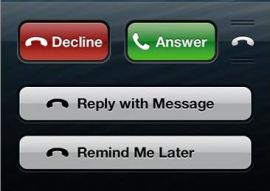
iOS 7 is different to me.  Look at this pic of an incoming call and compare it with the same screen in iOS 6:

iOS 7

iOS 7

iOS 6

iOS 6

The iOS 6 picture has buttons.  The iOS 7 picture is different.  Instead of have chiseled buttons, it looks like the Answer and Decline buttons have been stuck to the screen with labels.  That’s not the only place in the UI that has a label-like appearance.  Sending a new  iMessage or text to someone in the Messages app looks like applying a stamp to a piece of paper.  Taking all that into consideration, I think I finally understand what Ive is trying to do with this UI shift in iOS 7

Labels are easy to reapply.  You just peel them off and stick them back on.  Unlike the chiseled-in-stone button UI, a label can quickly and easily be reconfigured or replaced if it starts to look dated.  Apple made mention of this in Ive’s iOS 7 video where he talked about creating “hierarchical layers (to) establish order“.  Ive commented that this approach gives depth to the OS.  I think he’s holding back on us.

Jonathan Ive created UI layers in the OS so he can change them out more quickly.  Think about it.  If you only have to change a label in an app or change the way they are presented on screen, it allows you to make more rapid changes to the way the OS looks.  If the layers are consistent and draw from the same pool of resources, it allows you to skin the OS however you want with minimal effort.  Ive wasn’t just trying to scrub away the accumulation of Scott Forrestal’s ideas about the UI.  He wanted to change them and make the UI so flexible that the look can be updated in the blink of an eye.  That gives him the ability to change elements at will without the need to overhaul the system.  That kind of rapid configurability gives Apple the chance to keep things looking fresh and accommodate changing tastes.


Tom’s Take

I can almost hear people now saying that making future iOS releases able to be skinned is just another rip off of Android’s feature set.  In some ways, you are very right.  However, consider that Android was always designed with modularity in mind from the beginning.  Google wanted to give manufacturers and carriers the ability to install their own UI.  Think about how newsworthy the announcement of a TouchWiz-free Galaxy S4 was.  Apple has always considered the UI inviolate in all their products.  You don’t have much freedom to change things in iOS or in OS X.  Jonathan Ive is trying to set things up so that changes can be made more frequently in iOS.  Modders will likely find ways to insert their own UI elements and take these ideas in an ever more radical direction.  And all because Apple wanted to be able to peel off their UI pieces as easily as a label.

Nobody Cares

Writing a blog can be very fun and rewarding.  I’ve learned a lot from the things I’ve written.  I’ve had a blast with some of the more humorous posts that I’ve put up.  I’ve even managed to be anointed at the Hater of NAT.  After everything though, I’ve learned something very important about writing.  For the most part, nobody cares.

Now, before you run to your keyboard and respond that you do indeed care, allow me to expound on that idea just a bit.  I’ve written lots of different kinds of posts.  I’ve talked about educational stuff, funny lists, and even activist posts trying to get unpopular policies changed.  What I’ve found is that I can never count on something being popular.  There are days when I sit down in front of my computer and start furiously typing away as if I’m going to change the world with the words that I’m putting out.  When I hit the publish button, it’s as if I’m launching those paragraphs into a black hole.  I’m faced with a reality that maybe things weren’t as important as I thought.

A prime example is the original intent for my blog.  I wanted to write a book about teaching people structured troubleshooting.  I figured if I could get a few of those chapters down as blog posts, it would go a long way to helping me get everything sorted out in my mind.  Now, almost three years later, the two least read posts on my site are those two troubleshooting posts.  There are images on my site that have more hits than those two posts combined.  If I were strictly worried about page views, I’d probably have given up by now.

In contrast, some of the most popular posts are the ones I never put a second thought into.  How about my most popular article about the differences between HP and Cisco trunking?  I just fired that off as a way to keep it straight in my head.  Or how about my post about a throwaway line in a Star Trek movie that exploded on Reddit?  I never dreamed that those articles would be as big as they have ended up being.  I’m continually surprised by the things that end up being popular.

What does this mean for your blogging career?  It means that writing is the most important thing you can do.  You should invest time in creating good quality content.  But don’t get disappointed when people don’t find your post as fascinating as you.  Just get right back on your blogging horse and keep turning out the content.  Eventually, you’re going to find an unintentional gem that people are going to go wild about.

Despite the old adage, lightning does indeed strike twice.  The Empire State Building is hit about 100 times per year.  However, you never know when those strikes are going to hit.  Unless you are living in Hill Valley, California you can never know exactly when that bolt from the blue is going to come crashing down.  In much the same way, you shouldn’t second guess yourself when it comes to posting.  Just keep firing them out there until one hits it big.  Whether it be from endless retweets or a chance encounter with the front page of a news aggregator you just need to put virtual pen to virtual paper and hope for the best.