Is The Blog Dead?

I couldn’t help but notice an article that kept getting tweeted about and linked all over the place last week.  It was a piece by Jason Kottke titled “R.I.P. The Blog, 1997-2013“.  It’s actually a bit of commentary on a longer piece he wrote for the Nieman Journalism Lab called “The Blog Is Dead, Long Live The Blog“.  Kottke talks about how people today are more likely to turn to the various social media channels to spread their message rather than the tried-and-true arena of the blog.

Kottke admits in both pieces that blogging isn’t going away.  He even admits that blogging is going to be his go-to written form for a long time to come.  But the fact that the article spread around like wildfire got me to thinking about why blogging is so important to me.  I didn’t start out as a blogger.  My foray into the greater online world first came through Facebook.  Later, as I decided to make it more professional I turned to Twitter to interact with people.  Blogging wasn’t even the first thing on my mind.  As I started writing though, I realized how important it is to the greater community.  The reason?  Blogging is thought without restriction.

Automatic Filtration

Social media is wonderful for interaction.  It allows you to talk to friends and followers around the world.  I’m still amazed when I have conversations in real time with Aussies and Belgians.  However, social media facilitates these conversations through an immense filtering system.  Sometimes, we aren’t aware of the filters and restrictions placed on our communications.

twitter02_color_128x128Twitter forces users to think in 140-ish characters.  Ideas must be small enough to digest and easily recirculate.  I’ve even caught myself cutting down on thoughts in order to hit the smaller target of being about to put “RT: @networkingnerd” at the begging for tweet attribution.  Part of the reason I started a blog was because I had thoughts that were more than 140 characters long.  The words just flow for some ideas.  There’s no way I could really express myself if I had to make ten or more tweets to express what I was thinking on a subject.  Not to mention that most people on Twitter are conditioned to unfollow prolific tweeters when they start firing off tweet after tweet in rapid succession.

facebook_color02_128x128Facebook is better for longer discussion, but they are worse from the filtering department. The changes to their news feed algorithm this year weren’t the first time that Facebook has tweaked the way that users view their firehose of updates.  They believe in curating a given users feed to display what they think is relevant.  At best this smacks of arrogance.  Why does Facebook think they know what’s more important to me that I do?  Why must my Facebook app always default to Most Important rather than my preferred Most Recent?  Facebook has been searching for a way to monetize their product even before their rocky IPO.  By offering advertisers a prime spot in a user’s news feed, they can guarantee that the ad will be viewed thanks to the heavy handed way that they curate the feed.  As much reach as Facebook has, I can’t trust them to put my posts and articles where they belong for people that want to read what I have to say.

Other social platforms suffer from artificial restriction.  Pinterest is great for those that post with picture and captions or comments.  It’s not the best for me to write long pieces, especially when they aren’t about a craft or a wish list for gifts.  Tumblr is more suited for blogging, but the comment system is geared toward sharing and not constructive discussion.  Add in the fact that Tumblr is blocked in many enterprise networks due to questionable content and you can see how limiting the reach of a single person can be when it comes to corporate policy.  I had to fight this battle in my old job more than once in order to read some very smart people that blogged on Tumblr.

Blogging for me is about unrestricted freedom to pour out my thoughts.  I don’t want to worry about who will see it or how it will be read.  I want people to digest my thoughts and words and have a reaction.  Whether they choose to share it via numerous social media channels or leave a comment makes no difference to me.  I like seeing people share what I’ve committed to virtual paper.  A blog gives me an avenue to write and write without worry.  Sometimes that means it’s just a few paragraphs about something humorous.  Other times it’s an activist rant about something I find abhorrent.  The key is that those thoughts can co-exist without fear of being pigeonholed or categorized by an algorithm or other artificial filter.


Tom’s Take

Sometimes, people make sensationalist posts to call attention to things.  I’ve done it before and will likely do it again in the future.  The key is to read what’s offered and make your own conclusion.  For some, that will be via retweeting or liking.  For others, it will be adding a +1 or a heart.  For me, it’s about collecting my thoughts and pouring them out via a well-worn keyboard on WordPress.  It’s about sharing everything rattling around in my head and offering up analysis and opinion for all to see.  That part isn’t going away any time soon, despite what others might say about blogging in general.  So long as we continue to express ourselves without restriction, the blog will never really die no matter how we choose to share it.

Brave New (Dell) World

Dell_Logo

Companies that don’t reinvent themselves from time to time find themselves consigned to the scrap heap of forgotten technology.  As anyone that worked at Wang.  Or Packard Bell.  Or Gateway.  But, not everyone can be like IBM.  It takes time and careful planning to pull of a radical change.  And last but not least, it takes a lot of money and people willing to ride out the storm.  That’s why Dell has garnered so much attention as of late with their move to go private.

I was invited to attend Dell World 2013 in Austin, TX by the good folks at Dell.  Not only did I get a chance to see the big keynote address and walk around their solutions area, but I participated in a Think Tank roundtable discussion with some of the best and brightest in the industry and got to take a tour of some of the Dell facilities just up the road in Round Rock, TX.  It was rather interesting to see some of the changes and realignments since Michael Dell took his company private with the help of Silver Lake Capital.

ESG Influencer Day

The day before Dell World officially kicked off was a day devoted to the influencers.  Sarah Vela (@SarahVatDell) and Michelle Richard (@Meesh_Says) hosted us as we toured Dell’s Executive Briefing Center.  We got to discuss some of Dell’s innovations, like the containerized data center concept.

DellDCContainer

Dell can drop a small data center on your property with just a couple of months of notice.  Most of that is prepping the servers in the container.  There’s a high-speed video of the assembly of this particular unit that runs in the EBC.  It’s interesting to think that a vendor can provide a significant amount of processing power in a compact package that can be delivered almost anywhere on the planet with little notice.  This is probably as close as you’re going to get to the elasticity of Amazon in an on-premise package.  Not bad.

The Think Tank was another interesting outing.  After a couple of months of being a silent part of Tech Field Day, I finally had an opportunity to express some opinions about innovation.  I’ve written about it before, and also recently.  The most recent post was inspired in large part by things that were discussed in the Think Tank.  It believe that IT is capable of a staggering amount of innovation if they could just be given the chance to think about it.  That’s why DevOps and software defined methodologies have such great promise.  If I can use automation to take over a large part of my day-to-day work, I can use that extra time to create improvement.  Unloading the drudgery from the workday can create a lot of innovation.  Just look at Google’s Ten Percent Time idea.  Now what if that was 25%?  Or 50%?

Dell does a great job with their influencer engagements.  This was my second involvement with them and it’s been very good.  I felt like a valued part of the conversation and got to take a sneak peek at some of the major announcements the day before they came out.  I think Dell is going to have a much easier road in front of it by continuing to involve the community in events such as this.

What’s The Big Dell?

Okay, so you all know I’m not a huge fan of keynotes.  Usually, that means that I’m tweeting away in Full Snark Mode.  And that’s if I’m not opposed to things being said on stage.  In the case of Dell World, Michael Dell confirmed several ideas I had about the privatization of his company.  I’ve always held the idea that Dell was upset the shareholders were trying to tell him how to run his company.  He has a vision for what he wants to do and if you agree with that then you are welcome to come along for the ride.

The problem with going public is much the same as borrowing $20 from your friend.  It’s all well and good at first.  After a while, your buddy may be making comments about your spending habits as a way to encourage you to pay him back.  The longer that relationship goes, the more pointed the comments.  Now, imagine if that buddy was also your boss and had a direct impact on the number of hours your worked or the percentage of the commission you earned.  What if comments from him had a direct impact on the amount of money you earned?  That is the shareholder problem in a nutshell.  It’s nice to be flush with cash from an IPO.  It’s something else entirely when those same shareholder start making demands of you or start impacting your value because they disagree with your management style.  Ask Michael Dell how he feels about Carl Icahn?  I’m sure that one shareholder could provide a mountain of material.  And he wasn’t the only one that threatened to derail the buyout.  He was just the most vocal.

With the shareholders out of the way, Dell can proceed according to the visions of their CEO.  The only master he has to answer to now is Silver Lake Capital.  So long as Dell can provide good return on investment to them I don’t see any opposition to his ideas.  Another curious announcement was the Dell Strategic Innovation Venture Fund.  Dell has started a $300 million fund to explore new technologies and fund companies doing that work.  A more cynical person might think that Michael Dell is using he new-found freedom to offer an incentive to other startups to avoid the same kinds of issues he had – answering to single-minded masters only focused on dividends and stock price.  By offering to invest in a hot new startup, Michael Dell will hopefully spur innovation in areas like storage.  Just remember that venture capital funds need returns on their investments as well, so all that money will come with some strings attached.  I’m sure that Silver Lake has more to do with this than they’re letting on.  Time will tell if Dell’s new venture fund will pay off as handsomely as they hope.


Tom’s Take

Dell World was great.  It was smaller than VMWorld or Cisco Live.  But it fit the culture of the company putting on the show.  There weren’t any earth shattering announcements to come out of the event, but that fits the profile of a company finding its way in the world for the second time.  Dell is going to need to consolidate and coordinate business units to maximize effort and output.  That’s not a surprise.  The exuberance that Michael Dell showed on stage during the event is starting to flow down into the rest of Dell as well.  Unlike a regular startup in a loft office in San Francisco, Dell has a track record and enough stability to stick around for while.  I just hope that they don’t lose their identity in this brave new world.  Dell has always been an extension of Michael Dell.  Now it’s time to see how far that can go.

Disclaimer

I was an invited guest of Dell at Dell World 2013.  They paid for my travel and lodging at the event. I also received a fleece pullover, water bottle, travel coffee mug, and the best Smores I’ve ever had (really).  At no time did they ask for any consideration in the writing of this review, nor were they promised any.  The opinions and analysis presented herein reflect my own thoughts.  Any errors or omissions are not intentional.

Are Exit Strategies Hurting Innovation?

MSP-exit-strategy-300x225

During the Think Tank that I participated in at Dell World, the topic of conversation turned to startups.  Specifically, how do startups drive innovation?  As I listened to the folks around the table like Justin Warren (@JPWarren) and Bob Plankers (@Plankers) talk about the advantages that startups enjoy when it comes to agility, I started to wonder if some startups today are hurting the process more than they are helping it.

Exit Strategy

The entire point of creating a business is to make money.  You do that by creating a product that you can sell to someone.  It doesn’t have to be a runaway success.  So long as you structure the business correctly you can make money for a good long while.  The key is that you must structure the business to pay off in the long run.

Startups seem to have this idea that the most important part of the equation is to build something quickly and get it onto the market.  The business comes second.  That only works if you are playing a very short game.  The bad decisions you make in the foundation of your business will come back to bite you down the road.

Startups that don’t have a business plan only have one other option – an exit strategy.  In far too many cases, the business plan for a startup is to build something so awesome that another larger company is going to want to buy them.  As I’ve said before talking about innovation, buying your way into a new product line does work to a point.  For the large vendor, it is dependent on the available cash on hand.  For the startup, the idea is that you need to have enough capital on hand to survive long enough to be bought.

Looking For A Buyer For The End Of The World

There’s nothing more awkward than a company that’s obviously seeking a buyout from a large vendor that hasn’t received it yet.  I look at the example of Violin Memory.  Violin makes flash storage cards for servers to accelerate caching for workloads.  They were a strategic parter of HP for a long time.  Eventually, HP decided to build those cards themselves rather than rely on Violin as a supplier.  This put Violin in a very difficult position.  In hindsight, I’m sure that Violin wanted to be bought by HP and become a division inside the server organization.  Instead, they were forced to look elsewhere for funds.  They chose to file an initial public offering (IPO) that hit the initial target.  After that, the parts of the business that weren’t so great started dragging the stock price down, angering the investors to the point where executives are starting to leave and lawsuits look likely.

Where did Violin go wrong?  If they had built a solid business in the first place they might have been able to keep selling along even though HP had decided not to buy them.  They might have been able to stay afloat long enough to find another buyer or file an IPO when they have a more stable situation with earnings or expenses.  They might have been able to make money instead of losing it hand over fist.

The Standoff

The idea that startups are just looking for a payday from a larger company is hurting innovation.  Startups just want to get the idea formed enough to get some interest from buyers.  Who cares if we can make it work in reality?  We just have to get someone to bite on the prototype.  That means that development is key.  Things like payroll and operating expenses come second.

In return, companies are becoming skittish of buying a startup.  Why take a chance on a company that may not be around next week?  I’d rather spend my time on internal innovation.  Or, better yet buy that failed startup for pennies on the dollar when they liquidate due to inability to manage a business.  Larger companies are going to shy away from startups that want millions (or billions) for ideas.  That lengthens the time that it takes to innovate, either because companies must invest time internally or spend countless hours negotiating purchases of intellectual property.


Tom’s Take

Obviously, not all startups have these issues.  Look at companies like Nimble Storage.  They are a business first.  They make money.  They don’t have out-of-control expenses.  They filed for an IPO because it was the right time, not because they needed more money to keep the lights on.  That’s the key to proper innovation.  Build a company that just happens to make something.  Don’t build a product that just happens to have a business around it.  That means you can continue to improve and innovate on your product as time goes on.  It means you don’t have to look for an exit strategy as soon as the funding starts running dry.  Then your strategy looks more like a plan.

Panes of Stained Glass

00964

If there is an overused term when it comes to management software, it has to be Single Pane of Glass (SPoG). The first thing that marketing and sales organizations want to tell you is how unified their management tools are. I’ve found that the tools in question are usually not as paneless (pun intended) as might be indicated otherwise.

Glassmakers

The idea of the Single Pane of Glass term comes originally from the disparate tools that have been used since time immemorial to configure and manage IT systems. At first, configuration was a separate program. Monitoring was a separate program. Even between applications on the same system the tools were often separated. When the number of browser windows kept climbing it started to resemble a window pane on the desktop, with four or more open at any one time just to manage and monitor a single application.

This usually became worse over time as companies would acquire new software or tools and attempt to integrate them into the process. If the company had some kind of flagship product that was the go-to for monitoring and maintenance the acquisition was usually ported quickly to provide a one-stop shop for users. When the integration was completed, the company could proudly announce that everything could be done from one browser window, or the Single Pane of Glass.

More often than not, the process to integrate the pieces together was rushed and incomplete. Sometimes the integration would launch a new browser window. Other times an HTML-based monitoring system would fire up a Java VM because the new firewall integration could only be managed via Java. Still other integration attempts would have a browser window with a CLI shell embedded within, since the appliance could only be managed through the console. These haphazard attempts at integration look like something else entirely.

Stained Glass

I can’t take full credit for this idea. It actually belongs to J. Michael Metz (@DrJMetz) of Cisco. He mentioned it in a tweet when talking about a competitor’s management system. I took the idea and ran with it a bit.

Stained Glass Management Systems happen because people are so focused on the overall picture that they lose sight of the fact that each individual unit is useless in the overall context. While a stained glass window may be a beautiful work of art, looking at one close up betray the fact that the whole is indeed made up of lots of dissimilar parts.

You’ve probably experienced this at least once. Think about a software program that has a web interface. For reference, I’m going to pick on Cisco Unified Communications Manager Business Edition (CUCMBE). This is essentially a CUCM server and a Cisco Unity Connection server crammed together to create a VoIP appliance.

CUCMBE doesn’t have a unified management portal. It is in fact managed via two (or more) separate GUIs. Except for a few minor changes to each GUI in a couple of fields, you wouldn’t even know that you were working on software programs co-resident on the same box. Each platform keeps a separate copy of a GUI that doesn’t really have any consistency with the others. CUCM looks different than Unity Connection. On the newer CUCMBE platforms, those GUIs look even more different from products like Unified Presence or Cisco Video Communications Server (VCS).

Cisco never marketed the CUCMBE GUI as being SPoG to my knowledge. But I know of some companies that would claim that a GUI reachable from one IP address that can manage multiple systems is technically SPoG. That’s wrong. A true SPoG needs to have a unified management style. No jarring transitions between management paradigms. If I realize I’m working on a totally different software platform, your SPoG failed.

The solution shouldn’t be to cram as much functionality into a web browser window. The real goal should be to analyze what you are trying to accomplish with the SPoG tools and rewrite your interface to keep overlap and discontinuity to a minimum. If I’m putting the same information in three different places because four different programs each read from a different place, you need to go back to the drawing board.

The interface needs to be consistent in and of itself. If you can a something a widget in the management section, don’t have a wudget in a different section with a legend stating “Wudgets are widgets in this program.” Sometimes that means you have to blow up the data structures of you old programs. So be it. If I can see the individual parts of the window, it detracts from the overall picture.


Tom’s Take

Some companies get it. HP and IBM have created decent SPoG tools after a few years of trial and error. Some companies don’t get it. I won’t mention CiscoWorks. I’m still not sold on Cisco Prime. The key is to look at the end goal. Are you trying to create a picture by collecting individual pieces and working toward the whole? Or are you trying to create the equivalent of macaroni art? That would be where everything is thrown together and resembles a picture in name only. Stained Glass should be avoided at all costs. Integrate your system to the point where I can’t see the pieces and longer and you’ll have a picture pretty enough to sell.

No Total Recall – Outlook Message Recall

OutlookRecall

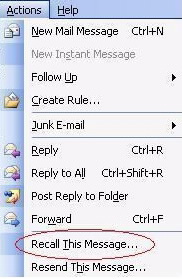
We’ve all had that moment when we hit send on something only to realize that we shouldn’t have.  Either there’s a glaring typo or a forgotten attachment or you attached a file you shouldn’t have.  Quickly you rush up to the Actions menu to take back that errant email via Outlook Message Recall.  And, much like every else on the planet, you click Recall This Message only to find out that it never works.

What is Outlook Message Recall?  And why does it fail almost every time?  Message recall is an Exchange feature that allows the server to reach into a connected Exchange user’s mailbox and pull out the bad message.  There are a lot of rules that govern whether or not a message can be recalled.  In most cases it comes down to whether or not the user is connected to your Exchange server and whether or not the message has been read.

The first condition is easy.  You can’t recall a message you sent to a Gmail address.  You can’t recall messages from a POP or IMAP mail store.  You can’t recall a message if the user you sent it to isn’t a user on your Exchange server.  The server only has authority to delete the original message if both users are on the same mail system.  There’s no point in recalling a message sent outside your organization.  In fact, attempting to do so usually results in the recall request calling attention to the original message.

The other condition seems to be whether or not the message was read.  If the user has read the message it will not be recalled.  Instead, the user will be notified that you want to recall the message and keep the original in their mailbox.  If you’re using a caching mailbox like I tend to do on my laptop, the original recalled message can’t be pulled out due to the nature of the mailbox.

I think the viewing status of the email is a pretty dumb conditional.  I habitually read all the email that comes into my inbox, even if I don’t intend to do something with it right away.  I need to glance at things to see how critical they are.  That means message recall would never work for messages in my inbox.  In fact, I’m pretty sure that message recall has never worked based on an informal poll I conducted with people.

I’ve gotten used to doing other things to ensure that my messages don’t escape before they’re ready.  I don’t put the recipients in until the text has been edited.  I don’t put a subject line in until the penultimate step so that I’ll be prompted to add it in.  I essentially write my emails backwards on purpose.

The best way to avoid using a broken, non-functional feature is to not need it in the first place.  Attention to detail will save you much more often than the recall button.  Taking a few moments to cool off before you ship out that burning missive will also protect you a whole lot better than a ham-handed attempt to pull back something that shouldn’t have been sent in the first place.

Vendorpendent

handshake

May you live in interesting times. – Purported Ancient Chinese Curse

Life is never boring for the independent blogger.  Especially when the vendors come calling.  In recent months, Sean Rynearson (@SRynearson) and Rocky Gregory (@BionicRocky) have taken up residence at Aruba Networks.  Gurusimran Khalsa (@gurusimran) has headed over to VMware.  Most recently, Ryan Adzima (@RAdzima) has joined the ranks of the wireless elite at AirTight Networks.  There’s still more to come if my guesses are right.  In many of those cases, I’ve been asked what I think about so many independent influencers heading for vendors.  My response is always the same: It’s a great thing.

A Cog In The Machine

So many independent people being hired by vendors shows the value of their thinking and analysis.  It’s much easier to interview for a job when your entire resume is online in the form of a blog full of deep thoughts and impressive research.  If the employer can Google your name and find not only your commentary but the commentary of people that have discussed things with you then the actual interview process is a formality.  I personally like it that way because I’m horrible at telling people about myself.  I’d much rather let my words do the talking for me.

Vendors know that having an independent thinker on staff is a huge asset.  If the independent is detached for the existing process, they can point out weaknesses or quickly adjust strengths to make things better for the vendor.  A dispassionate third party view is useful when determining if marketing efforts are working correctly or if a product line needs to be refreshed or removed entirely.  Sometimes you can’t get the objectivity needed from someone that’s been entrenched at a vendor for too long.

Independents worry about working for vendors.  They are afraid they will lose their objectivity.  They want to be sure that their opinions are their own and don’t reflect the views of their employers.  I’ve been asked on more than one occasion by those folks if it’s even possible.  My response: Yes, but it’s hard.

It’s Not Easy Being Free

You have to be vigilant when you want to make sure you are independent.  Your thoughts and ideas should never be suppressed because someone doesn’t like them or because they don’t fit a marketing campaign.  The value in having an independent on your payroll is the objectivity that person brings to the table.  Hiding that objectivity for the sake of a few dollars on the bottom line is the road to ruin.

Likewise, you as the independent need to be sure you don’t cross the line when it comes to reducing your own independence.  I’ve seen more than one person go to work for vendor and slowly transform themselves from an independent thinker to a corporate mouthpiece.  When you put the leash on yourself and impinge you own credibility you’ve done a disservice to your employer as well as yourself.  Attacking a competitor via blog posts or social media serves no real purpose.  Debating salient issues is a better use of time for everyone.  Don’t let yourself be dragged into the fray.  Rise above and keep the discussions focused on technology and not on the logo on the device.

Tom’s Take

I’ve stayed independent because of my own stubbornness.  I feel that my views are better voiced outside the vendor community.  That doesn’t mean that vendors are evil and should be avoided.  On the contrary, vendors are a great fit for a great number of bloggers.  Any time someone comes to me and tells me they’ve taken a position with a vendor I applaud their choice.  It ultimately comes down to the person making the choice.  If you feel you can stay independent inside the greater organization then a vendor is a great fit.  Just remember to be vigilant and stay true to who you are.  Not the logo on your shirt.

Keep It In The Family

kids-fighting

I have a brother.  We act like brothers.  We argue and fight with each other fairly often.  We get along in our own way.  One thing we do *not* tolerate is anyone else picking on us. We’ve been known to have a disagreement, but when someone comes up and starts something, we will put aside our disagreement and band together to fight against whoever thought it was a good idea to mess with either one of us.  That’s what brothers do.  Right or wrong, you back your brother.

The Work Family

Managers aren’t all that different from family.  We spend a lot of our lives working in proximity with managers.  The middle of the road types are like family members we tolerate.  Those that aren’t so good tend to be like family members we don’t really get along with at all.  There are some that end up being just like a close family member, like a brother or sister.  It doesn’t mean that the relationship isn’t still managerial.  What makes it key is what happens when someone comes down on you.

My last manager was a great person.  He was calm and thoughtful.  He saw every side of a problem and did what was right.  Those qualities make him great to work for.  But to transcend above that, you have to do something to set yourself apart.  For me, it was the way he corrected behavior.

He tended to give what I like to call “Do Better” talks.  He never yelled.  He never got upset.  In fact, all he usually said was, “I’m disappointed.”  For guys like me, disappointment is ten times worse than getting yelled at.  After chats like that, we agreed to not do whatever it was again and move on.  That’s the essence of a Do Better talk.  No blame, just do better next time.

Backing Your Family

Where he shined was what happened when the other managers came hunting for heads.  You’ve seen this all the time.  Someone screws up and the issue is dealt with.  However, some higher manager feels the need to exert control do they find the person responsible for the issue and give them a dressing down for it.  That doesn’t really serve to correct the behavior.  It’s more about dominance.

Weak willed middle managers will sit back and let the higher manager have their way with employees.  That doesn’t foster a supportive atmosphere.  If you’re never sure who is going to come head hunting, it doesn’t make you want to admit failure.  Which means the issues never get corrected, just covered up.

My old manager was different.  Whenever I screwed up and someone at the top of the food chain came looking for me I never had to worry.  The same man that would call me on the carpet for making mistakes would turn right around and defend me to those that came looking to chew me out again.  In his eyes, he’d dealt with the problem.  Picking on me served no purpose.  Just like my brother, he’d take up arms with me to defend our “family” against others.  It didn’t take long for everyone to learn that my manager dealt with things his way.  And there was no point to trying to deal with his employees against him.

Managers that are willing to defend you right after chewing you out are a special breed.  Those are the kind of folks that employees will walk across broken glass to work for.  It’s not for everyone, though.  Standing up to the heat to defend someone that did something wrong is never easy.  Especially if the higher manager is upset and emotional.  The key is to trust in your instincts as a manager and believe that dealing with the situation your way is the right way.  Having someone come in and undermine you management skills makes you look ineffective.  It’s better to weather the storm of yelling from one person than to lose the respect of everyone in your department.

Treating your employees like family doesn’t mean you can’t be their manager.  You can still  be in charge and have a good relationship with them.  You can win their respect time and time again by backing them even after you’d had to correct them.  When they see you standing up for them against all comers, they’ll have someone they can believe in.  And they’ll be as close to you as any family member.


If you’d like to see more thoughts about management and some great career advice, be sure to check out The Tech Interview.  It’s a great site with great articles and run by awesome people.  Take it to heart and you’ll go far in this world.

Why Do We Tolerate Bad Wireless?

HotelSpeedConnection

If there is one black eye on the hospitality industry, it has to be wireless.  I don’t think I’ve ever talked to anyone that is truly happy with the wireless connectivity they found in a hotel.  The above picture from an unnamed hotel in Silicon Valley just serves to underscore that point.  When I was on a recent speaking trip in New England, I even commented about the best hotel wireless I’d ever seen:

Granted, that was due to a secluded hotel on MIT‘s university network, but the fact remains that this shouldn’t be the exception.  This should be the rule.

Thanks to advances in mobile technology like LTE, we have a new benchmark for what a mobile device is capable of producing.  My LTE tablet and phone outrun my home cable connection.  That’s fine for browsing on a picture frame.  However, when it’s time to get real work done I still need to fire up my laptop.  And since there isn’t an integrated LTE/4G hotspot in my MacBook, I have to rely on wireless.

Wireless access has gone from being a kitschy offering at specialized places to being an everpresent part of our daily lives.  When I find myself in need of working outside the office, I can think of at least five different local establishments that offer me free wireless access.  Signing up for mobile hotspot services easily doubles that number.  There are very few places that I go any more that don’t give me the ability to use WiFI.  However, there is a difference between having availability and having “good” availability.

Good Enough Wireless

I would never upload video at a coffee shop or an airport.  The sheer number of folks using the network causes massive latency and throughput issues.  Connections are spotty and it’s not uncommon to see folks throw their hands up in the air because something just randomly stopped working.  However, the most telling statistic is how often we will go back to that same location to use the free wifi again.

Hotels have a captive audience.  You’re there to attend a conference during the day or spend the night.  You are geographically isolated.  You get what you get when it comes to connectivity.  Newer hotel chains that focus on business travelers understand the need for wireless connectivity.  They usually offer it for free with your room.  That’s because they usually have the infrastructure to support wireless coverage from large numbers of guests.  Older hotels that aren’t quite up to snuff or don’t understand why travelers need Internet access usually charge exorbitant fees or bundle the wireless into a “resort” package that gives you a whole bunch of high-margin useless services to get what you want.  Sometimes they use those fees to upgrade the infrastructure.  Or they just pocket the money and go on with their day.

Internet In My Pocket

As much as we complain about terrible wireless at hotels, it’s not like we have an alternative.  Wireless hotspot devices, commonly called “MiFis” after the Verizon branding, are popular with real road warriors.  Why hunt for a coffee shop when you can fire up a wireless network in your pocket?  Most current mobile devices even come with hotspot functionality built in.  But the carriers haven’t gotten the message yet.  For every one that allows hotspot usage (Verizon), you have those that don’t believe in hotspot and want to gouge you with higher fees or data plan changes to revamp bad mobile data decisions in the past.  Yes, I’m looking right at you AT&T.

Mobile hotspots can fix wireless problems in isolated cases, but loading a hotel full of people on MiFis will inevitably end in disaster.  Each of them uses a portion of the LTE/4G spectrum.  Think about a large gathering where everyone’s mobile phones cause spotty reception.  Not because they are all in use, but because they just happen to be occupying the same space.  Towers get overloaded, backhaul networks slow down, and service suffers for everyone.  If you don’t believe me, try making a phone call at Cisco Live some time.  It’s not pretty.

As long as there are no options for solving the problem, hospitality will go right on offering the same terrible coverage they do now.  As far as they are concerned, wireless is best effort.  Best effort should never be acceptable.  You can fix this problem by going to the front desk and telling them all about it.  No, don’t yell at the desk attendant.  They have zero control over what’s going on.  There’s a better way.

Satisfaction Not Guaranteed

Ask for a satisfaction survey.  Fill it out and be brutally honest when you get to the “Are You Pleased” section.  Those surveys go right up the chain into the chain satisfaction ratings.  If they start getting disgruntled comments about bad wireless coverage, I can promise that some Quality Champion somewhere is going to look into things.  Hotels hate black eyes on their satisfaction ratings.  Bad reviews keep people from staying at a hotel.  If you want to get the wireless fixed, tell them how important it is.  Tell them you’ll stay somewhere else next time because you can accomplish anything.  Voting with your wallet is a sure fire way to make an impact.

Tom’s Take

I remember the old Cingular/AT&T Wireless commercials with the cell phones cutting out during calls.  I laughed and thought about all the times it had happened to me.  It because such a sticking point that every carrier worked to upgrade their network and provide better call quality.  No one would stand for spotty service any more as they began to rely on their mobile phones as their primary communications devices.

Wireless is the same now as cell phones were then.  We need a concerted effort to upgrade the experience for everyone to make it usable for things like Hotspot 2.0, which will offload traffic from LTE to WiFI seemlessly.  We can’t let terrible wireless rule us like spotty cell phone coverage did years ago.  Do everything you can to make wireless useful for everyone.

IT Jugglers

Juggle Balls

I once interviewed for a job where the interviewer asked how I decided to work on tasks. He said, “There are two kinds of workers. The first concentrates on a task and does nothing else until it is completed. They can only do one thing at a time. Then, there are the jugglers. Which one are you?” When I responded that I tended toward the latter, the interviewer smiled.  That was obviously the answer he was looking for.

IT is very much defined by focus. Being able to work on a project until it is totally finished is a very admirable quality to be desired. In my experience, especially in the VAR world, it is equally as important to be able to shift your focus quickly to other tasks that require attention. As indicated above, it’s not unlike juggling. Being able to focus on a project for a few hours or days and then move to a different project for a few hours can be a very critical skill for high level engineers.

Technology has been doing this for years. Think about a preemptive multitasking CPU. It appears to be many things at once. It’s really executing instructions for a given process for a period of time (a timeslice). Because you can process enough instructions in that time to accomplish a function it all appears to work like magic. The key is to tune the processor to use the right timeslices. If the timeslice is too long the processor will sit idle waiting for the program to generate new instructions. If the time slice is too short the program won’t be able to execute enough instructions during the window and the program will appear unresponsive. Just like a juggler, it’s all about the timing.

Choosing what to juggle in IT is almost as important as knowing how to do it. When you are just starting out with juggling, you use safe, soft objects to contain the damage. You don’t start off with chainsaws and molotov cocktails. When juggling IT projects, be sure to juggle those that don’t have hard deadlines or require critical path updates on a regular basis. If you’re required to provide a weekly update on an installation, be sure you’ve allocated enough time during the week to do something. Otherwise, that weekly installation report is going to look pretty thin.

When learning to juggle, most people spend entirely too much time worrying about the ball in their hand.  They tend to lose focus of all the other objects floating in the air.  That’s why they tend to start dropping them.  In the same way, you can’t be so dialed in on one project that you completely neglect all the other things going on.  Finding a good point to stop one task and start working on another is a very fine art.

This isn’t for everyone.  If you’re a person that can’t shift focus fast enough to keep all the balls (or projects) in the air without dropping something, you should avoid working on many things at once.  There’s no shame in having laser focus on something.  It works well for a lot of folks.  It gets hard things done right.  It’s just another way to do get the job done.


Tom’s Take

I’m a juggler.  I try to keep everything going at once while I wrap up what I can.  I do my best to avoid dropping things, but something slips through from time to time.  I also taught myself to juggle in real life.  I can keep three tennis balls going with no issues.  I realize my limitations, though.  I know that more than that is too many.  In the project space, I know that having more than I can handle is bad for everything, so I try to keep my focus on a manageable about of juggled things.  It’s better to juggle a few things well than juggle an impressive number of things poorly.  I’ll let you know when I work my way up to the chainsaws.

I Can Fix Gartner

MQFix

I’ve made light of my issues with Gartner before. From mild twitching when the name is mentioned to outright physical acts of dismissal. Aneel Lakhani did a great job on an episode of the Packet Pushers dispelling a lot of the bad blood that most people have for Gartner. I listened and my attitude toward them softened somewhat. It wasn’t until recently that I I finally realized that my problem isn’t necessarily with Gartner. It’s with those that use Gartner as a blunt instrument against me. Simply put, Gartner has a perception problem.

Because They Said So

Gartner produces a lot of data about companies in a number technology related spaces. Switches, firewalls, and wireless devices are all subject to ranking and data mining by Gartner analysts. Gartner takes all that data and uses it to give form to a formless part of the industry. They take inquiries from interested companies and produce a simple ranking for them to use as a yardstick for measuring how one cloud hosting provider ranks against another. That’s a good and noble cause. It’s what happens afterwards that shows what data in the wrong hands can do.

Gartner makes their reports available to interested parties for a price. The price covers the cost of the analysts and the research they produce. It’s no different that the work that you or I do. Because this revenue from the reports is such a large percentage of Gartner’s income, the only folks that can afford it are large enterprise customers or vendors. Enterprise customers are unlikely to share that information with anyone outside their organization. Vendors, on the other hand, are more than willing to share that information with interested parties. Provided that those parties offer up their information as a lead generation exercise and the Gartner report is favorable to the company. Vendors that aren’t seen as a leader in their particular slice of the industry aren’t particularly keen on doing any kind of advertising for their competitors. Leaders, on the other hand, are more than willing to let Gartner do their dirty work for them. Often, that conversation goes like this:

Vendor: You should buy our product. We’re the best.
Customer: Why are you the best? Are you the fastest or the lowest cost? Why should I buy your product?
Vendor: We’re the best because Gartner says so.

The only way that users outside the large enterprises see these reports is when a vendor publishes them as the aforementioned lead generation activity. This skews things considerably for a lot of potential buyers. This disparity becomes even more insulting when the club in question is a polygon.

Troubling Trigonometry

Gartner reports typically include a lot of data points. Those data points tell a story about performance, cost, and value. People don’t like reading data point. They like graphs and charts. In order to simplify the data into something visual, Gartner created their Magic Quadrant (MQ). The MQ distills the entire report into four squares of ranking. The MQ is the real issue here. It’s the worst kind of graph. It doesn’t have any labels on either axis. There’s no way to rank the data points without referring to the accompanying report. However, so many readers rarely read the report that the MQ becomes the *only* basis for comparison.

How much better is Company A at service provider routing than Company B? An inch? Half an inch? $2 billion in revenue? $2,000 gross margin? This is the key data that allows the MQ to be built. Would you know where to find it in the report if you had to? Most readers don’t. They take the MQ as the gospel truth and the only source of data. And the vendors love to point out that they are further to the top and right of the quadrant than their competitors. Sometimes, the ranking seems arbitrary. What makes a company be in the middle of the leaders quadrant versus toward the middle of the graph? Are all companies in the leaders quadrant ranked and placed against each other only? Or against all companies outside the quadrant? Details matter.

Assisting the Analysis

Gartner can fix their perception problems. It’s not going to be easy though. They have the same issue as the Consumer’s Union, producer of Consumer Reports. Where the CU publishes a magazine that has no advertising, they use donations and subscription revenues to offset operating costs. You don’t see television or print ads with Consumer Reports reviews pasted all over them. That’s because the Consumer’s Union specifically forbids their inclusion for commercial purposes.

Gartner needs to take a similar approach if they want to fix the issues with how they’re seen by others. Sell all the reports you want to end users that want to know the best firewall to buy. You can even sell those reports to the firewall vendors themselves. But the vendors should be forbidden from using those reports to resell their products. The integrity you gain from that stance may not offset the loss of vendor revenue right away. But it will gain you customers in the long run that will respect your stance refusing the misuse of Gartner reports as 3rd party advertising copy.

Put a small disclaimer at the bottom of every report: “Gartner provides analysis for interested parties only. Any use of this information as a sales tool or advertising instrument is unintended and prohibited.” That shows what the purpose of the report is about as well as discouraging use simply to sell another hundred widgets.

Another idea that might work to dispel advertising usage of the MQ is releasing last year’s report for little to no cost after 12 months.  That way, the small-to-medium enterprises gain access to the information without sacrificing their independence from a particular vendor.  I don’t think there will be any loss of revenue from these reports, as those that typically buy them will do so within 6-8 months of the release.  That will give the vendors very little room to leverage information that should be in the public domain anyway.  If you feel bad for giving that info away, charge a nominal printing fee of $5 or something like that.  Either way, you’ll blunt the advertising advantage quickly and still accomplish your goal of being seen as the leader in information gathering.


Tom’s Take

I don’t have to whinny like a horse every time someone says Gartner. It’s become a bit of legend by now. What I do take umbrage with is vendors using data points intended for customers to rank purchases and declare that the non-labeled graph of those data points is the sole arbiter of winners and losers in the industry. What if your company doesn’t fit neatly into a Magic Quadrant category? It’s hard to call a company like Palo Alto a laggard in traditional firewalls when they have something that is entirely non-traditional. Reader discretion is key. Use the data in the report as your guide, not the pretty pictures with dots all over them. Take that data and fold it into your own analysis. Don’t take anyone’s word for granted. Make your own decisions. Then, give feedback. Tell people what you found and how accurate those Gartner reports were in making your decision. Don’t give your email address to a vendor that wants to harvest it simply to gain access to the latest report that (surprisingly) show them to be the best. When the advertising angle dries up, vendors will stop using Garter to sell their wares. When that day comes, Gartner will have a real opportunity to transcend their current image and become something more. And that’s a fix worth implementing.